Showing posts with label South America. Show all posts
Monday, March 10, 2014
The Minhocao
According to legends, something massive dwells beneath the forests of Brazil. It bores enormous tunnels through the soil, large enough for a child to walk through. It uproots trees, destroys crops and leaves water-filled ditches in its wake. Natives call it the Minhocao -- and its nature has been discussed for over a century. Granted, little evidence for the beast has been found since the 1800s. But the stories alone give us much to work with, and allow us to deduce its identity.
The traditional description of the Minhocao resembles a giant worm. Legends detail a gigantic serpentine beast, dozens of feet long and covered in black scales. The Minhocao, it is said, has two stalk-like tentacles portruding from its head -- but it lacks eyes altogether. This amalgamation of features is rather confusing. Several creatures share a few of these traits, but none exhibit all of them.
Let's look at some possible candidates for the Minhocao's identity. One, suggested by cryptozoologist Karl Shuker, is the caecilian. These wormlike amphibians are capable of burrowing, and can be found throughout South America. They sometimes have a scaly appearance, and on occasion have head-tentacles -- but caecilians are relatively small in size. The largest is not five feet long, certainly incapable of making massive tunnels. These biggest of these creatures are no thicker than a human arm. Legless lizards and blind snakes, while they also share traits of the Minhocao, are unlikely for the same reason.
Bernard Heuvelmans, the father of cryptozoology, had a far different theory -- and it's the one I find most probable. He believed that the Minhocao was a prehistoric armadillo relative called the glyptodont, and that the stories of its appearance were entirely fanciful. Unlike snakes or caecilians, glyptodonts (if they burrowed at all) could make monster-sized tunnels. Furthermore, their fossils are found in South America, and the Amazon is relatively unexplored. There's plenty of habitat in which they could dwell, despite the improbability of their survival. Now, I don't generally advocate for prehistoric cryptids, and I'm not saying I believe in this one. But this fossil animal is the best Minhocao candidate yet suggested.
Read more about the Minhocao:
http://www.forteantimes.com/strangedays/cryptozoology/4753/minhoco_or_megamillipede.html
http://www.unknownexplorers.com/minhocao.php
Image (public domain) from http://upload.wikimedia.org/wikipedia/en/5/51/Minhocao.png
Thursday, January 16, 2014
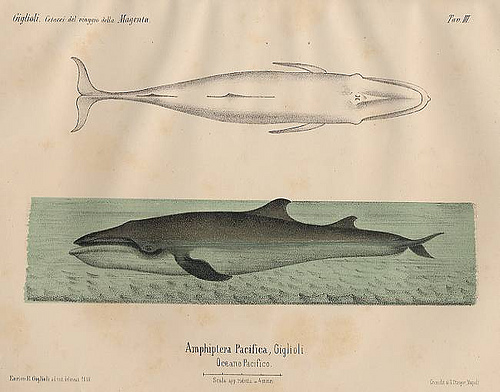
Giglioli's Whale
The baleen whales are Earth's largest living vertebrates. The greatest among them weigh 200 tons, and some exceed a hundred feet in length. This makes it all the more shocking that whales are so mysterious. Their breeding grounds and migration routes are still under study, and much about their lives remains unknown. In fact, despite their size and our technological prowess, some whale species have eluded detection for centuries. New whales have been discovered even in the last decade-- and more may remain undiscovered.
Among these, according to some cryptozoologists, is Giglioli's Whale. It was first described-- and scientifically named-- by the zoologist Enrico Giglioli. He observed it at length in 1867, while it swam off the Chilean coast. The animal measured sixty feet long, and resembled a right whale. But it had one unique feature-- a second dorsal fin-- that distinguished it from all other cetaceans.
Giglioli never saw the whale again, but hoped that other scientists would have better luck. Few did-- since then, the species has only been sighted twice. One sighting, off the coast of Scotland, was documented in 1868. The other occured in the 1980s, near the island of Corsica. No specimen of the whale has ever been collected, and most scientists doubt its existance.
Still, some classify it as a proper marine species-- though a rare one, and infrequently encountered. Scientists encountered several megamouth sharks before the first was captured, and some proven whale species have yet to be caught alive. Will Giglioli's Whale be a similar success story? Only time will tell.
Read more about Giglioli's Whale:
http://biologicalmarginalia.wordpress.com/2013/01/01/amphiptera/#more-8
http://seamonsters.wikispaces.com/Giglioli's+Whale
Image from http://www.futilitycloset.com/wp-content/uploads/2008/03/2008-03-31-gigliolis-whale.jpg (public domain)
Tuesday, August 25, 2009
Sucuriju Gigante

The Sucuriju Gigante, or Giant Anaconda, as it is sometimes known, is a monstrous snake reported from several different countries of South America, especially Brazil. It is identified with various snakes, like the anaconda or boa, though it is probably more similar to the anaconda due to its aquatic nature. This huge snake is sometimes reported as reaching 150 feet in size, and dwells almost entirely in water. It is said to have yellow, glowing, lamp-like eyes that have a hypnotic effect on viewers. This monstrous serpent is a constrictor, squeezing the life out of its hapless prey and swallowing it whole. However, it is easily defeated, and several are supposed to have been shot dead by witnesses to this creature. Photos circulate of this beast, many dating back to the mid 1900s, but many are suspected to be hoaxes. The Sucuriju Gigante also figures in the mythology of native tribes, and many revere it as a sort of creator god or guardian of the waters.
Wednesday, August 19, 2009
El Cuero

In Lake Lacar, a small glacier-formed lake in the Andes, dwells an extremely unusal cryptid known as El Cuero, or The Cowhide. This creature has a flat, hairless, ray-like body that resembles the hide of an animal floating on the surface of the water. It is known to attack and kill people and animals that mistake it for such a harmless object, dragging them underwater and draining their blood with its proboscis. This proboscis is unusual for a ray, but it is not this cryptid's only startling feature. El Cuero supposedly bears a pair of reddish eyestalks. These ususual traits and the lack of physical evidence for the animal's existence raises suspicion, but many legends and sightings of this creature exist that make its existence at least possible. Interestingly, there are many similar cryptids throughout other lakes in Argentina and Chile, all of which may be of one species.
Friday, August 8, 2008
Ucu

The Ucu is another humanoid cryptid, this one a South American variety that lives in the foothills of the Andes. It is about the same size and description as a North American Bigfoot, but with lighter-colored fur. It probably has less hair as well, due to its warmer climate, and it may be smaller due to the densely-forested area in which it lives. The Ucu is not sighted as much as its northern cousin, perhaps because not as many people look for it. This is not a famous cryptid, and may be evading sightings due to lack of people's interest in it. The Ucu lives only about 1,500 miles from the Bigfoot, so perhaps this is a southern subspecies.
Peruvian Mystery Jaguar

These are large white cats with black irregularly-shaped spots that are found in the rainforests of Peru. They seem to match the description of a standard jaguar, except for the animal's pigmentation. It is possible that this creature represents a mutation that managed to survive and form a small population. It could also be an imported white cat that adapted to the environment, or perhaps an albino with the illusion of spots created by shadows from rainforest trees. As this is a recent cryptid that has yet to be adequately studied, no convincing evidence has surfaced for either side.
Mapinguari

The Mapinguari is a giant ground-dwelling sloth reminescant of the huge prehistoric variety that lived in Patagonia, where this cryptid is found. The supposedly-extinct Patagonian ground sloth is the only animal living or dead that could explain this beast, and as such is the most likely candidate. Giant sloth fur and dung from much more recently than the beast's supposed extinction has been found in the Mapinguari's range, though this evidence is disputed by some. The Mapinguari must consume a lot of foliage, so areas that have been cleared by other large creatures are unsuitable for it. Mostly uninhabited Patagonian plains with plenty of vegetation are the best place to look for this giant, slow-moving herbivore.
Thursday, August 7, 2008
Chupacabra

Throughout the last decade goats and sheep in central and South America have been found drained of blood through puncture wounds in the chest or neck. These have been blamed on a new cryptid called the Chupacabra, or goatsucker. This creature resembles a wolf in size and shape, with a row of spines down its back, as well as two long fangs and, in some depictions, wings. It is often also portrayed as a green-skinned alienlike humanoid, though this is blatant sensationalism and few sightings support this claim. Chupacabras are often linked with UFOs and other extraterrestrial phemomena since lights in the sky and UFOs often occur in the areas where Chupacabras attack. It would be simple to dismiss the Chupacabra as a blood-drinking wolf, except to large mammals consume blood. It is far more likely that the Chupacabra is a new species entirely, a mutation, or completely nonexistant whatsoever.
Andean Wolf

The Andean Wolf is a mountain dog or wolf that dwells in South America. It is known from several pelts that are supposedly from the creature, though several of the ones that have been studied have turned out to be hoaxes or overly contaminated. An existing animal in the area, the maned wolf, can probably be blamed for some sightings of this animal. In fact, the species may in fact be simply a new, larger subspecies of the aforementioned animal, if it exists at all. The possibility of this animal's existance is greatly weakened by the hoaxes that have been based off of it. This cryptid is not taken very seriously by most, and due to lack of investigation the mystery of the maned wolf may not be solved for years to come.
Subscribe to:
Posts (Atom)