Showing posts with label Cryptids. Show all posts

Tuesday, March 11, 2014

Post Revamp: the Buru


The Himalayas are home to the Yeti, one of Earth's most famous cryptids.  But the western part of this mountain range once contained a lesser-known beast.  This aquatic creature, known as the Buru, dwelled in the river valleys of eastern India.  According to locals, it has been extinct for decades, but lived recently enough to be clearly remembered.

The Buru, it is said, was a reptilian creature between ten and fifteen feet long.  It had a long neck and forked tongue, along with claw-like feet well adapted for digging.  The beast had fish-like skin, a rounded tail and a flat snout behind which lay its eyes.  For a time, the Buru coexisted with the Indian inhabitants of its valleys.  But eventually, it came to be seen as dangerous, and the species was exterminated.  The marshes where it dwelled were drained, and its watery homes were filled with boulders.  No Buru has been seen since.

To most cryptozoologists, the Buru's traits suggested an aquatic monitor lizard.  Some of these lizards, like the Komodo dragon, can exceed ten feet in length -- and prehistoric varieties like Megalania grew even larger.  Furthermore, fossil monitors lived in India, meaning that finding one in the region wouldn't be improbable.  The downside of the monitor theory is that these lizards don't live in the water.  Some of them can swim fairly well, but the Buru was said to spend most of its time submerged.  Monitors are terrestrial reptiles; they need to warm themselves in the sun and hunt land-dwelling prey.  These energy requirements would be more profound, not less, in a gigantic species -- making an aquatic variant unlikely.

Another possibility is that that the Buru was a crocodilian.  Crocodiles spend much more time in the water than monitor lizards, and are generally far larger.  They also share the Buru's flat snout, rounded tail and claws.  Further evidence comes from the Buru's name -- which can also mean "crocodile" in the native languages.  The crocodile theory would seem a fairly good fit, but one piece of evidence undermines it.  The Buru, it is said, could hardly leave the water -- while crocodiles do so on a regular basis.  These cryptids, after their marshes were drained, remained buried in the mud at the bottom.  In a crocodile's marsh was drained, it could easily move around and hunt on the shore.

This odd discrepancy inspired Karl Shuker, a noted cryptozoologist, to pose another theory.  He proposes that the Buru was a gigantic species of lungfish.  These fish have skin resembling the Buru's, along with eyes at the back of a long, flattened snout.  They lack long necks or a forked tongue, but spend virtually all their time in water -- unlike any other Buru-candidate.  Personally, I don't think this the best of matches.  Lungfishes don't grow close to the Buru's size, and none are found in Asia whatsoever.  Besides, nobody would be in danger from a giant lungfish -- these creatures are absolutely harmless.  Personally, I favor the crocodilian explanation.

Read more about the Buru:
http://karlshuker.blogspot.com/2012/08/riddle-of-buru-and-lungfish-link.html
http://www.newanimal.org/buru.htm
http://cryptomundo.com/cryptozoo-news/miller-buru/
Image (public domain, of a swimming water monitor) from http://upload.wikimedia.org/wikipedia/commons/8/86/Flickr_-_don_macauley_-_Varanus_salvator.jpg

Monday, March 10, 2014

The Minhocao


According to legends, something massive dwells beneath the forests of Brazil.  It bores enormous tunnels through the soil, large enough for a child to walk through.  It uproots trees, destroys crops and leaves water-filled ditches in its wake.  Natives call it the Minhocao -- and its nature has been discussed for over a century.  Granted, little evidence for the beast has been found since the 1800s.  But the stories alone give us much to work with, and allow us to deduce its identity.

The traditional description of the Minhocao resembles a giant worm.  Legends detail a gigantic serpentine beast, dozens of feet long and covered in black scales.  The Minhocao, it is said, has two stalk-like tentacles portruding from its head -- but it lacks eyes altogether.  This amalgamation of features is rather confusing.  Several creatures share a few of these traits, but none exhibit all of them.

Let's look at some possible candidates for the Minhocao's identity.  One, suggested by cryptozoologist Karl Shuker, is the caecilian.  These wormlike amphibians are capable of burrowing, and can be found throughout South America.  They sometimes have a scaly appearance, and on occasion have head-tentacles -- but caecilians are relatively small in size.  The largest is not five feet long, certainly incapable of making massive tunnels.  These biggest of these creatures are no thicker than a human arm.  Legless lizards and blind snakes, while they also share traits of the Minhocao, are unlikely for the same reason.

Bernard Heuvelmans, the father of cryptozoology, had a far different theory -- and it's the one I find most probable.  He believed that the Minhocao was a prehistoric armadillo relative called the glyptodont, and that the stories of its appearance were entirely fanciful.  Unlike snakes or caecilians, glyptodonts (if they burrowed at all) could make monster-sized tunnels.  Furthermore, their fossils are found in South America, and the Amazon is relatively unexplored.  There's plenty of habitat in which they could dwell, despite the improbability of their survival.  Now, I don't generally advocate for prehistoric cryptids, and I'm not saying I believe in this one.  But this fossil animal is the best Minhocao candidate yet suggested.

Read more about the Minhocao:
http://www.forteantimes.com/strangedays/cryptozoology/4753/minhoco_or_megamillipede.html
http://www.unknownexplorers.com/minhocao.php
Image (public domain) from http://upload.wikimedia.org/wikipedia/en/5/51/Minhocao.png

Sunday, March 9, 2014

The Montauk Monster


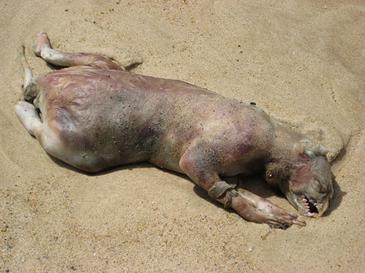
In 2008, shortly after BeastPedia began its five-year hiatus, a strange carcass washed up near Montauk, NY.  It was clearly a decaying mammal, with visible paws and patches of grey hair.  But what exactly was it?  Photographs of the beast, circulated on the internet, caused rampant speculation.  Some thought the creature an alien, some thought it a cryptid, and some thought it a genetic experiment.  An animal research center, they pointed out, was only a few miles away.  What if one of the subjects had escaped?

The creature, as it turned out, was nothing so exotic.  It was a decomposing raccoon, rendered near-unrecognizable by the forces of the tides.  Several posts ago, I mentioned taphonomy -- the study of how living things decay.  This is another mystery solved by that useful science.  Let's look at the carcass in detail, examining it step by step, until we can bring the "monster" back to life.

First of all, we know this creature was a mammal.  There are patches of fur clinging to its hide, which clearly isn't reptilian.  A second photo shows visible testicles, and the creature's dentition is visibly mammal-like.  So are its ears, its toes, the position of its legs, and virtually everything else we can see.  How big was it?  A fly on the carcass' back gives us a sense of scale -- and tells us it was about the size of a dog.

Thus far, we know we're dealing with a mid-sized North American mammal -- and a carnivore, based on the shape of the teeth.  This leaves us only a few options, including dogs, cats and raccoons.  The Montauk Monster looks like none of these -- but only because it's decomposed.  When a body floats in water, it rapidly bloats and begins to lose its hair.  That's what has happened here, and what makes the creature look so deformed.  The second thing to decompose is the snout -- which contains plenty of soft tissues.  When these fall apart, the premaxillary bones are exposed, producing the monster's "beak."

What identifies the Montauk Monster as a raccoon (as opposed to a dog or cat) is the shape of its teeth.  All families of mammals have fairly unique dentition, which can be told apart by an expert.  Skull shape is a major indicator of taxonomy, and to a mammalogist, this carcass screams "raccoon."

Read more about the Montauk Monster:
http://scienceblogs.com/tetrapodzoology/2008/08/04/the-montauk-monster/
http://nymag.com/daily/intelligencer/2008/07/the_monster_of_montauk.html
Image (public domain) from http://upload.wikimedia.org/wikipedia/en/8/8f/RhodeislandMonster.jpg

Thursday, March 6, 2014

The Bloop


Most cryptids have never been caught on video.  Many have never been photographed.  A handful have never even been witnessed -- their presence is inferred from physical evidence or second-hand tales.  But there is only one cryptid that has never been seen at all.  It's called the Bloop, and it's the first ever "acoustic cryptid."  Our only knowledge of this creature, if a creature at all, is the sound that it makes.

The Bloop was first documented by the National Ocean and Atmospheric Administration.  For decades, they had been monitoring the sounds of the sea -- recording and documenting everything their microphones picked up.  Most of these sounds were identifiable, such as whale calls and submarine engines.  But one of them was not.  Dubbed "the Bloop", it was phenomenally loud, and came from the deep Pacific.  The noise was clearly not man-made in origin, and did not match common oceanographic events.  So what was it?

One scientist at the NOAA attributed the sound to a massive animal.  Its sonic profile, he said, did not fit anything geological.  It was most likely a living being, due to the specific frequency alterations found within the sound.  If this were the case, the Bloop would have to be a new species.  And it would be something unlike all known sea creatures.  Blue whales are the loudest animals in the ocean, but the Bloop dwarfed the volume and the depth of their songs.  One scientist estimated, based on sonic force alone, that the Bloop would have to be 250 feet long.

For years the Bloop went unexplained, the subject of rampant speculation.  But finally, in 2013, NOAA scientists announced that the mystery had been solved.  The Bloop, they said, was not organic at all.  In fact, it was the sound produced by massive icequakes.  These quakes (scientifically called "cryoseisms") are caused by stress fractures in massive blocks of ice.  When they finally split apart, their soundforms are identical to the Bloop -- which was merely such an icequake on a massive scale.  I'll admit I'm disappointed that the Bloop isn't organic.  But would you really want to swim with a 250-foot monster?

Read more about the Bloop, and listen to it at the first link below!
http://www.youtube.com/watch?v=OBN56wL35IQ
http://www.pmel.noaa.gov/acoustics/sounds/bloop.html
http://www.wired.co.uk/news/archive/2012-11/29/bloop-mystery-not-solved-sort-of
http://io9.com/5883622/meet-the-bloop-the-mysterious-sound-from-the-bottom-of-the-pacific-ocean
Image (public domain) from http://upload.wikimedia.org/wikipedia/commons/2/2a/Bloop.jpg

Wednesday, March 5, 2014

The Trinity Alps Salamander


In the mountains of California, so the legend goes, there once lived truly massive salamanders.  According to one witness, who popularized the cryptid in the 1920s, they could grow up to nine feet in length -- smaller speciens measured five.  These reports spawned great interest even among mainstream scientists.  Several expeditions were launched between the 1940s and the 1960s, all hoping to prove the creature's existence.

Though several sightings took place during this period, no expedition returned with physical evidence.  Even fairly exhaustive searches failed to turn up giant salamanders -- though small ones were found in abudance.  Since the mid-20th century, this cryptid has been witnessed only scarcely, and few hold out hope for its existence.  If such a creature ever lived, by now it may be extinct.

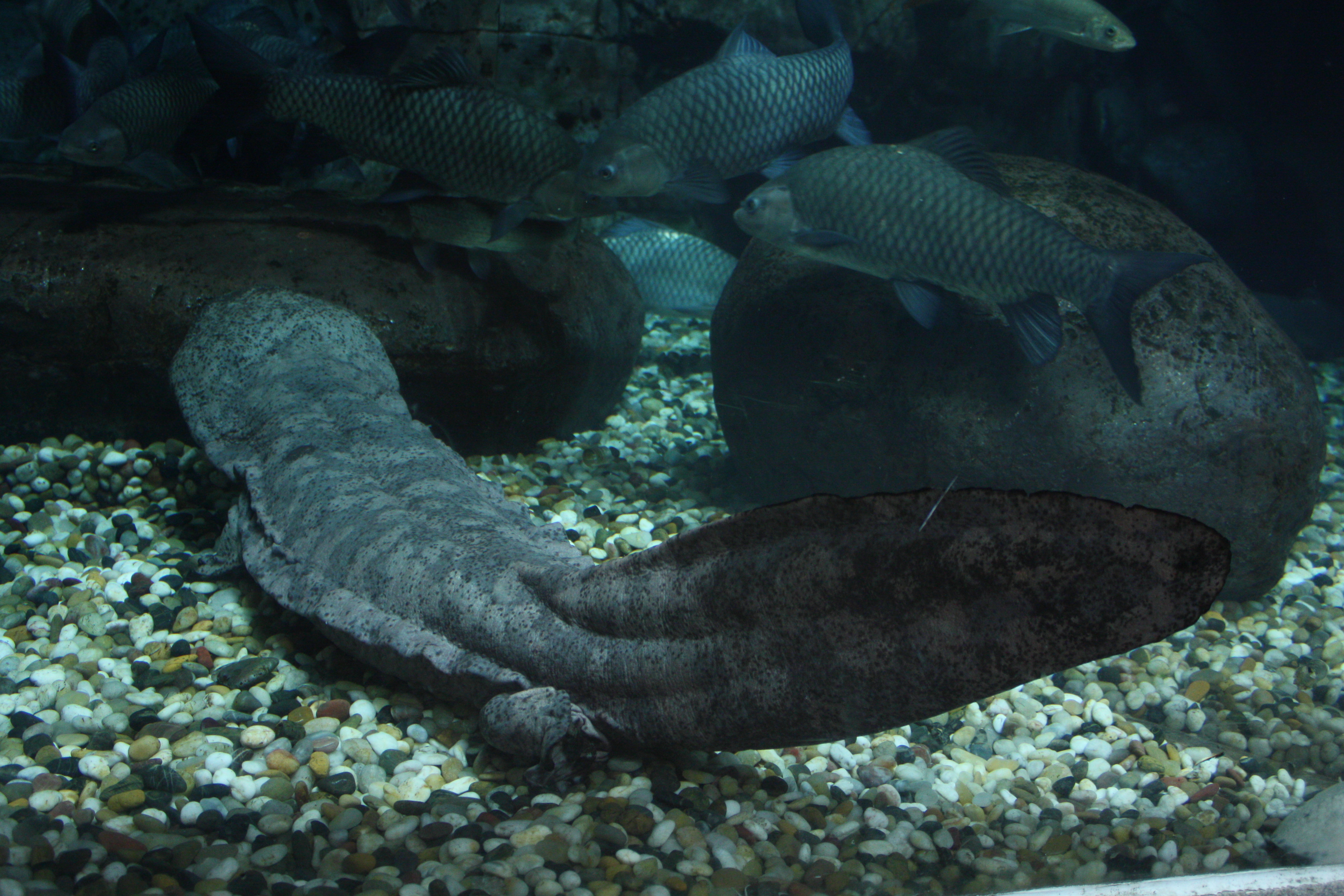
Now, my posts always take a rational tone -- and that means I do lots of debunking.  But in this case, I think our cryptid deserves a second look.  Personally, I don't think large salamanders are ridiculous, and there are plenty of reasons why.  First of all, the Trinity Alps are great salamander territory.  Plenty of species live in the region, including one (Dicamptodon) that grows to a foot in length.  The climate of the Trinity Alps is also ideal.  It strongly resembles that of Japan -- where the world's second-largest amphibian dwells.

I'm talking about the Japanese giant salamander -- a species five feet in length.  Its Chinese cousin can grow even longer, into the range of the Trinity Alps giants.  Yes, these creatures live thousands of miles from California -- but their biological family is very widespread.  In fact, a close relative of the giant salamanders lives right here in America.  It's called the hellbender, and it's our largest native amphibian, at almost two feet in length.  This is a lot smaller than the Trinity Alps cryptid, but still quite impressive.

Now we have a possible scenario.  What if a member of the giant salamander family, which does exist in America, grew to massive size?  It's certainly possible, as such gigantism already exists in similar climates.  The lack of sightings is troublesome, and I'm not sure the Trinity Alps really houses such a monster.  But I don't think giant salamanders are impossible, especially in Asia and western America.  Don't get your hopes up, but don't write this one off!

Read more about the Trinity Alps Salamander:
http://forteanzoology.blogspot.com/2011/01/raheel-mughal-trinity-alps-giant.html
http://www.unknownexplorers.com/giantsalamander.php
Image (public domain, picturing a Chinese giant salamander) from http://upload.wikimedia.org/wikipedia/commons/d/df/2009_Andrias_davidianus.JPG

Tuesday, March 4, 2014

Igopogo


What comes to mind when you hear the phrase "lake monster?"  If you're anything like me, you think of a Nessie-like creature.  It lives in a deep, remote lake; it's large and mysterious; it's reptilian, and probably serpentlike.  Igopogo defies virtually all of these expectations.  Lake Simcoe's native cryptid is an unusual beast -- small, mammalian and remarkably close to civilization.

A monster in Lake Simcoe has been reported for centuries -- tales of the beast date back to Huron legend.  But modern sightings began just decades ago, peaking during the '60s and '70s.  By this point, several other lake monsters had risen to global prominence.  While Nessie was the most famous, it was Ogopogo (a fellow Canadian) which gave the Simcoe Monster its name.  Locally, it is also known as Kempenfelt Kelly and Beaverton Bessie.

As I said, Igopogo is a fairly strange lake monster.  The easy accessibility of Lake Simcoe is odd enough -- it's only an hour north of Toronto.  But that's just the beginning.  Igopogo, according to witnesses, sounds nothing like your classic "sea serpent."  One (likely hoaxed) photo shows a multi-humped creature-- but few other sources describe it this way.  Generally, it is cited as small and doglike, about nine to twelve feet in length.  The beast is usually seen in the water, but is occasionally said to bask on shore.

The most famous Igopogo sighting was actually recorded on video.  While racing hydroplanes, an unnamed witness was shocked to see the beast emerge right in front of him.  Cryptozoologist John Kirk believes the creature in the video is a pinniped -- a relative of the seals and sea lions.  These animals do seem a good match for the Simcoe cryptid.  The largest of them can reach twenty feet in length -- making Igopogo seem modest by comparison.  There are also plenty of seals in Canada, making the explanation parsimonious.

The seal theory has one major downside -- Lake Simcoe is hundreds of miles inland.  Seals live on the coast, not in lakes -- and it's easy to wonder how one could end up there.  Theoretically, one could travel through the river system and migrate short distances across land.  But what could motivate it to do so?  And why would seals do this in sufficient numbers to establish a population?  Furthermore, if there were seals living in Simcoe, surely they would be seen more often.  All mammals have to surface for air, and though Lake Simcoe is large, it's not exactly remote.  It's hard to believe seals could live there and remain undetected.

Read more about Igopogo:
http://www.livescience.com/410-investigators-search-canadian-lake-monster.html
http://www.bcscc.ca/igopogo.htm
http://www.americanmonsters.com/site/2010/11/igopogo-canada/
Image (public domain and probably hoaxed) from http://upload.wikimedia.org/wikipedia/en/8/8b/Igopogo.jpg

Saturday, March 1, 2014

The Axehandle Hound


This week's been a slow one on BeastPedia -- I've been extremely busy, and haven't been able to write as much as I'd have liked.  It was much to my surprise, then, when yesterday's post resulted in more views than I'v ever seen on this blog.  I guess you all like fearsome critters!  As an apology for my slack posting, I'll send a couple more your way before moving back to cryptids.  Today, I bring you the Axehandle Hound.

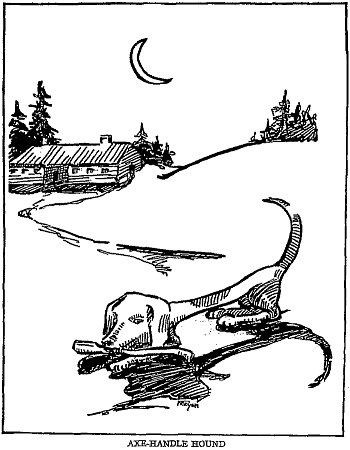
Thousands of years ago, humans domesticated the wolf-- more or less by accident.  Wolves skirted the edges of our campfires, picking up scraps of meat and feeding on our garbage.  Over the centuries, they lost their fear of humankind and became fairly easy to tame.  The result was man's best friend -- the household dog.  The Axehandle Hound, according to lumberjack folktales, got its start the same way.  This doglike critter frequents the edges of logging camps in search of food to steal.

But there's one big difference between this creature and the wolf.  Wolves feed on meat, but Axehandle Hounds eats... wait for it... axe handles.  This makes them a great nuisance for lumberjacks, whose tools the critters would destroy.  Axehandle Hounds are said to prefer the Peavey brand, and detest handles made of red oak.  This latter quirk is a handy one.  A foolish lumberjack, so the story goes, once domesticated a Hound.  But he had lost his leg in a logging accident, and used a wooden axe-handle to replace it.  His pet continually gnawed on the thing, until he fed it a piece of red oak and it ran away.

The story of the Axehandle Hound is a strange one, full of inside references to lumberjack culture.  Clearly, it was invented to explain the loss of axe handles -- an extremely common event.  After all, they were made of wood and their heads fell off easily.  When dropped on the ground, they were nearly indistinguishable from any other stick in the forest.  Why do Axehandle Hounds prefer the Peavey brand?  Because lumberjacks did, regarding it as superior and using it with great frequency.  Since more Peavey axes were used, more Peavey axe-handles were lost.  According to joking woodsmen, it must have been the hound.

Red oak handles, on the other hand, were largely regarded as useless.  A lumberjack spent hours every day working with his axe -- it was his main tool and source of livelihood.  The quality of that axe was thus very important, and a weak handle simply would not do.  Red oak was an "inferior" wood -- theoretically, it wasn't strong enough to bear an axe head.  Handles made of this material were therefore spurned.

Read more about the Axehandle Hound:
http://www.lumberwoods.com/p5.htm
http://content.wisconsinhistory.org/cdm/ref/collection/tp/id/55361
Image (public domain) from http://www.lumberwoods.com/images/axehandlehound_small.png

Tuesday, February 25, 2014

The Zuiyo-Maru Creature


In 1977, the Zuiyo-Maru caught itself a sea monster.  This Japanese trawler was looking for mackerel -- but what it found in its net was something else entirely.  The creature was long dead and badly decomposed.  Most of its flesh had rotted away, and its skeleton was clearly visible.  Still, the animal looked like nothing else on earth.  It was thirty feet long -- too big to be anything but a shark or whale.  Yet it resembled neither.  Its most distinguishing traits were its long neck and large fins -- which made it, more than anything, resemble a plesiosaur.

Unfortunately, the Zuiyo-Maru carcass was never brought to shore.  Concerned it would spoil his fish, the captain had it tossed overboard -- after the crew took photographs.  One of these (seen above) was widely publicized as evidence of surviving plesiosaurs.  It caused a media sensation, and sparked the interest of countless cryptozoologists.  According to recent studies, though, it's not a reptile at all.  It seems most likely that the Zuiyo-Maru caught a dead basking shark.

If you've ever seen a basking shark, you're probably very skeptical.  They're bulky, thick-headed, giant-mouthed filter-feeders -- in short, they look nothing like the picture above.  The key point to note, though, is how basking sharks decay.  Most animals, after death, "fall apart" in a specific sequence.  The study of decomposition is called taphonomy, and it can tells us a lot about the Zuiyo-Maru's find.

A basking shark's corpse distinegrates head-first.  The giant lower jaw sloughs off, separating from the rest of the body.  The fat, fleshy portions slide away from the skeleton -- leaving an emaciated carcass behind.  This carcass seems to have a long "neck" with a small head -- but in fact, this "head" is just the brain case.  The animal's jaws are long gone; in effect, the corpse has been decapitated.  A dead basking shark is a dead ringer for this cryptid.

This idea didn't convince everyone -- some were sure that the Zuiyo-Maru had found a sea serpent.  They pointed to purported discrepancies seen in the photograph -- features that a basking shark shouldn't have.  Eventually, though, testing of the monster's flesh revealed its identity.  According to amino acid tests, the carcass was indeed a shark.  Could plesiosaurs still be out there?  Many cryptozoologists think so.  But the Zuiyo-Maru's monster isn't one of them.

Read more about the Zuiyo-Maru Creature:
http://paleo.cc/paluxy/plesios.htm
http://bizarrezoology.blogspot.com/2013/10/zuiyo-maru-carcass-shark-or-unknown.html
http://frontiersofzoology.blogspot.com/2013/12/zuiyo-maru-addendum-and-rebuttal.html
Image (public domain) from http://upload.wikimedia.org/wikipedia/en/4/4e/Zuiyo_Maru.jpg

Monday, February 24, 2014

The Ivory-Billed Woodpecker


A few months ago, while hiking with some friends, I saw my first woodpecker.  I've heard these birds plenty of times -- their rapid-fire tapping is unmistakable.  But I'd never gotten a good look at one, and was impressed when I did.  These little birds are flying jackhammers.  They ram their beaks into trees with startling force -- I was amazed mine didn't break its neck.  They're also strikingly beautiful, and distressingly rare.  In fact, one of America's most famous woodpeckers has gone extinct altogether.

In its day, the Ivory-Billed Woodpecker was not a rare bird.  It could be found throughout the forests of the American southeast -- forests which, in the 19th century, began to disappear.  Loggers cleared hundreds of acres of woodpecker habitat, causing populations to plummet.  Hunters were no help, killing some of the last individuals for trophies and museum specimens.  By the 1930s, the population had dwindled, and only a handful remained.  By 1944, the species had disapeared.

But there are hints that the Ivory-Billed Woodpecker may yet exist.  Since the bird's supposed extinction, several notable sightings have come to light.  Most of these took place within the last two decades -- the best in 2005 and 2006.  The 2005 reports, from Arkansas, were the first to be taken seriously.  They included photos and videos of a large, white-striped woodpecker.  Witnesses claimed that the bird's red crest, wing position and tapping pattern confirmed its identity.  Critics dismissed the evidence, believing a pileated woodpecker to be responsible.

In 2006, new evidence came out of Florida, where a research team recorded woodpecker sightings and sounds.  They were unable to take video, or even photographs -- but they claimed their data was conclusive nonetheless.  Many ornithologists remained skeptical.  The survival of the woodpecker remains, for the time being, debated.  Only one thing will change this -- unequivocal photographic proof.

The Ivory-Billed Woodpecker is an interesting case among cryptids.  Most unknown animals are treated with extreme skepticism, and are not given serious consideration.  The woodpecker, on the other hand, has been investigated by several major institutions.  Research teams have spent years searching for the bird, and multiple scientific papers have discussed its possible survival.  Why this special treatment?  Simple -- the woodpecker is a bird, and one that was previously known to science.

In recent years, "birding" has become an increasingly common pastime.  Tens of thousands enjoy the hobby, and as a result, we understand our local birds like we do few other animals.  When a rare species is spotted, dozens of witnesses converge on the location.  They report their finds online, discuss them with others, and submit them to interested ornithologists.  The birder community is popular and well-organized -- which means that a species like the Ivory-Billed Woodpecker draws great attention.  It lived into recent times, making its survival conceivable -- and many ornithologists are very willing to consider it.

How likely is the woodpecker's persistence?  I'm very willing to consider it.  Other rare birds have been found decades after "extinction" -- perhaps the Ivory-Billed will join them.  Admittedly, there's little habitat left for this species -- but some can be found in Arkansas, where the species has been sighted.  Keep watching the skies, as they say.  This bird may still travel them.

Read more about the Ivory-Billed Woodpecker:
http://animaldiversity.ummz.umich.edu/accounts/Campephilus_principalis/
http://www.birds.cornell.edu/ivory
http://www.allaboutbirds.org/guide/Ivory-billed_Woodpecker/id
http://www.ivorybill.org/
http://www.npr.org/2005/04/28/4622633/ivory-billed-woodpecker-rediscovered-in-arkansas
Image (public domain) from http://upload.wikimedia.org/wikipedia/commons/1/18/Ivory-billed_Woodpecker_by_Jerry_A._Payne.jpg

Saturday, February 22, 2014

The Enfield Horror

My posts on this blog follow a loose format.  I describe a mysterious creature, talk about evidence, and then discuss its likelihood.  I look at possible explanations, and determine which is most probable.  Today, though, I can't do that -- because I have no idea what the Enfield Horror could be.  This is a strange cryptid indeed -- backed by plenty of evidence, yet completely lacking an explanation.

There have only been a handful of sightings, all from 1973.  They started on April 25th, with a man named Henry McDaniel returned home with his wife.  There he found his children in a state of terror -- something, they told him, had tried to break into the house.  Evidently, it hadn't given up -- because shortly thereafter, McDaniel heard a scratching at the door.  When he investigated the sounds, he expected to see a stray dog.  What he beheld instead was horrifying.

The creature was between four and five feet tall, with greyish skin and bulging red eyes.  It stood on three legs, and had small claws for arms.  Horrified, McDaniels emptied a pistol into the beast -- which bounded away, covering fifty feet in three jumps before vanishing unharmed.  McDaniels wasn't the only witness -- a local boy was attacked half an hour earlier by a creature of the same description.

The Enfield story quickly became a media sensation.  Young "monster hunters" combed the woods looking for the beast, and some of them evidently saw it.  They described it as a "grey monkey" that moved much faster than an animal -- far too quickly to be caught.  McDaniels also saw the creature again, traveling along the railroad tracks in the dead of night.  By the end of May, the sightings had ceased, and none have been reported since.  But the question is this -- what caused them in the first place?

Usually, I would dismiss such an improbable-sounding cryptid.  There are no large animals that walk on three legs, let alone ones with claws and bulging eyes.  There's no natural explanation for this creature -- small wonder that it's often called an alien.  So why am I not brushing off this monster?  Because despite its bizarre nature, it's supported by plenty of evidence.  Police found three-footed tracks in McDaniels' yard, and the witnesses involved were quite reliable.  Loren Coleman himself heard the Horror's shriek, and observed the scratch marks on McDaniels' door.

In light of this evidence, some people have offered theories to the Horror's identity.  None of these seem probable, but I'll repeat them for the sake of discussion.  Some suggest that the Enfield Horror was a loose kangaroo -- which would explain its jumping motion.  Its third leg, they say, could have been a dragging tail.  To me, this seems like a stretch -- kangaroos aren't grey, lack red eyes, have no claws and are easily identified.  Who could mistake a kangaroo for such a monster?  Besides, if a kangaroo had escaped from a zoo, it would surely have been reported.

Another possibility is that the Enfield Horror was a "Devil Monkey."  This is a broad category of cryptids including various North American primates.  They tend to be fast, aggressive and around the Enfield Horror's size.  While Dale Drinnon -- whose opinions I respect -- supports this theory, I'm not so sure.  Monkey tails aren't thick enough to mistake for a leg, and none have hairless grey skin.  As I said at the beginning of this post, I'm going to hold out on stating an opinion.  In this case, no clear answer is apparent.

Read more about the Enfield Horror:
http://www.americanmonsters.com/site/2010/03/enfield-horror-illinois-usa/
http://www.cryptomundo.com/cryptozoo-news/enfield73/
http://www.prairieghosts.com/enfield.html
http://frontiersofzoology.blogspot.com/2012/03/enfield-horror-is-also-fw-monkey.html

Friday, February 21, 2014

The Kumi Lizard


The monitor of Komodo is a dragon indeed.  At ten feet long, it's Earth's largest lizard -- and certainly its most dangerous.  the Komodo dragon is a mighty predator, capable of taking down water buffalo.  This isn't due to strength alone -- the creature is venomous, and can poison its prey with a bite.  Impressed?  You should be -- the Komodo dragon is truly the king of the lizards.  But this crown, as paleontologists know, has been recently earned.  Only 30,000 years ago, it belonged to a much larger and deadlier species.

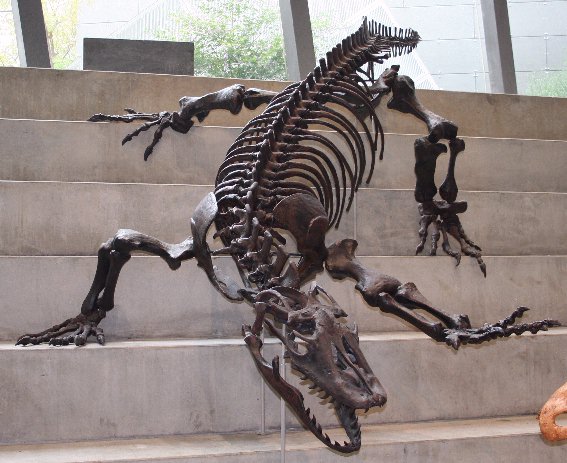
Its name was Megalania.  A neighbor of the Komodo dragon, it lived in prehistoric Australia alongside many other extinct species.  During the Pleistocene, Australia's animals were huge -- much larger than anything seen there today.  Megalania could exceed twenty-three feet; its prey included ten-foot wombats and thousand-pound kangaroos.  Around 30,000 years ago, all of these "megafauna" disappeared -- right when humans arrived on the continent.  Few scientists think this is a coincidence.  A popular theory is that humans overhunted these animals -- driving Megalania to extinction.

But some are convinced that the beast still lives.  They point to tales of the "Kumi Lizard" -- a reptilian cryptid of New Zealand.  It lives in trees, so it's said, and is about five feet long.  The creature has been sighted as recently as the '70s, and is far larger than the island's other lizards.  Is Megalania's survival possible?  Perhaps, but it's not likely.  On the plus side, New Zealand has plenty of undeveloped land, and a giant reptile would not lack for habitat.  But on the other hand, what would Megalania eat?  There are no giant wombats in New Zealand -- only thousands of sheep, which would surely be noticed if they went missing.

Furthermore, the Kumi Lizard sounds nothing like Megalania.  The latter is four times the cryptid's length -- nothing that size could climb a tree.  Furthermore, Megalania was not native to New Zealand.  Could it have swum there from Australia?  Maybe -- several monitor lizards are semi-aquatic.  But that's an awfully long distance, and would challenge heavy reptiles.

Unfortunately, Megalania seems to be truly extinct.  But that doesn't debunk the Kumi Lizard.  There are two other theories that might explain this cryptid, and both of them are far more likely.  First of all, the creature might be a crocodile monitor.  This species is a powerful swimmer, and lives on nearby New Guinea.  It's a much better seafarer than Megalania -- perhaps it once reached New Zealand.  Furthermore, it's close to the Kumi in size -- adults can reach reach eight feet, and they're fairly decent climbers.

Alternatively, the Kumi Lizard might be a new species.  There are several monitors living in Oceania; an undiscovered type isn't impossible.  If such a species existed, it would belong to the genus Varanus.  That would make it a smaller cousin of the Komodo dragon -- and, of couse, of Megalania.

Read more about the Kumi Lizard and Megalania
http://nzcryptozoologist0.tripod.com/id20.html
http://www.paranormalinvestigators.org.nz/home.php?page=cryptozoology&id=14
http://picsandstuff.wordpress.com/2011/09/27/the-mysterious-kumi-1898/
http://www.bbc.co.uk/nature/wildfacts/factfiles/3046.shtml
http://animaldiversity.ummz.umich.edu/accounts/Varanus_komodoensis/
Image (of Megalania skeleton, public domain) from http://upload.wikimedia.org/wikipedia/commons/0/07/Varanus_priscus_Melbourne_Museum.jpg

Wednesday, February 19, 2014

The Hoboken Monkey-Man


This may be the most obscure cryptid I've ever described.  You won't find it on Wikipedia, or in most crypto-books.  I've seen it detailed in only two sources -- both of which are listed below.  The first is "Weird NJ", a magazine which brought the creature to my attention.  The second is a newspaper article, which partially debunks the myth.

But let's start with the story.  The Hoboken Monkey-Man, so it's said, is a decades-old urban legend.  Around Halloween 1982, rumors about the creature spread through the school system -- passed student-to-student in hallway whispers.  According to these tales, children were being attacked by a half-human monster.  It would kidnap them, toss them out windows, and even attempt to murder them.  Some said that students had gone missing; others that a teacher had been killed.

These claims were completely false, as the Hoboken police reported.  No students had been harmed, and no monster had been sighted.  Still, the hysteria spread, encouraged in part by local parents.  The year 1982 was marked by several kidnappings -- leaving parents worried for their children.  They used the Monkey-Man as a scare tactic, encouraging safety through fear.  Eventually, the Monkey-Man tales died down -- but Hoboken residents have not forgotten them.

Was there really a Monkey-Man?  Almost certainly not.  This cryptid's likelihood is often overstated, due to a false claim made in "Weird NJ".  The magazine tells us the Monkey-Man was taken seriously -- so seriously, in fact, that the police devoted a task force to the creature.  This is untrue, as the Hoboken police force has confirmed.  The Monkey-Man is an urban legend, backed by no real evidence whasoever.

Note:  There are no public-domain images of the Hoboken Monkey-Man.  The image here is a public-domain picture of a macaque from http://upload.wikimedia.org/wikipedia/commons/1/1f/Berberaffe,_Barbary_Macaque_(Macaca_sylvanus)_-_Tierpark_Gera_09.jpg.  Awww.

Read more about the Hoboken Monkey-Man:
http://www.hudsonreporter.com/view/full_story/2414578/article-Ever-heard-of-the--Hoboken-Monkey-Man--Residents-recall-mythical-primate-who-terrorized-kids
http://cressida.websitewelcome.com/~weirdev/index.php?option=com_content&task=view&id=44&Itemid=28

Tuesday, February 18, 2014

The Hokkaido Wolf


If you want to see wolves in Japan, you'll have to visit the zoo.  But this wasn't always the case; 125 years ago, the nation was home to two unique subspecies.  The first was the Honshu Wolf, a diminutive creature extinct since 1905.  Once common, their populations were ravaged by disease starting in the 1700s.  Human persecution finished off the species for good.  The othe Japanese wolf disappeared even earlier.  This was the Hokkaido Wolf, a larger and rarer breed found in the north.

European tradition has long featured murderous wolves.  But Japanese folklore portrayed them differently.  Wolves, to the Japanese, were noble and spiritual animals.  They were guardians of the mountains, and protectors of those in need.  They had supernatural powers, according to some stories, and were always treated with great respect.  When it became a threat, an individual wolf might be killed -- but when this happened, its spirit was appeased with great ceremony.

Overall, Japanese wolves were seen in a very positive light.  There are various theories which attempt to explain this -- some more likely than others.  One hypothesis is that Japanese wolves were actually helpful to farmers.  Yes, they took occasional livestock -- but they also hunted crop-stealing deer and rabbits.  Sometimes, wolves would even leave part of their prey behind.  On the whole, they increased the productivity of farms, and their benefits outweighed their dangers.

Unfortunately for the wolves, this changed during the 1800s.  After the Meiji Restoration, Japanese agriculturalists put tremendous emphasis on livestock.  And in an effort to "catch up" with western nations, the nation kicked its economy into overdrive.  Rapid industrialization followed, along with increased agricultural land use.  This had several effects on wolf populations.  First of all, it reduced their habitat, bringing them into frequent conflict with humans.  Second of all, it killed off their natural prey -- forcing them to hunt livestock

No longer were wolves seen as beneficial.  Now, they were common farm pests to be killed at every opportunity.  Farmers slaughtered the animals with guns and poison; eventually, this was incentivized by the government.  It issued formal bounties, awarding prize money for every wolf killed.  Dog-spread diseases further reduced populations.  The Hokkaido Wolf disappeared with tremendous speed -- and by 1889, it was extinct.

Or so it is said.  Sightings of the animal have never ceased, and dozens have been reported in the past decades.  Locals report hearing wolf howls, finding wolf dung, seeing wolf footprints and even encountering the animals.  Many of these stories are dubious, but the sheer volume of sightings gives one pause.  There are still plenty of wild places in Japan, and plenty of large prey.  The animals once hunted by wolves -- the deer and the serow -- are still present, and could support a small population.  Perhaps someday, like other "Lazarus species", the Hokkaido Wolf will be rediscovered.

Read more about the Hokkaido Wolf:
http://wolfology1.tripod.com/id147.htm
http://www.scilogs.com/endless_forms/2010/09/27/although-the-gray-wolf-canis/
http://www.cryptomundo.com/cryptozoo-news/brent-wolf3/
Image (public domain) from http://upload.wikimedia.org/wikipedia/commons/4/40/%E3%82%A8%E3%82%BE%E3%82%AA%E3%82%AA%E3%82%AB%E3%83%9F%E5%89%A5%E8%A3%BD%E3%83%BB%E9%96%8B%E6%8B%93%E8%A8%98%E5%BF%B5%E9%A4%A8%EF%BC%91%EF%BC%99%EF%BC%98%EF%BC%94%EF%BC%90%EF%BC%99%EF%BC%91%EF%BC%94.jpg

Monday, February 17, 2014

Post Revamp: the Maltese Tiger


Tigers are among Earth's most fascinating animals.  Their size, majesty and charisma has made them enormously popular -- and enormously recognizable.  In a way, this is ironic, since tigers as reclusive as it comes.  In the wild, they are near-impossible to find, and even researchers can go years without seeing one.  There are two main reasons for this.  First of all, tigers are shy and solitary, spending little time even with members of their own kind.  And second of all, tigers are extremely rare, with under 4,000 left in the world.

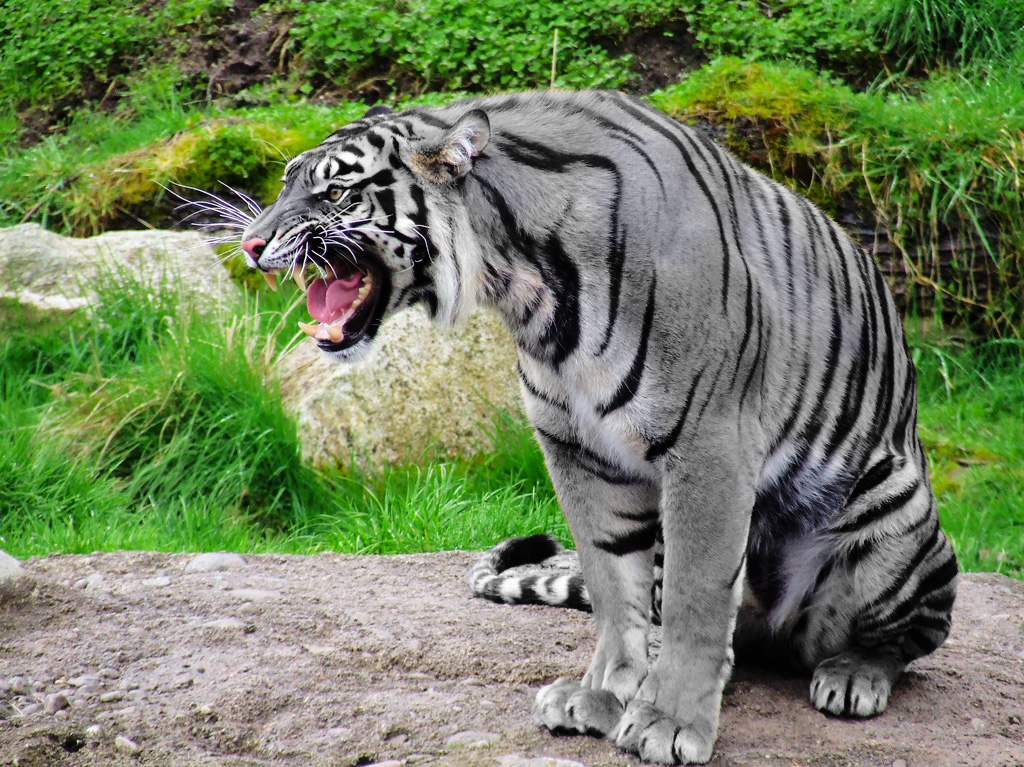
Even rarer, some say, is the "Maltese Tiger."  This is an unusual sort of cryptid -- not a new species, but a variant of an existing one.  Maltese Tigers, supposedly, are discolored by a rare mutation.  Their fur is blue instead of orange, and their normally-black stripes are grey.  This explains the name "Maltese" -- many cats from Malta have blue-grey fur.

Before talking about the probability of this cryptid, we should discuss whether Maltese tigers are even possible.  In normal cats, this coloration pattern is created by a specific set of genetic alleles.  Were these alleles present in tigers, they would indeed produce a blue-colored animal.  But such a tiger would not have stripes, unlike the Maltese Tigers of cryptozoology.  A more complicated set of alleles could indeed produce a blue, striped animal -- but such an individual has never been observed.

A perhaps likelier theory is that "Maltese" tigers are not blue at all.  White tigers do exist, and can be produced by a lack of pheomelanin.  This mutation is not uncommon; several white individuals have been captured or bred over the years.  Tigers are mostly nocturnal, and in the moonlight a white animal could easily appear bluish.  The "Maltese" coloration may thus be a trick of the light.

Whether Maltese Tigers are blue or white, they cannot be common.  Only a handful of sightings have ever been reported -- mostly from China, but also from neighboring countries.  In this region, tigers are extremely rare, due to poaching and use in traditional medicine.  Do unusually-coloerd morphs appear on occasion?  Perhaps, but there certainly isn't a population -- and tigers are so infrequently seen that we may never know for sure.

Read more about the Maltese Tiger:
http://www.redorbit.com/education/reference_library/general-2/cryptozoology/1112993059/maltese-tiger/
http://io9.com/could-the-mythical-blue-tiger-actually-exist-1331164937
Image (public domain) from http://upload.wikimedia.org/wikipedia/commons/f/f7/Maltese_Tiger.jpg

Sunday, February 16, 2014

Post Revamp: Bergman's Bear


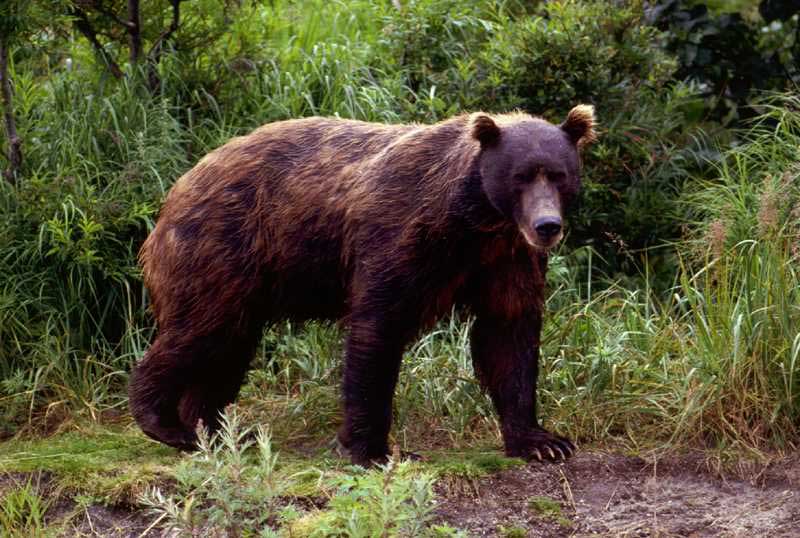
Most cryptids, no matter how many sightings they have, suffer a lack of physical evidence.  Bergman's Bear has the opposite problem.  It is mostly known from tangible remains -- a hide and skull examined in the 1920s.  This bear has never been reliably reported, and only sketchy accoutns testify its existence.  Supposedly, this creature lives in Russia's Kamchatka Peninsula, and resembles a grizzly in appearance.  The main differences are its size and the quality of its hair.

Bergman's Bear is named for Sten Bergman -- the Swedish zoologist who examined its remains decades ago.  He was instantly struck by the hide's unusual character.  First of all, its hair was black -- darker than that of a normal Russian brown bear.  The hair was also unusually short, and the pelt itself was massive.  Bergman was also shown the creature's outsized skull, and some of its footprints -- which were over fourteen inches long.  The naturalist believed he was dealing with a new subspecies.  Scientifically, it has been named "Ursus arctos piscator" -- but it has gone down in history as "Bergman's Bear."

What is this mysterious animal?  One theory, raised during a rare spurt of sightings, is that Bergman's Bear is a prehistoric relic called Arctodus.  But this ancient bear only lived in North America, and had long, thin legs.  Bergman's Bear sounds nothing like this -- in fact, a native name for the animal means "trousers pulled down."  Does that sound lanky to you?  A better theory is that Bergman was right -- and that his bear is a new brown bear subspecies.

That is, if the animal still exists.  Kamchatka is sparsely inhabited, and during the Cold War was inaccessible due to military testing.  At a glance, it seems an ideal cryptid hiding spot -- but the peninsula has not remained empty.  It is regularly patrolled by bear hunters, few of whom report giant short-haired animals.  Some say Bergman's Bear is extinct; were it present, it would surely be encountered.  Others argue the bear never existed.  Brown bears are variable in color, and some can appear black.  They can also grow to incredible sizes -- with Kamchatka bears (Ursus arctos beringianus) being some of the largest.  Was Bergman's Bear a simple misidentification?  Until more remains are found, we cannot be sure.

Read more about Bergman's Bear:
http://www.cryptozoology.com/cryptids/godbear.php
http://www.examiner.com/article/cryptozoology-bergman-s-bear-of-the-kamchatka-peninsula-russia
http://www.unknownexplorers.com/bergmansbear.php
http://www.strangeark.com/bfr/historical/bille-mystery-bears.html
http://thelordgeekington.wordpress.com/2014/01/16/bergmans-hypersplitting/
Image (public domain, of a Kamchatka brown bear) from http://upload.wikimedia.org/wikipedia/commons/3/3f/Brown-bear-in-spring.jpg

Saturday, February 15, 2014

Post Revamp: the Barmanou


The Barmanou is a mysterious hominin of northwestern Pakistan.  Like many cryptids, it has been known to locals for centuries -- but has only recently been the subject of serious research.  The creature came to European knowledge during the 1900s, after a series of Spanish explorations in Pakistan.  These reports inspired, nearly a century later, a dedicated Barmanou-finding expedition.  Led by zoologist Jordi Magraner, it collected years' worth of evidence -- most of which was lost after Magraner's tragic murder.

The Barmanou belongs to the "wildman" subtype of crypto-hominins.  Unlike the Yeti and Sasquatch -- which resemble apes -- this creature is far more human-like.  It is large and hairy, like all mystery primates, but also evidently intelligent.  It is said to wear animal hides like clothes, and to kidnap human women with amorous intent.  This means that, if the Barmanou is real, it may be something close to our own species.  No ape recognizes humans as viable mates.

What could the Barmanou be?  If anything, it's likely a relict hominin.  We aren't the only species of human -- dozens evolved, then disappeared, during the past six million years.  Only a few of these species made it into Eurasia -- most notably the Neanderthals and Homo erectus.  It's been suggested that the Barmanou is one of these.  The Neanderthals are better candidate, as they were more intelligent and more closely related to our species.  Besides, they lived more recently, dying out only tens of thousands of years ago.

It's hard to believe that prehistoric hominins could be hiding in Pakistan.  All human species were social creatures; they'd have to live in groups, making concealment difficult.  But consider this -- the mountain ranges where the Barmanou live are among Earth's least explored peaks.  And the Barmanou live close to other reported cryptids.  This species' range is sandwiched between those of the more famous Yeti and Almas.  The Yeti, if anything, is an ape -- but the Almas sounds quite Neanderthal-like.

Read more about the Barmanou:
http://www.bigfootencounters.com/biology/jordi.htm
http://www.americanmonsters.com/site/2010/08/barmanu-afghanistan-pakistan/
http://www.examiner.com/article/cryptozoology-the-man-of-the-forest-known-as-the-barmanou
http://www.unknownexplorers.com/barmanu.php
Image from http://whitengreen.com/imagenew/bigfootpakistan2.jpg

Friday, February 14, 2014

Post Revamp: the Arabhar


The Arabhar is a cryptid snake known for its ability to fly.  It reportedly lives in the Arabian Sea region, and is capable of traveling great distances through the air.  The mechanism for this creature's flight has not been reported -- I've seen it depicted with both wings and sails.  The former would make it capable of true flight; the latter would make it better suited to gliding.

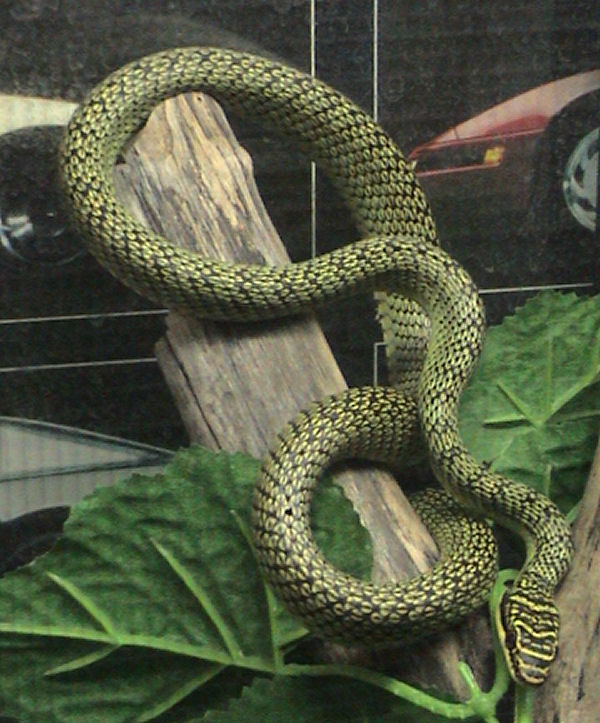
Surprising as this may seem, the Arabhar is a fairly believable cryptid.  After all, there are already five species of "flying snake" known to science.  Found in the genus Chrysopelea, they are capable of climbing trees and gliding hundreds of feet through the air.  They do this by flattening their body to form a wing-like shape, then undulating back and forth for propulsion.

This gliding is not true flight.  Flying snakes lack wings, leaving them unable to surmount the force of gravity.  This means that they are incapable of increasing their altitude, and can only travel downwards.  Furthermore, they have little control over their direction, and can vary it only slightly in midair.  During "flight", these snakes are living javelins -- traveling only in the direction they were launched.

Could the Arabhar be a new "flying" snake?  Easily.  Multiple Chrysopelean species live in India and Sri Lanka -- exactly where the Arabhar is found.  The snake pictured here is one of them, and may well belong to this cryptid's genus.  This theory does an excellent job of explaining the Arabhar -- but it's not the only one out there.  With great hesitation, I now present to you a second option.  It's highly improbable, especially because the Chrysopelean theory is so strong.  But nothing is impossible, especially in cryptozoology, and so I'm forced to ask... could the Arabhar actually have wings?

Flight has independently evolved several times.  Birds, bats and insects all developed this feature quite separately -- so perhaps a snake could too.  But how would such a flight mechanism work?  Birds and bats use modified forelimbs as wings -- but snakes have no limbs at all.  The most popular theory is inspired by the "flying dragon" -- lizard that "flies" using flaps of skin.  These skin-flaps are attached to long, projecting ribs, which form a sort of sail.  When the dragon leaps out of a tree, it extends its "wings" and glides -- sometimes up to 200 feet.

Again, though, this is not true flight.  The flying dragon is a glider, just like the flying snakes -- which have a much more efficient and probable propulsion system.  There's only one piece of evidence that the Arabhar has wings -- and it comes from ancient Egypt.  There, legends told of flying snakes, capable of spitting deadly poison.  These creatures were portrayed with massive wings, and their images served as tomb decorations.  Were the Egyptians recording a real creature?  Most likely not, but who knows... perhaps they were witnesses to the Arabhar.

Read more about the Arabhar:
http://www.lorencoleman.com/top_cryptids.html
http://theunexplainedworld.tumblr.com/post/62113897864/arabhar-these-unconfirmed-flying-snakes-are
http://animals.nationalgeographic.com/animals/reptiles/flying-snake/
http://animaldiversity.ummz.umich.edu/accounts/Draco_volans/
Image from http://upload.wikimedia.org/wikipedia/commons/b/b6/Chrysopelea_ornata.jpg (public domain)

Sunday, February 9, 2014

Post Revamp: the Mngwa


Recently, I've been on a streak of African crypto-revamps.  For now, this will be my last post in that series; you'll get something very different tomorrow!  But today, I bring you the Mngwa -- a rare man-eating cryptid like the Nandi Bear.  Like many African cryptids, this monster is an enormous cat.  Its size is variable in description -- some say it's smaller than a donkey; others say it's larger than a lion.  But all sources agree on this:  the Mngwa has striped grey fur, and it's extremely deadly.

Sightings of the Mngwa date back 900 years -- it appears in African folklore, where it's described alongside the leopard and the lion.  Clearly, the native tribes view it as a distinct species; something unlike any other cat.  It certainly doesn't sound like any species we know of.  Lions have manes, and are never grey in color.  Cheetahs are tiny compared to the mngwa.  Leopards are spotted, not striped -- and again, they're not grey.  If the Mngwa exists, it may be a completely unique animal.

That is, if it exists at all.  Many believe it doesn't, and that this cryptid is completely folkloric.  One such skeptic was William Hichens, a British magistrate in colonial Tanzania.  He first heard stories of the Mngwa in the 1920s -- and paid them no heed whatsoever.  Until, that is, several citizens of his town were reportedly slaughtered by the beast.  One of their corpses was clutching a grey tuft of hair -- confirmed by scientists to belong to a cat.

Do we have any good theories about the Mngwa's identity?  Unfortunately, no.  Among the big cats, our best suspect is the leopard -- which has pawprints of similar shape.  Bernard Heuvelmans, the father of cryptozoology, proposed that the Mngwa was a giant relative of the African golden cat.  This is an odd theory, as that species is very small -- but it would explain quite a lot.  For one thing, the Mngwa is said to purr instead of roaring.  For another, golden cats can actually be gray in color.  Perhaps Heuvelmans was right -- the feared Mngwa's only relative may be tabby-sized.

Read more about the Mngwa:
http://cryptozoo-oscity.blogspot.com/2009/09/mngwalegendary-big-cat-of-tanzania.html
http://www.unknownexplorers.com/mngwa.php
http://webcache.googleusercontent.com/search?q=cache:http://thecryptozoologist.webs.com/apps/blog/show/14850761-the-mngwa-terror-of-the-coastlands
Image from http://criptozoologia.webmisterio.com/images/mngwa-leyenda-animal.jpg

Saturday, February 8, 2014

Post Revamp: the Nandi Bear


The Mokele-Mbembe is Africa's most famous cryptid.  But surely the most infamous is the Nandi Bear.  By definition, cryptids are mysterious creatures -- but for the most part, they're not particularly deadly.  The Nandi Bear is an exception, known for its reported habit of eating human brains.  This creature dwells in eastern Africa, and tends to hunt at night.  It is large, slightly smaller than a bear or lion, and lacks a long tail.  It has a bearlike snout, a shuffling gait, and longer front legs than hindlimbs.  It is said to be a climber of trees, and is much feared by native Kenyans.  Due to superstition, some will not speak of it; they view it as a sort of boogeyman.

The Nandi Bear's identity is the subject of fierce speculation.  But contrary to what its name implies, the creature is probably not a bear.  Only one modern bear species lived in Africa -- the Atlas Bear, now extinct for 120 years.  The Nandi Bear could be a relic population, but this doesn't seem probable.  The Atlas bear never lived in eastern Africa, and the migration of this species across the Sahara is unlikely.  Besides, small bears like this one aren't known to attack humans.

Another popular candidate is the chalicothere -- a prehistoric mammal that shared the Nandi Bear's claws and sloped back.  Chalicotheres did live in East Africa, but they went extinct 800,000 years ago.  More importantly, all of them were herbivores, and used their claws to strip vegetation from trees.  The idea of a brain-eating chalicothere is honestly preposterous.

Somewhat more likely is a giant baboon.  Baboons have sloped backs, long fangs, and aggressive temperaments.  They've been known to attack humans before, and on occassion they will eat meat.  In prehistoric times, gigantic variants did exist, and these reached the size of the Nandi Bear.  But all baboons live in packs, while the Nandi Bear is solitary -- and unlike the cryptid, baboons are diurnal.

And so we come to our final candidate, and by far the most likely -- a hyena.  Hyenas are deadly predators, and an excellent phyiscal match for the Nandi Bear.  They have powerful jaws, short snouts and a sloping back.  Their gait resembles the cryptid's, and so do their habits -- hyenas often hunt at night, and occasionally attack humans.  What's more, a prehistoric species called the short-faced hyena is about the Nandi Bear's size.  It was a known predator of our ancestors -- in fact, one hominin fossil contains bitemarks that match its teeth.  Where did the hyena bite its poor victim?  Right on the skull, like a Nandi Bear.

Now, the hyena theory isn't perfect.  Hyenas tend to go for the faces of human victims, not the braincases.  What's more, the people of Kenya know a hyena when they see one -- and typically, they call the Nandi Bear a primate.  But no other candidate is very likely, leaving the short-faced hyena as our best bet.  Has this species been hiding in Africa for half a million years?

Read more about the Nandi Bear:
http://www.cryptozoology.com/cryptids/nandi_bear.php
http://www.unknownexplorers.com/nandibear.php
http://karlshuker.blogspot.com/2012/09/nandi-bears-and-death-birds-my-top-ten.html
http://www.karlshuker.blogspot.co.uk/2011/05/do-black-ratels-and-orange-hyaenas.html
Image (of short-faced hyena) from http://upload.wikimedia.org/wikipedia/commons/2/2e/Short-faced_hyena1.JPG

Friday, February 7, 2014

Post Revamp: the Marozi


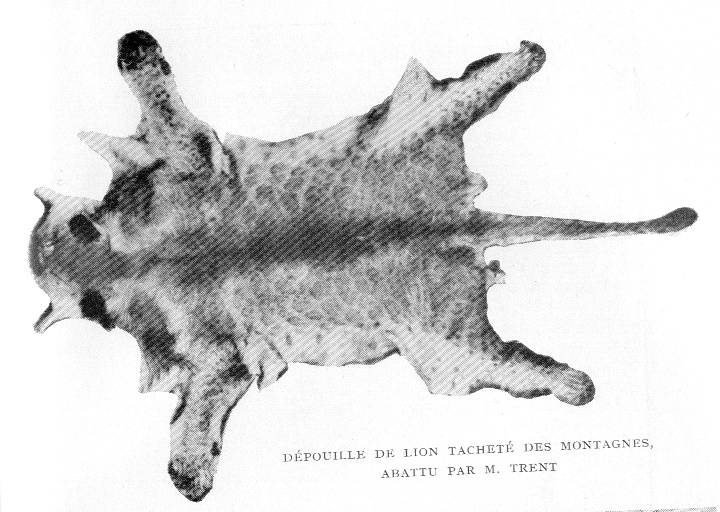
Whether the Marozi exists is hardly a question.  This mysterious cat, also called a "spotted lion," has been sighted in Africa for more than a century.  Scientists have obtained Marozi dung, Marozi footprints, Marozi bones and even a Marozi skin.  The creature has been measured, studied, and even preserved in a museum.  There's little doubt that this cryptid is out there -- the real question is what it is.

Physically, the Marozi resembles an adolescent lion.  It's slightly smaller than an adult lion would be, and tends to lack a mane.  Most notably, however, it is lightly spotted like a leopard.  Spotting is often observed in young lions -- but this trait fades with age.  Only cubs have spots as prominent as the Marozi's.  There are various theories about the identity of these spotted cats.  Some belive they are a new lion subspecies, adapted for life in the mountains.  Others say they are lion/leopard hybrids, or simply a mutant population like the King Cheetahs.

The hybrid hypothesis is fairly unlikely.  In the wild, lions and leopards are competitors -- they hunt the same prey, and generally consider each other to be enemies.  In captivity, the two species have been bred, but this has never been known to occur in nature.  Furthermore, lion/leopard hybrids don't look much like the Marozi.  They still often have manes, and their spots are more visible than a Marozi's should be.  Is it possible that an occasional lion and leopard could interbreed in the wild?  Yes.  But this would never happen often enough to establish a population.

The mutation and subspecies theories are more likely.  There are at least five lion subspecies -- another one isn't hard to imagine.  And since lions are not overly common, it's possible that genetic drift could produce a different-looking group.  A mutation, allowing spots to persist into adulthood, could occur in a single individual.  If that individual had many offspring, and was part of a small population, its mutant coloration could spread through the entire group.  Sooner or later, this mystery will be solved -- there's already Marozi DNA in London's Natural History Museum.  All we need now is a motivated scientist and a simple genetic test.  Soon the Marozi will be cryptid no more.

Read more about the Marozi:
http://www.newanimal.org/marozi.htm
http://www.lairweb.org.nz/tiger/marozi.html
http://www.messybeast.com/genetics/lions-spotted.htm
Image (of Marozi skin) from http://i12.servimg.com/u/f12/09/04/81/20/marozi10.jpg