Showing posts with label North America. Show all posts

Sunday, March 9, 2014

The Montauk Monster


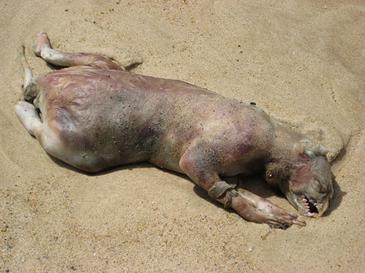
In 2008, shortly after BeastPedia began its five-year hiatus, a strange carcass washed up near Montauk, NY.  It was clearly a decaying mammal, with visible paws and patches of grey hair.  But what exactly was it?  Photographs of the beast, circulated on the internet, caused rampant speculation.  Some thought the creature an alien, some thought it a cryptid, and some thought it a genetic experiment.  An animal research center, they pointed out, was only a few miles away.  What if one of the subjects had escaped?

The creature, as it turned out, was nothing so exotic.  It was a decomposing raccoon, rendered near-unrecognizable by the forces of the tides.  Several posts ago, I mentioned taphonomy -- the study of how living things decay.  This is another mystery solved by that useful science.  Let's look at the carcass in detail, examining it step by step, until we can bring the "monster" back to life.

First of all, we know this creature was a mammal.  There are patches of fur clinging to its hide, which clearly isn't reptilian.  A second photo shows visible testicles, and the creature's dentition is visibly mammal-like.  So are its ears, its toes, the position of its legs, and virtually everything else we can see.  How big was it?  A fly on the carcass' back gives us a sense of scale -- and tells us it was about the size of a dog.

Thus far, we know we're dealing with a mid-sized North American mammal -- and a carnivore, based on the shape of the teeth.  This leaves us only a few options, including dogs, cats and raccoons.  The Montauk Monster looks like none of these -- but only because it's decomposed.  When a body floats in water, it rapidly bloats and begins to lose its hair.  That's what has happened here, and what makes the creature look so deformed.  The second thing to decompose is the snout -- which contains plenty of soft tissues.  When these fall apart, the premaxillary bones are exposed, producing the monster's "beak."

What identifies the Montauk Monster as a raccoon (as opposed to a dog or cat) is the shape of its teeth.  All families of mammals have fairly unique dentition, which can be told apart by an expert.  Skull shape is a major indicator of taxonomy, and to a mammalogist, this carcass screams "raccoon."

Read more about the Montauk Monster:
http://scienceblogs.com/tetrapodzoology/2008/08/04/the-montauk-monster/
http://nymag.com/daily/intelligencer/2008/07/the_monster_of_montauk.html
Image (public domain) from http://upload.wikimedia.org/wikipedia/en/8/8f/RhodeislandMonster.jpg

Wednesday, March 5, 2014

The Trinity Alps Salamander


In the mountains of California, so the legend goes, there once lived truly massive salamanders.  According to one witness, who popularized the cryptid in the 1920s, they could grow up to nine feet in length -- smaller speciens measured five.  These reports spawned great interest even among mainstream scientists.  Several expeditions were launched between the 1940s and the 1960s, all hoping to prove the creature's existence.

Though several sightings took place during this period, no expedition returned with physical evidence.  Even fairly exhaustive searches failed to turn up giant salamanders -- though small ones were found in abudance.  Since the mid-20th century, this cryptid has been witnessed only scarcely, and few hold out hope for its existence.  If such a creature ever lived, by now it may be extinct.

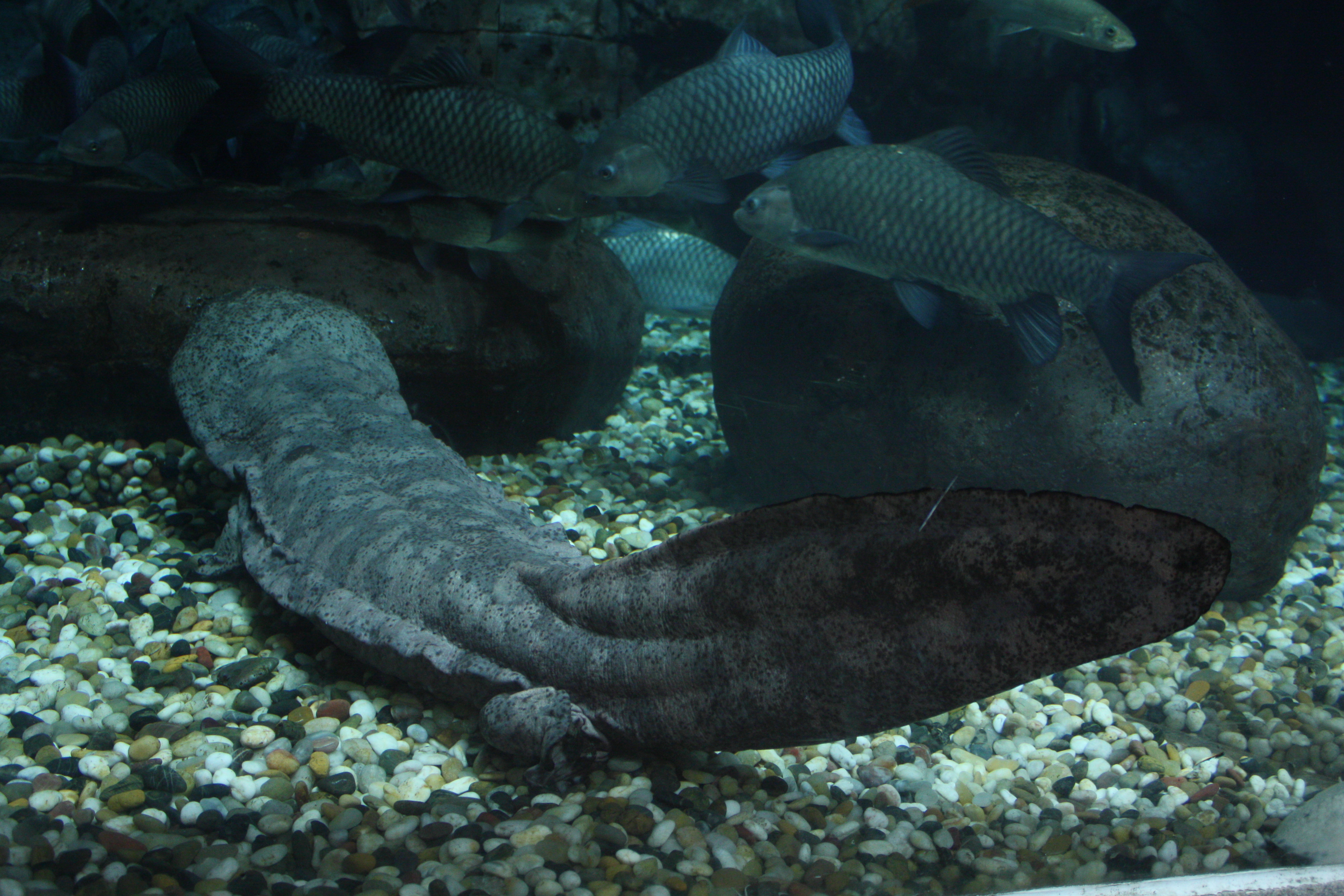
Now, my posts always take a rational tone -- and that means I do lots of debunking.  But in this case, I think our cryptid deserves a second look.  Personally, I don't think large salamanders are ridiculous, and there are plenty of reasons why.  First of all, the Trinity Alps are great salamander territory.  Plenty of species live in the region, including one (Dicamptodon) that grows to a foot in length.  The climate of the Trinity Alps is also ideal.  It strongly resembles that of Japan -- where the world's second-largest amphibian dwells.

I'm talking about the Japanese giant salamander -- a species five feet in length.  Its Chinese cousin can grow even longer, into the range of the Trinity Alps giants.  Yes, these creatures live thousands of miles from California -- but their biological family is very widespread.  In fact, a close relative of the giant salamanders lives right here in America.  It's called the hellbender, and it's our largest native amphibian, at almost two feet in length.  This is a lot smaller than the Trinity Alps cryptid, but still quite impressive.

Now we have a possible scenario.  What if a member of the giant salamander family, which does exist in America, grew to massive size?  It's certainly possible, as such gigantism already exists in similar climates.  The lack of sightings is troublesome, and I'm not sure the Trinity Alps really houses such a monster.  But I don't think giant salamanders are impossible, especially in Asia and western America.  Don't get your hopes up, but don't write this one off!

Read more about the Trinity Alps Salamander:
http://forteanzoology.blogspot.com/2011/01/raheel-mughal-trinity-alps-giant.html
http://www.unknownexplorers.com/giantsalamander.php
Image (public domain, picturing a Chinese giant salamander) from http://upload.wikimedia.org/wikipedia/commons/d/df/2009_Andrias_davidianus.JPG

Tuesday, March 4, 2014

Igopogo


What comes to mind when you hear the phrase "lake monster?"  If you're anything like me, you think of a Nessie-like creature.  It lives in a deep, remote lake; it's large and mysterious; it's reptilian, and probably serpentlike.  Igopogo defies virtually all of these expectations.  Lake Simcoe's native cryptid is an unusual beast -- small, mammalian and remarkably close to civilization.

A monster in Lake Simcoe has been reported for centuries -- tales of the beast date back to Huron legend.  But modern sightings began just decades ago, peaking during the '60s and '70s.  By this point, several other lake monsters had risen to global prominence.  While Nessie was the most famous, it was Ogopogo (a fellow Canadian) which gave the Simcoe Monster its name.  Locally, it is also known as Kempenfelt Kelly and Beaverton Bessie.

As I said, Igopogo is a fairly strange lake monster.  The easy accessibility of Lake Simcoe is odd enough -- it's only an hour north of Toronto.  But that's just the beginning.  Igopogo, according to witnesses, sounds nothing like your classic "sea serpent."  One (likely hoaxed) photo shows a multi-humped creature-- but few other sources describe it this way.  Generally, it is cited as small and doglike, about nine to twelve feet in length.  The beast is usually seen in the water, but is occasionally said to bask on shore.

The most famous Igopogo sighting was actually recorded on video.  While racing hydroplanes, an unnamed witness was shocked to see the beast emerge right in front of him.  Cryptozoologist John Kirk believes the creature in the video is a pinniped -- a relative of the seals and sea lions.  These animals do seem a good match for the Simcoe cryptid.  The largest of them can reach twenty feet in length -- making Igopogo seem modest by comparison.  There are also plenty of seals in Canada, making the explanation parsimonious.

The seal theory has one major downside -- Lake Simcoe is hundreds of miles inland.  Seals live on the coast, not in lakes -- and it's easy to wonder how one could end up there.  Theoretically, one could travel through the river system and migrate short distances across land.  But what could motivate it to do so?  And why would seals do this in sufficient numbers to establish a population?  Furthermore, if there were seals living in Simcoe, surely they would be seen more often.  All mammals have to surface for air, and though Lake Simcoe is large, it's not exactly remote.  It's hard to believe seals could live there and remain undetected.

Read more about Igopogo:
http://www.livescience.com/410-investigators-search-canadian-lake-monster.html
http://www.bcscc.ca/igopogo.htm
http://www.americanmonsters.com/site/2010/11/igopogo-canada/
Image (public domain and probably hoaxed) from http://upload.wikimedia.org/wikipedia/en/8/8b/Igopogo.jpg

Monday, March 3, 2014

The Hugag


The Hugag is a "fearsome critter" of the Great Lakes region.  Superficially resembling a moose, this hairy quadruped can weigh in excess of three tons.  It has toes instead of hooves, and a long, horselike tail.  But there all comparison to normal creatures must end.  The Hugag has a number of bizarre traits not seen in other mammals.  For one, its head is completely bald -- though the rest of its body is shaggy.  For another, its ears are corrugated like the tail of an Anhinga.  The purpose of these features is completely unknown.

The Hugag's strangeness does not end there.  Also unusual is the animal's upper lip -- which is swollen to such proportions that it hangs near the ground.  This lip is used to scrape needles and twigs off of pine trees.  The Hugag eats some of these needles, while covering itself with others in place of hair.  These needles are held in place by pine-sap, which oozes from the Hugag's pores.

This beast's most unusual feature is the jointlessness of its legs.  All four are completely rigid, unable to bend in any direction.  The Hugag is thus an extremely awkward traveler, rocking back and forth as it waddles through the forest.  If it ever lay down, the Hugag could not stand again -- and so it is forced to sleep standing up.  To accomplish this, it leans against one of the pine trees off which it feeds.

Hunters, noticing this habit, developed a method to hunt the creature.  They would pay attention to which trees the Hugag frequented -- identifiable due to their lack of pine-needles and bent posture.  These trees would be sawed partially in half, so that they remained standing but were extremely unstable.  When the Hugag next leaned against one of these trees, trunk and animal would both crash to the ground.  The hunters, lying in wait, would then slaughter the helpless beast.

Read more about the Hugag:
http://www.fearsomecreaturesofthelumberwoods.com/pg9.htm
http://www.lumberwoods.com/p29.htm
Image (public domain) from http://www.fearsomecreaturesofthelumberwoods.com/images/hugag.jpg

Sunday, March 2, 2014

The Funeral Mountain Terrashot


I've posted about several folkloric creatures in the last few days.  Many of these "fearsome critters" were jokes, but others were used to explain everyday phenomena.  Today, we cover the Funeral Mountain Terrashot -- which provides an example of folk etymology.  It was invented, so it seems, to explain the name of California's Funeral Range.  And its story is about as bizarre as you'll see on this blog.

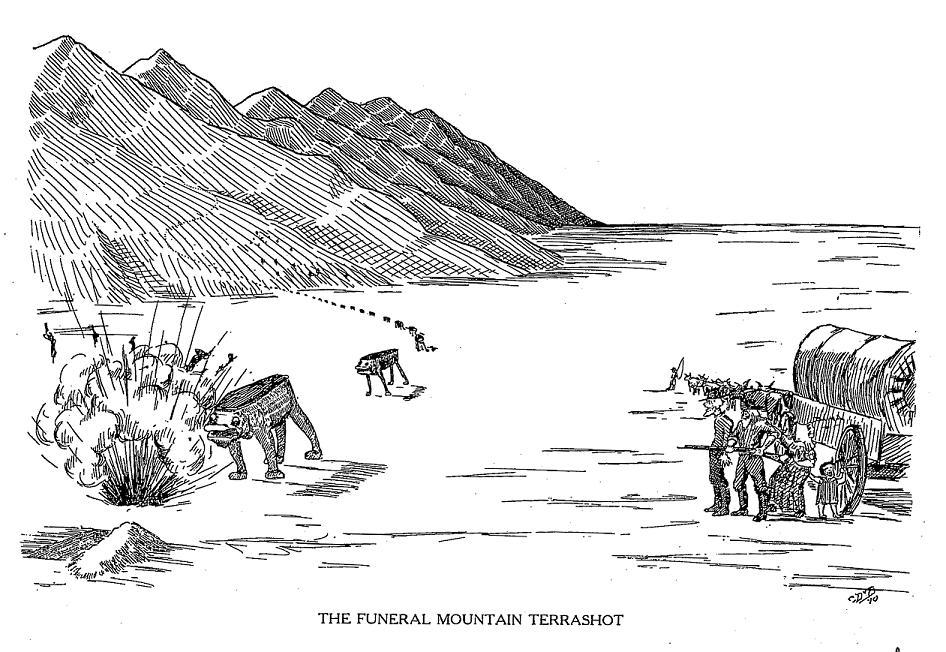
The Funeral Mountain Terrashot resembles a living coffin.  It waddles around the mountains on four stumpy legs, wobbling precariously from side to side.  It is easy for the beast to tip over -- though as we'll see, that's the least of its traveling problems.  Normally, the Terrashot dwells in peace, gathering and breeding in alpine meadows.  But when its population grows sufficiently large, the creature's migratory instincts set in.  At this point, the entire Terrashot clan leaves the mountains, trundling in a single-file line across the desert.

These migrations, unfortunately, are very short-lived.  When a Terrashot touches the desert's hot sands, it begins to swell uncontrollably.  Eventually, it explodes like a shotgun shell in a cloud of brimstone.  Even after seeing the death of their leader, the other Terrashots march on like lemmings.  One after the other, each creature detonates, punching a grave-shaped hole into the sand.

Supposedly some mormons witnessed this abortive migration and named the Funeral Range after the phenomenon.  No Terrashots have been seen since; perhaps the last of them were struck by fatal wanderlust.  Only their name lives on -- or so the story goes.

Read more about the Funeral Mountain Terrashot:
http://www.fearsomecreaturesofthelumberwoods.com/pg19.htm
Image (public domain) from http://www.fearsomecreaturesofthelumberwoods.com/images/terrashot.jpg

Saturday, March 1, 2014

The Axehandle Hound


This week's been a slow one on BeastPedia -- I've been extremely busy, and haven't been able to write as much as I'd have liked.  It was much to my surprise, then, when yesterday's post resulted in more views than I'v ever seen on this blog.  I guess you all like fearsome critters!  As an apology for my slack posting, I'll send a couple more your way before moving back to cryptids.  Today, I bring you the Axehandle Hound.

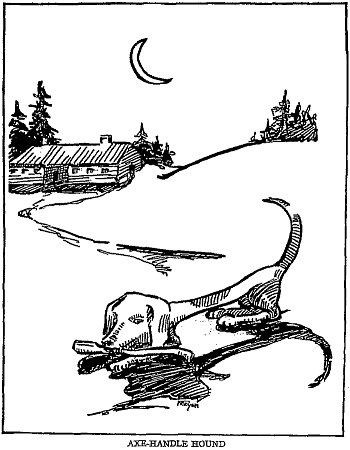
Thousands of years ago, humans domesticated the wolf-- more or less by accident.  Wolves skirted the edges of our campfires, picking up scraps of meat and feeding on our garbage.  Over the centuries, they lost their fear of humankind and became fairly easy to tame.  The result was man's best friend -- the household dog.  The Axehandle Hound, according to lumberjack folktales, got its start the same way.  This doglike critter frequents the edges of logging camps in search of food to steal.

But there's one big difference between this creature and the wolf.  Wolves feed on meat, but Axehandle Hounds eats... wait for it... axe handles.  This makes them a great nuisance for lumberjacks, whose tools the critters would destroy.  Axehandle Hounds are said to prefer the Peavey brand, and detest handles made of red oak.  This latter quirk is a handy one.  A foolish lumberjack, so the story goes, once domesticated a Hound.  But he had lost his leg in a logging accident, and used a wooden axe-handle to replace it.  His pet continually gnawed on the thing, until he fed it a piece of red oak and it ran away.

The story of the Axehandle Hound is a strange one, full of inside references to lumberjack culture.  Clearly, it was invented to explain the loss of axe handles -- an extremely common event.  After all, they were made of wood and their heads fell off easily.  When dropped on the ground, they were nearly indistinguishable from any other stick in the forest.  Why do Axehandle Hounds prefer the Peavey brand?  Because lumberjacks did, regarding it as superior and using it with great frequency.  Since more Peavey axes were used, more Peavey axe-handles were lost.  According to joking woodsmen, it must have been the hound.

Red oak handles, on the other hand, were largely regarded as useless.  A lumberjack spent hours every day working with his axe -- it was his main tool and source of livelihood.  The quality of that axe was thus very important, and a weak handle simply would not do.  Red oak was an "inferior" wood -- theoretically, it wasn't strong enough to bear an axe head.  Handles made of this material were therefore spurned.

Read more about the Axehandle Hound:
http://www.lumberwoods.com/p5.htm
http://content.wisconsinhistory.org/cdm/ref/collection/tp/id/55361
Image (public domain) from http://www.lumberwoods.com/images/axehandlehound_small.png

Friday, February 28, 2014

The Wapaloosie


The Wapaloosie is another "fearsome critter" invented by 19th-century lumberjacks.  In this case, though, the term doesn't seem fitting -- the Wapaloosie isn't frightening at all.  In fact, the diminutive beast is completely harmless.  Physically, it resembles a mouse, combined with the long body of a dachshund.  It climbs trees by arching its spine like an inchworm, moving slowly but surely up the trunk.  Though it lacks a squirrel's speed, the Wapaloosie is more sure-footed, due to spiked toes that prevent it from falling.

The Wapaloosie puts these adaptations to good use.  In fact, it has to -- the creature only feeds on tree-dwelling fungi.  Sometimes these grow far above the ground, so the Wapaloosie would starve were it not a good climber.  The animal's tree-scaling behavior is so important that it has become instinctual.  It is said to climb during its sleep, as soon as it's born, and even (most strangely of all) after death.

The story goes that an enterprising woodsman shot a Wapaloosie looking to make some mittens.  Unfortunately, despite the creature's soft fur, these turned out to be completely useless.  As soon as the lumberjack picked up his axe, the gloves crawled off his hands and up the wooden handle.  Whenever he would rest his hand on a tree, the gloves would leap off and try to scale it.  Eventually, he was forced to abandon them in a ditch -- and last saw them climbing over fallen logs.

Read more about the Wapaloosie:
http://www.fearsomecreaturesofthelumberwoods.com/pg25.htm
Image (public domain) from http://www.fearsomecreaturesofthelumberwoods.com/images/wapaloosie_small.png

Thursday, February 27, 2014

The Argopelter


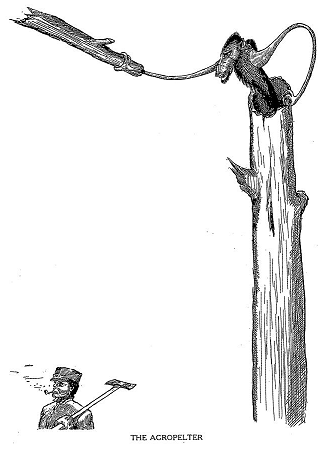
The Argopelter is a "fearsome critter" -- a folkloric beast of America's back-country.  In the 19th century, it reputedly terrorized loggers and lumberjacks, attacking them when they intruded on its habitat.  Physically, this creature was not intimidating -- it was thin, lanky and monkey-like.  But don't let its appearance fool you.  The Argopelter was a lethal menace, and a master of projectile warfare.

This critter was completely arboreal, living and sleeping within the treetops.  By night, it would sleep in woodpecker holes, feeding upon the owls that sometimes dwelled there.  By day, it would climb out onto a branch and wait for passerby.  When one came near, the Argopelter would break off a rotting chunk of wood, whirling it around its head at high speed.  Finally, it would let go, launching its weapon and striking the "trespasser" dead.

Generally, an Argopelter attack was never seen coming.  A lumberjack would vanish into the woods, seeking a tree to cut, and simply wouldn't come back.  Eventually, his comrades would come searching -- to find only his body, crushed beneath a fallen branch.  Most would call this a freak accident, unsuspecting of the real culprit.  The Argopelter, meanwhile, would lie in wait -- until another victim came into range.

As a side-note, I've always wondered the source of the Argopelter's name.  I've never seen one recorded, but I've come up with my own pet theory.  The Argo is a ship of Greek legend -- a wooden vessel that carried many great heroes.  Eventually, though, the boat began to decay and was taken out of service.  Its former captain, Jason, still visited the vessel -- until he was killed when its prow fell off and crushed him.  Perhaps the name "Argopelter" is a reference to this story.  Death by rotting wood sounds awfully familiar.

Read more about the Argopelter:
http://www.fearsomecreaturesofthelumberwoods.com/pg35.htm
http://www.fearsomecreaturesofthelumberwoods.com/p3.htm
Image (public domain) from http://www.fearsomecreaturesofthelumberwoods.com/images/agropelter_small.png

Monday, February 24, 2014

The Ivory-Billed Woodpecker


A few months ago, while hiking with some friends, I saw my first woodpecker.  I've heard these birds plenty of times -- their rapid-fire tapping is unmistakable.  But I'd never gotten a good look at one, and was impressed when I did.  These little birds are flying jackhammers.  They ram their beaks into trees with startling force -- I was amazed mine didn't break its neck.  They're also strikingly beautiful, and distressingly rare.  In fact, one of America's most famous woodpeckers has gone extinct altogether.

In its day, the Ivory-Billed Woodpecker was not a rare bird.  It could be found throughout the forests of the American southeast -- forests which, in the 19th century, began to disappear.  Loggers cleared hundreds of acres of woodpecker habitat, causing populations to plummet.  Hunters were no help, killing some of the last individuals for trophies and museum specimens.  By the 1930s, the population had dwindled, and only a handful remained.  By 1944, the species had disapeared.

But there are hints that the Ivory-Billed Woodpecker may yet exist.  Since the bird's supposed extinction, several notable sightings have come to light.  Most of these took place within the last two decades -- the best in 2005 and 2006.  The 2005 reports, from Arkansas, were the first to be taken seriously.  They included photos and videos of a large, white-striped woodpecker.  Witnesses claimed that the bird's red crest, wing position and tapping pattern confirmed its identity.  Critics dismissed the evidence, believing a pileated woodpecker to be responsible.

In 2006, new evidence came out of Florida, where a research team recorded woodpecker sightings and sounds.  They were unable to take video, or even photographs -- but they claimed their data was conclusive nonetheless.  Many ornithologists remained skeptical.  The survival of the woodpecker remains, for the time being, debated.  Only one thing will change this -- unequivocal photographic proof.

The Ivory-Billed Woodpecker is an interesting case among cryptids.  Most unknown animals are treated with extreme skepticism, and are not given serious consideration.  The woodpecker, on the other hand, has been investigated by several major institutions.  Research teams have spent years searching for the bird, and multiple scientific papers have discussed its possible survival.  Why this special treatment?  Simple -- the woodpecker is a bird, and one that was previously known to science.

In recent years, "birding" has become an increasingly common pastime.  Tens of thousands enjoy the hobby, and as a result, we understand our local birds like we do few other animals.  When a rare species is spotted, dozens of witnesses converge on the location.  They report their finds online, discuss them with others, and submit them to interested ornithologists.  The birder community is popular and well-organized -- which means that a species like the Ivory-Billed Woodpecker draws great attention.  It lived into recent times, making its survival conceivable -- and many ornithologists are very willing to consider it.

How likely is the woodpecker's persistence?  I'm very willing to consider it.  Other rare birds have been found decades after "extinction" -- perhaps the Ivory-Billed will join them.  Admittedly, there's little habitat left for this species -- but some can be found in Arkansas, where the species has been sighted.  Keep watching the skies, as they say.  This bird may still travel them.

Read more about the Ivory-Billed Woodpecker:
http://animaldiversity.ummz.umich.edu/accounts/Campephilus_principalis/
http://www.birds.cornell.edu/ivory
http://www.allaboutbirds.org/guide/Ivory-billed_Woodpecker/id
http://www.ivorybill.org/
http://www.npr.org/2005/04/28/4622633/ivory-billed-woodpecker-rediscovered-in-arkansas
Image (public domain) from http://upload.wikimedia.org/wikipedia/commons/1/18/Ivory-billed_Woodpecker_by_Jerry_A._Payne.jpg

Saturday, February 22, 2014

The Enfield Horror

My posts on this blog follow a loose format.  I describe a mysterious creature, talk about evidence, and then discuss its likelihood.  I look at possible explanations, and determine which is most probable.  Today, though, I can't do that -- because I have no idea what the Enfield Horror could be.  This is a strange cryptid indeed -- backed by plenty of evidence, yet completely lacking an explanation.

There have only been a handful of sightings, all from 1973.  They started on April 25th, with a man named Henry McDaniel returned home with his wife.  There he found his children in a state of terror -- something, they told him, had tried to break into the house.  Evidently, it hadn't given up -- because shortly thereafter, McDaniel heard a scratching at the door.  When he investigated the sounds, he expected to see a stray dog.  What he beheld instead was horrifying.

The creature was between four and five feet tall, with greyish skin and bulging red eyes.  It stood on three legs, and had small claws for arms.  Horrified, McDaniels emptied a pistol into the beast -- which bounded away, covering fifty feet in three jumps before vanishing unharmed.  McDaniels wasn't the only witness -- a local boy was attacked half an hour earlier by a creature of the same description.

The Enfield story quickly became a media sensation.  Young "monster hunters" combed the woods looking for the beast, and some of them evidently saw it.  They described it as a "grey monkey" that moved much faster than an animal -- far too quickly to be caught.  McDaniels also saw the creature again, traveling along the railroad tracks in the dead of night.  By the end of May, the sightings had ceased, and none have been reported since.  But the question is this -- what caused them in the first place?

Usually, I would dismiss such an improbable-sounding cryptid.  There are no large animals that walk on three legs, let alone ones with claws and bulging eyes.  There's no natural explanation for this creature -- small wonder that it's often called an alien.  So why am I not brushing off this monster?  Because despite its bizarre nature, it's supported by plenty of evidence.  Police found three-footed tracks in McDaniels' yard, and the witnesses involved were quite reliable.  Loren Coleman himself heard the Horror's shriek, and observed the scratch marks on McDaniels' door.

In light of this evidence, some people have offered theories to the Horror's identity.  None of these seem probable, but I'll repeat them for the sake of discussion.  Some suggest that the Enfield Horror was a loose kangaroo -- which would explain its jumping motion.  Its third leg, they say, could have been a dragging tail.  To me, this seems like a stretch -- kangaroos aren't grey, lack red eyes, have no claws and are easily identified.  Who could mistake a kangaroo for such a monster?  Besides, if a kangaroo had escaped from a zoo, it would surely have been reported.

Another possibility is that the Enfield Horror was a "Devil Monkey."  This is a broad category of cryptids including various North American primates.  They tend to be fast, aggressive and around the Enfield Horror's size.  While Dale Drinnon -- whose opinions I respect -- supports this theory, I'm not so sure.  Monkey tails aren't thick enough to mistake for a leg, and none have hairless grey skin.  As I said at the beginning of this post, I'm going to hold out on stating an opinion.  In this case, no clear answer is apparent.

Read more about the Enfield Horror:
http://www.americanmonsters.com/site/2010/03/enfield-horror-illinois-usa/
http://www.cryptomundo.com/cryptozoo-news/enfield73/
http://www.prairieghosts.com/enfield.html
http://frontiersofzoology.blogspot.com/2012/03/enfield-horror-is-also-fw-monkey.html

Wednesday, February 19, 2014

The Hoboken Monkey-Man


This may be the most obscure cryptid I've ever described.  You won't find it on Wikipedia, or in most crypto-books.  I've seen it detailed in only two sources -- both of which are listed below.  The first is "Weird NJ", a magazine which brought the creature to my attention.  The second is a newspaper article, which partially debunks the myth.

But let's start with the story.  The Hoboken Monkey-Man, so it's said, is a decades-old urban legend.  Around Halloween 1982, rumors about the creature spread through the school system -- passed student-to-student in hallway whispers.  According to these tales, children were being attacked by a half-human monster.  It would kidnap them, toss them out windows, and even attempt to murder them.  Some said that students had gone missing; others that a teacher had been killed.

These claims were completely false, as the Hoboken police reported.  No students had been harmed, and no monster had been sighted.  Still, the hysteria spread, encouraged in part by local parents.  The year 1982 was marked by several kidnappings -- leaving parents worried for their children.  They used the Monkey-Man as a scare tactic, encouraging safety through fear.  Eventually, the Monkey-Man tales died down -- but Hoboken residents have not forgotten them.

Was there really a Monkey-Man?  Almost certainly not.  This cryptid's likelihood is often overstated, due to a false claim made in "Weird NJ".  The magazine tells us the Monkey-Man was taken seriously -- so seriously, in fact, that the police devoted a task force to the creature.  This is untrue, as the Hoboken police force has confirmed.  The Monkey-Man is an urban legend, backed by no real evidence whasoever.

Note:  There are no public-domain images of the Hoboken Monkey-Man.  The image here is a public-domain picture of a macaque from http://upload.wikimedia.org/wikipedia/commons/1/1f/Berberaffe,_Barbary_Macaque_(Macaca_sylvanus)_-_Tierpark_Gera_09.jpg.  Awww.

Read more about the Hoboken Monkey-Man:
http://www.hudsonreporter.com/view/full_story/2414578/article-Ever-heard-of-the--Hoboken-Monkey-Man--Residents-recall-mythical-primate-who-terrorized-kids
http://cressida.websitewelcome.com/~weirdev/index.php?option=com_content&task=view&id=44&Itemid=28

Monday, February 3, 2014

The Flatwoods Monster


People have an irritating tendency to associate cryptids with aliens.  Cryptozoology, as the name implies, focuses on unknown (but plausible) animals.  Its hypotheses should thus be naturalistic in origin.  "The Yeti evolved from Gigantopithecus" is a valid theory.  "Bigfoot comes from outer space" is not.  In general, the "extraterrestrial explanation" is just poor science -- it may be exciting, but there's almost always a better answer.

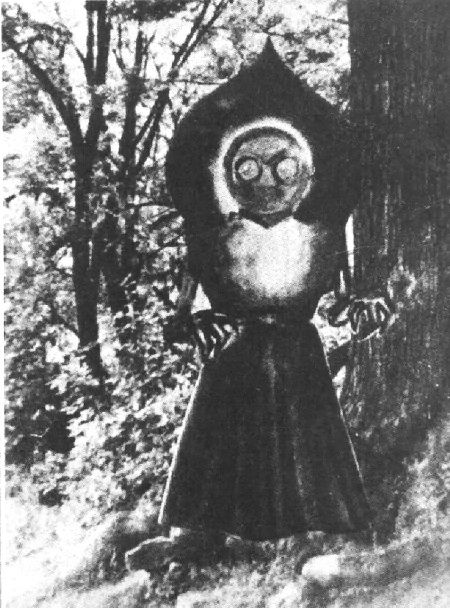
I say "almost " because there's an exception to every rule.  One of those exceptions may be the Flatwoods Monster.  In September 1952, three Virginian schoolboys saw a glowing object shoot through the night.  It came to rest on a nearby farm, upon which two of the boys immediately rushed to tell their mother.  Along with three other locals, she went to investigate, and to see what had fallen from the sky.

Navigating by flashlight, the party of four traveled through the woods.  Eventually, they reached the top of a hill -- where they found a "pulsating ball of fire".  Even more startlingly, they saw a monstrous creature gliding towards them.  It was ten feet tall, with a red face and a spade-shaped hood.  The creature had small, talonlike arms and hissed as it glided across the ground, its feet invisible between a green skirtlike garment.  Terrified, the witnesses fled down the hill, and reported their experience.

In the wake of the encounter, all the witnesses immediately became ill.  They reported a chemical mist they had smelled on the hilltop, something to which they attributed their sickness.  The doctor who examined them, evidently, had seen their symptoms before -- in victims of mustard-gas attacks.  On top of their physical problems, the Flatwoods group were all traumatized.  They reported persistent nightmares, and one was hospitalized for weeks.

It's easy to see why people call this monster an alien.  This ten-foot, spade-hooded being sounds like nothing on earth -- and it appeared alongside a fiery UFO.  In this case, extraterrestrial explanations seem to be justified.  But of course, there are always alternative theories.  Two in particular come to mind -- and they aren't mutually exclusive.  The first is that the Flatwoods witnesses merely saw a barn owl.  Before you scoff, consider this:  these owls have heart-shape faces, hiss while they fly, and often perch ten feet off the ground.  When startled, it would be easy to mistake such a bird for a monster -- especially in poor lighting.

Another theory is mass hysteria.  1952 was dubbed "The Year of the Flying Saucers" -- dozens of sightings were reported across America, and UFOs were on everybody's mind.  A meteor was seen over Virginia on the same night that the monster appeared.  Perhaps the three Virginian boys saw it, and reported it to their mother.  Upon hearing of a fiery object in the sky, she and the other witnesses jumped to conclusions -- they expected to find a spaceship, and perhaps even an alien, where the fireball had landed.

Of course, this would have made them nervous and jumpy.  You would be, too, if you were searching the woods by flashlight for a UFO!  So when they reached the top of the hill, it would have been easy for the witnesses to panic.  Perhaps they did see a barn owl, and in their paranoid state mistook it for a monster.  And what of the toxic fumes?  There may have been none at all.  Hysteria, Wikipedia notes, produces symptoms very similar to mustard gas.  The Flatwoods quartet could have been suffering from either.

There are a number of details in the Flatwoods case that are hard to explain away.  No owl has this monster's coloration, and it's hard to hallucinate a giant fireball.  I'm not convinced this cryptid was an alien -- but the idea isn't ludicrous.  The Flatwoods Monster has been sighted only once, so we may never determine its identity.  But for once, I'm willing to entertain a less natural explanation.

Read more about the Flatwoods Monster:
http://www.ufocasebook.com/Flatwoods.html
http://www.ufoevidence.org/cases/case535.htm
Image from http://www.ufoevidence.org/cases/pictures/FlatwoodsMonster.jpg

Sunday, February 2, 2014

The Altamaha-ha


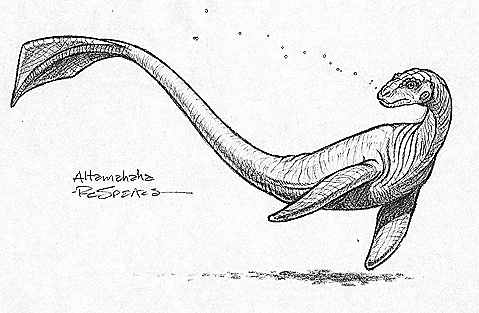
"Altie," as it's sometimes called, is a cryptid from southeastern Georgia.  First described in Native American legend, the beast has been reported for centuries -- mostly from streams near the Altamaha River.  In many ways, Altie resembles a typical lake monster.  It has a long neck, a gray hide, and a size of some 20 feet.  But this cryptid also has some less common features -- including a long, crocodilian and a dolphinlike swimming motion.  This final trait is rather striking.  All fish and reptiles propel themselves with side-to-side movements of their tails; only mammals move their flukes up and down in the water.

Is the Altamaha-ha a mammal?  And if so, what kind?  No seals and dolphins can be found in inland North America; neither of these seems a good possibility.  Perhaps this beast is a manatee -- which does, in fact, have a gray hide, and which swims in the reported manner.  Manatees can live in fresh water, unlike most other aquatic mammals, and they are present in the nearby state of Florida.

Of course, there are multiple problems with the manatee theory.  For one, Manatees are far smaller than the Altamaha-ha.  For another, they are slow and stout -- unlike this long, lithe cryptid.  Furthermore, their heads are the furthest thing from crocodilian, and they are hard to mistake for any other animal.  A more likely idea is that the Altamaha-ha is some sort of giant eel or gar.  Neither of these fish swims in a mammalian manner, but otherwise they seem to be good candidates.  Both are serpentlike and slender, both can live in fresh water, both grow to a large size and both have reptilian-looking faces.

The alligator gar is a particularly likely prospect.  These prehistoric-looking fish can grow to ten feet, and are named for their reptilian appearance.  They live in Georgia's lakes, and are thin enough to appear snakelike.  Admittedly, they swim like any other fish -- and they don't match Altie's reported length.  But if the monster is a known species, it's probably this one.  If not, who knows what it might be?  A large inland dolphin?  Cetaceans do have alligator-like teeth.  A monster eel?  They're capable of undulating in many different directions.  There's only one way to find out -- obtaining more evidence and solving the mystery.

Read more about the Altamaha-ha:
http://clatl.com/atlanta/stalking-altie-does-georgia-have-its-own-loch-ness-monster/Content?oid=3283993
http://rhettdavisboy.angelfire.com/sighting.htm
http://frontiersofzoology.blogspot.com/2011/07/altamaha-ha.html
Image from http://static4.wikia.nocookie.net/__cb20140104212938/cryptidz/images/9/9b/Altie.jpg

Tuesday, January 28, 2014

The Splinter Cat


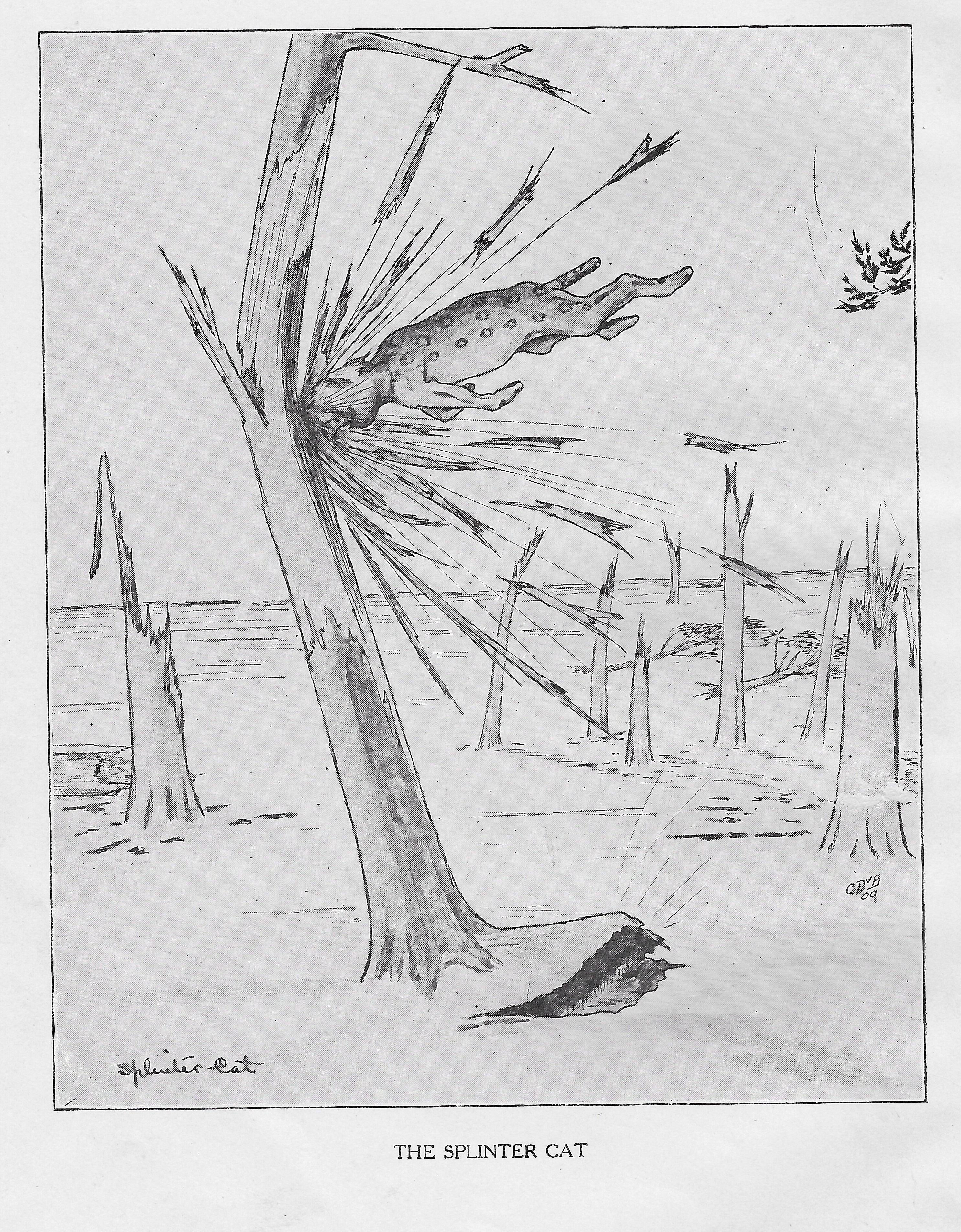
It’s time for a “fearsome critter!”  I’ve left dozens of these guys undescribed, and haven’t written one up in weeks.  Today I introduce you to the Splinter Cat-- an arboreal beast of the Pacific Northwest.  These felines cannot be distinguished from normal cats, except by their unusual behavior.  Your average tabby eats mice and cat food, but the Splinter Cat feeds on bees.

This is odd, but not unheard of in nature.  Plenty of animals eat insects, and many have adaptations to prevent stings.  No, the odd thing about the Splinter Cat isn’t its diet-- it’s how that diet is obtained.  When it gets hungry, a Splinter Cat climbs the nearest tree before leaping off into thin air.  It will then crash head-first into a nearby trunk, shattering it completely and destroying any beehives within.  The destroyed trees are often explained as lightning-strike victims.

The problem is this-- not all trees contain hives.  A Splinter Cat is thus forced to ram its way through entire groves every time it wants a meal.  This is a rather inefficient method of hunting, and not pleasant for the animal.  It's easy to see why the Splinter Cat is so ornery.  You would be too, if you had a massive headache every time you tried to eat!

Read more about the Splinter Cat:

Friday, January 24, 2014

Steller's Sea Ape


Seven decades before Lewis and Clark's journey, Vitus Bering began his Second Kamchatka Expedition.  Bering, though Danish by birth, was an officer of the Russian navy.  He was also a great explorer, who had traveled through Siberia in the 1720s.  In doing so, he conclusively proved that Russia and North America were not connected by land-- that there was open water between them.  In his second expedition, he would travel these northern seas, while mapping the unexplored Siberian coast.

Bering's 1933 expedition involved thousands of men.  Among them were many scientists, brought along to document the wildlife and geology of northern Russia.  One of them, Georg Wilhelm Steller, would become quite famous in his own right.  Steller was a naturalist, who traveled with the expedition all the way to Alaska.  Indeed, he was the first to document many Alaskan animal species-- including Steller's Eider, Steller's Eagle, Steller's Jay and the now-extinct Steller's Sea Cow.

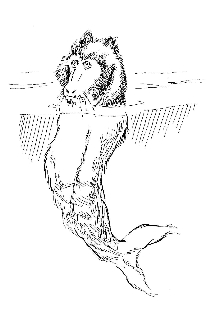
But Steller also described one less-ordinary animal-- a creature which remains a cryptid two centuries later.  He called it a "sea ape," though it has little in common with any primate.  Instead, the animal was more doglike in appearance-- with tall, pointed ears and drooping whiskers.  It was furry, intelligent, and playful-- much like an otter or seal.  But it had no limbs, and a tail like a shark.

Steller's Sea Ape is quite a cryptozoological puzzle.  It was reported by the most reliable of witnesses-- a trained zoologist, who discovered many other animal species.  Steller was known to be extremely factual and accurate in his observations, so it's unlikely that he would attempt to hoax the public.  But what did Steller see?  Most believe that the Sea Ape was a misidentified seal.  But this, to me, does not sound probable.  Steller encountered many seals during his journey, and was extremely familiar with the animals.  An amateur might mistake one for a Sea Ape-- but an explorer and naturalist would not.

No, it seems to me that there are two possibilities when it comes to the Sea Ape:  either Steller saw something in the Alaskan seas, or he made something up.  At first I thought the latter option unlikely, but recently I've changed my mind.  As I said, Steller was a talented naturalist, who I highly doubt would hoax the public.  But his descriptions of the Sea Ape were not publicly released.  They do not appear in his official expedition reports, or in the ship's log.  They can't even be found in Steller's book about the aquatic wildlife of Alaska.  Clearly, Steller himself knew that the Sea Ape wasn't reputable enough to publicize.  So why would he write about this creature in his journal?

Biologist Andrew Thaler has a theory that I personally quite like.  He points out that, during the time when Steller described the Sea Ape, the naturalist was on poor terms with Vitus Bering.  The two men had never gotten along, and tensions were especially high during the Alaskan part of the trip.  Bering, like many of the crew, was extremely sick with a disease called Scurvy.  Steller had recommended a simple cure, but the crew completely ignored him.  With the captain sick, Steller was never allowed off the ship to explore-- something that limited his work and left him highly frustrated.

Thaler suggests that this frustration manifested itself as the Sea Ape-- meant to be an insulting caricature of Vitus Bering himself.  Bering's most notable features were his moustache and pointy ears, similar to those "seen" on the Sea Ape.  But this alone is circumstantial.  To me, the incriminating evidence is this:  Steller originally named his animal the "Danish Sea Ape."  At the time, the expedition was nowhere near Denmark, and there was only one Dane on the ship:  Bering.

Bering would die of scurvy during the expedition, and Steller would perish shortly thereafter.  Steller thus had no way to explain that his "Sea Ape" was a joke-- it was taken to be a description of a real animal.  The mistake has persisted for centuries, and Steller's Sea Ape is still listed in many cryptozoology books.  In fact, it is an eighteenth-century insult, still echoing in the present day.

Read more about Steller's Sea Ape:
http://www.cryptomundo.com/cryptozoo-news/stellers-seaape/
http://www.southernfriedscience.com/?p=6968
http://www.southernfriedscience.com/?p=11327
http://www.popularsocialscience.com/2013/07/02/profiles-in-natural-history-georg-wilhelm-steller-and-the-ape-in-the-sea/
Image from http://www.cryptomundo.com/wp-content/uploads/stellers.jpg

Sunday, January 19, 2014

The Beast of Bladenboro


As 1953 came to a close, the attacks began.  Johnny Vause lost both of his dogs on New Year's Eve-- the first had most of its head torn off; the second was found half-eaten and missing its jaw.  The next day, two more dogs were killed-- and more would follow almost every day for a week.  The attacks were vicious-- often, the victims' heads were mangled, and large pieces were torn from the corpses.

Over the course of two weeks, the "Beast of Bladenboro" would claim dogs, goats, pigs and small cows.  Invariably, the bodies were horrifically mutilated.  One pet rabbit was comptetely decapitated; a goat was found dead with its skull crushed flat.  In Bladenboro, a small town, the attacks became headline news-- especially after the autopsy of one victimized dog.

This dog, according to its examiners, had been completely drained of blood.  This is not entirely unusual, nor does it imply a supernatural cause-- many predators kill victims via blood loss.  But the Bladenboro media, sensationalizing the case, nonetheless deemed the monster a "vampire."  This added to the growing climate of fear-- as did an attempted attack by the beast on a local woman.

Before long, Bladenboro's atmosphere verged on hysterical.  Posses containing hundreds of men swept the countryside looking for the monster.  Locals killed every bobcat they could find, proudly claiming each trophy as the culprit of the attacks.  (One of these bobcats is pictured above.)  Hunters traveled to the town from miles away, hoping for the chance to kill the monster.  And within two weeks, the attacks stopped-- rapidly fading into local legend.

So what was the Beast of Bladenboro?  Even at the time, countless theories abounded.  Some believed the killer to be a coyote, bobcat, wolverine or wild dog.  However, none of these animals could easily inflict the monster's trademark wounds.  A more likely explanation is that the beast was a cougar.  Mountain lions are large enough slaughter large animals-- and the footprints found in Bladenboro are cougarlike.  The screams of the Beast, like those of a mountain lion, were said to sound like an injured woman.  Furthermore, witnesses described the monster as an enormous cat-- the cougar is America's only large feline.

There is one major problem with the cougar theory-- these animals cannot be found in Bladen County, NC.  Until recently, all evidence for their presence there has been suspect and anecdotal.  A few years ago, however, a cell-phone picture was anonymously sent to the press.  It revealed what appeared to be a mountain lion, only miles from the town of Bladenboro.  Cougars are stealthy creatures, and not easily detected-- were one to be found in North Carolina, I would not be surprised.

Read more about the Beast of Bladenboro:

Saturday, January 18, 2014

The Loveland Frog


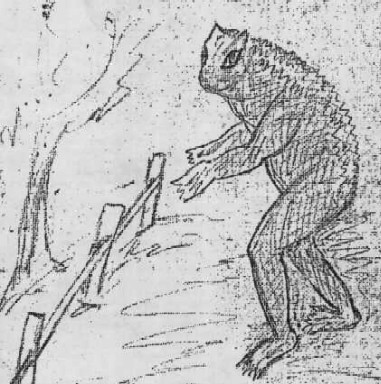
A number of cryptozoological stories deal with bipedal, reptilian monsters.  One of these is the Loveland Frog, first sighted in 1955.  At around three in the morning, while driving along a lonely road, an Ohioan businessman spotted something under a bridge.  He stopped his car and got out, observing three or four humanoid creatures hunching in the shadows.

They were, by his estimate, around three feet tall.  Each had webbed feet, leathery skin and the wide-mouthed face of a frog.  They had deep facial wrinkles instead of hair, and smelled vaguely of almonds.  The businessman watched them for several minutes, only to flee when one of them raised a mechanical wand.  This device emitted a shower of sparks, and upon seeing it the observer escaped back to his car.

The "Frog" was not seen again for nearly two decades, though stories of it lived on.  But in 1972, two Loveland police officers encountered something in the woods.  The sightings occured separately, though only months apart-- and the officers themselves reported nothing to the media.  Still, word leaked out to the press that the creature had appeared once more.

According to popular myth, the officers saw an amphibious biped like the one from '55.  Unfortunately, this could not be further from the truth.  One of the officers, after his retirement, confirmed in an interview that he saw nothing but a large lizard.  He believed it to be an escaped pet, and shot the creature  to confirm the other officer's sighting.  The body was never recovered, but the officer believes that the animal died of its wounds.

Is the Loveland Frog a legitimate cryptid, or the product of an inflated tale?  It's difficult to say.  The most recent encounters were certainly exaggerated-- and the original also stretches credibility.  A frog-like monster is one thing... a frog-like monster shooting sparks from a wand is another.  Furthermore, as Cryptomundo notes, the 1955 sighting occured shortly after the release of "The Creature from the Black Lagoon."  This movie, featuring an amphibious humanoid, could have inspired the legend of the Frog.  However, stories of reptilian humanoids abound in cryptozoology.  Their sheer numbers, if not their reliability, may give us cause to reconsider the Frog.

Read more about the Loveland Frog:
http://www.xprojectmagazine.com/archives/cryptozoology/lovelandfrog.html
http://www.cryptomundo.com/bigfoot-report/loveland-frog/
Image from http://www.cryptomundo.com/wp-content/Rana.jpg

Tuesday, January 14, 2014

The Gumberoo


Today marks my last post (for the time being) on a "fearsome critter" of lumberjack myth.  Tomorrow I'll tackle a proper cryptid.  For now, though, I give you the Gumberoo.  This creature supposedly lives on America's west coast, haunting the northwest's cedar forests.  It dwells in burned trees, emerging only to hunt and breed.

Descriptions of the Gumberoo are highly variable.  One source describes a resemblance to the black bear.   Another claims the Gumberoo has nineteen legs, and that it likes to swing in trees.  The consistent points are as follows:  this monster is black in coloration, nearly hairless, and covered in thick, rubbery hide.  The Gumberoo's skin can reflect any projectile, including bullets, back at its attackers.

Why, then, would anyone attack a Gumberoo?  First of all, it can easily be mistaken for a bear-- and second of all, the beast is dangerous in itself.  The Gumberoo has a voracious appetite, and will devour large animals in a single sitting.  No amount of food will make it ill-- as the Gumberoo's stomach can stretch to accomodate its prey.

This creature has only one weakness-- fire.  When exposed to flame or extreme heat, a Gumberoo will violently explode.  This may explain their rarity-- cedar forests are notoriously flammable.  Gumberoo detonations smell of burnt tires, which reveals an interesting fact.  Gumberoos don't imitate rubber-- their bodies contain it.

Read more about the Gumberoo:
http://www.fearsomecreaturesofthelumberwoods.com/pg11.htm
http://www.lumberwoods.com/p21.htm
Image from http://www.fearsomecreaturesofthelumberwoods.com/images/gumberoo_small.png (public domain)

The Hidebehind


No matter how much you hate your job, it has one bright side you may have forgotten.  You're very, very unlikely to be eaten by a bear.  Nineteeth-century lumberjacks had no such comfort, and they faced many other dangers to boot.  If a bear didn't get you, perhaps a falling tree would-- or a flash flood, or a forest fire, or some other disaster.  A number of grim fates were possible.

The worst of all, according to lumberjack folklore, was death by Hidebehind.  The Hidebehind was a "fearsome critter" rather different from its brethren.  While most of these folkloric beasts were comical, the Hidebehind was feared.  This was no monster to joke about-- it was a horrific murderer, used to explain mysterious disappearances.

The Hidebehind was so named because it was incredibly slender-- able to conceal itself behind even the thinnest of trees.  It would stalk its human prey through the woods, darting from trunk to trunk whenever its quarry turned his back.  When it finally came close enough to strike, the Hidebehind would gouge out the intestines of its target, consuming them raw.  Assault was so sudden that a victim might die of fright.

The one defense against the Hidebehind was alcohol.  The monster could not stomach the smell of beer, saving many inebriated lumberjacks.  A convenient excuse, certainly-- but one by which many foresters swore.  Indeed, this encouragement of drunkenness was the Hidebehind's sole redeeming trait.

Read more about the Hidebehind:
http://www.lumberwoods.com/p23.htm
http://content.wisconsinhistory.org/cdm/ref/collection/tp/id/55361
Image from http://upload.wikimedia.org/wikipedia/commons/9/92/Hidebehind.jpg (public domain)

Thursday, January 9, 2014

The Snoligoster


You'd be right to sense a pattern in my recent posts-- since I returned to this blog, I've only written about the "fearsome critters" of American folklore.  I'll be broadening my subject matter soon, but I've been reading a lot about these guys lately-- and have a few more I want to share before moving on.  One of them is the Snoligoster, an obscure monster that I learned about recently.

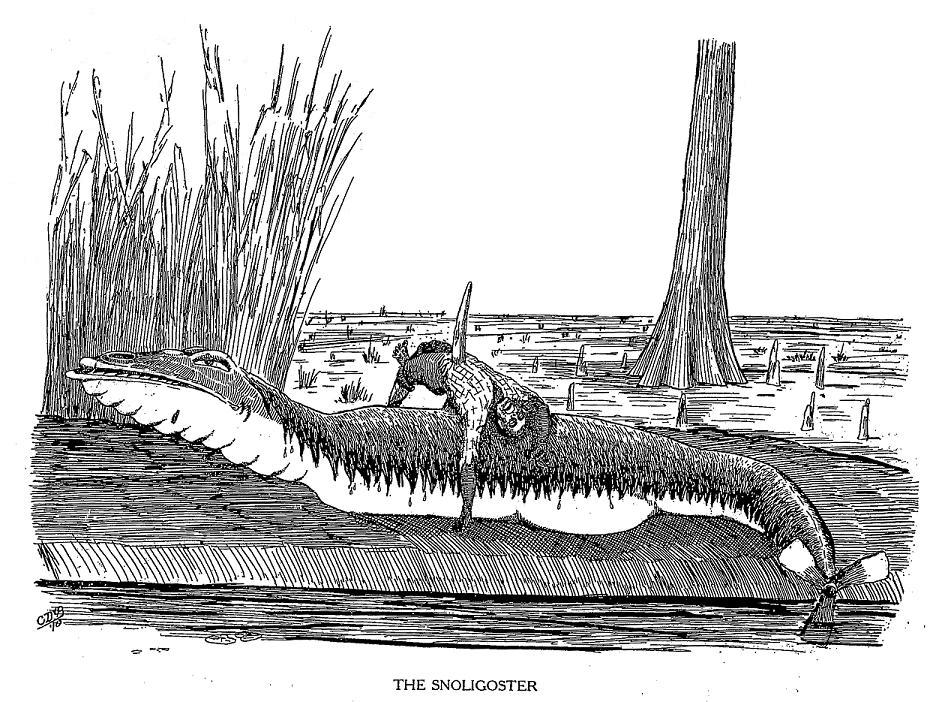
The Snoligoster is Floridian in origin, dwelling primarily in cypress swamps.  An aquatic reptile, it prefers warm climates, and spends most of its fime floating in the river.  While swimming, the Snoligoster is difficult to spy.  It looks much like a crocodile, and shares this more common animal's low profile in the water.  When it is floating on the surface, it's easy to mistake a crocodile (or a Snoligoster) for a log.

The Snoligoster, however, is a bit easier to spot.  This is due to the large, bony spike that portrudes from its back.  This natural spear is the Snoligoster's main weapon, used to impale prey and carry it off.  The Snoligoster prefers to eat human flesh, and will sneak up behind some poor soul before stabbing him and swimming away.  Once its victim stops struggling, the Snoligoster buries him in the riverbank and feasts.

Before eatings its meal, the Snoligoster pounds it to a pulp with its three-bladed, propellor-like tail.  The monster has no limbs, and requires this unusual appendage to move through the water.  In fact, it can move far more rapidly than a crocodile-- allowing it to catch victims by surprise.  The Snoligoster's tail can also be used as a club, battering enemies too evasive to stab.

Read more about the Snoligoster:
http://www.fearsomecreaturesofthelumberwoods.com/pg15.htm
Image from http://www.fearsomecreaturesofthelumberwoods.com/images/snoligoster.jpg (public domain)