Showing posts with label Fearsome Critters. Show all posts
Monday, March 3, 2014
The Hugag
The Hugag is a "fearsome critter" of the Great Lakes region. Superficially resembling a moose, this hairy quadruped can weigh in excess of three tons. It has toes instead of hooves, and a long, horselike tail. But there all comparison to normal creatures must end. The Hugag has a number of bizarre traits not seen in other mammals. For one, its head is completely bald -- though the rest of its body is shaggy. For another, its ears are corrugated like the tail of an Anhinga. The purpose of these features is completely unknown.
The Hugag's strangeness does not end there. Also unusual is the animal's upper lip -- which is swollen to such proportions that it hangs near the ground. This lip is used to scrape needles and twigs off of pine trees. The Hugag eats some of these needles, while covering itself with others in place of hair. These needles are held in place by pine-sap, which oozes from the Hugag's pores.
This beast's most unusual feature is the jointlessness of its legs. All four are completely rigid, unable to bend in any direction. The Hugag is thus an extremely awkward traveler, rocking back and forth as it waddles through the forest. If it ever lay down, the Hugag could not stand again -- and so it is forced to sleep standing up. To accomplish this, it leans against one of the pine trees off which it feeds.
Hunters, noticing this habit, developed a method to hunt the creature. They would pay attention to which trees the Hugag frequented -- identifiable due to their lack of pine-needles and bent posture. These trees would be sawed partially in half, so that they remained standing but were extremely unstable. When the Hugag next leaned against one of these trees, trunk and animal would both crash to the ground. The hunters, lying in wait, would then slaughter the helpless beast.
Read more about the Hugag:
http://www.fearsomecreaturesofthelumberwoods.com/pg9.htm
http://www.lumberwoods.com/p29.htm
Image (public domain) from http://www.fearsomecreaturesofthelumberwoods.com/images/hugag.jpg
Sunday, March 2, 2014
The Funeral Mountain Terrashot
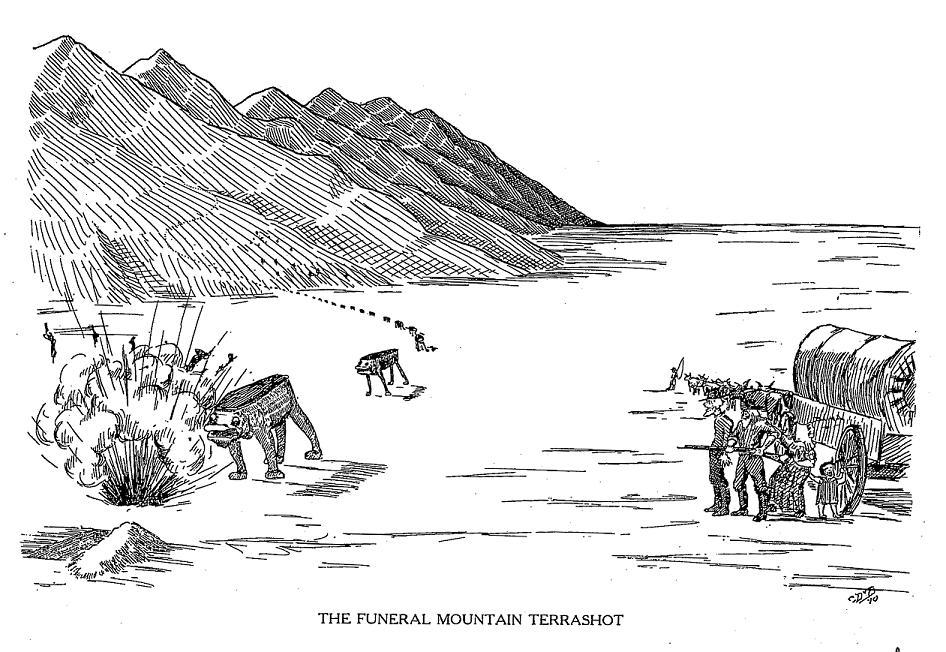
I've posted about several folkloric creatures in the last few days. Many of these "fearsome critters" were jokes, but others were used to explain everyday phenomena. Today, we cover the Funeral Mountain Terrashot -- which provides an example of folk etymology. It was invented, so it seems, to explain the name of California's Funeral Range. And its story is about as bizarre as you'll see on this blog.
The Funeral Mountain Terrashot resembles a living coffin. It waddles around the mountains on four stumpy legs, wobbling precariously from side to side. It is easy for the beast to tip over -- though as we'll see, that's the least of its traveling problems. Normally, the Terrashot dwells in peace, gathering and breeding in alpine meadows. But when its population grows sufficiently large, the creature's migratory instincts set in. At this point, the entire Terrashot clan leaves the mountains, trundling in a single-file line across the desert.
These migrations, unfortunately, are very short-lived. When a Terrashot touches the desert's hot sands, it begins to swell uncontrollably. Eventually, it explodes like a shotgun shell in a cloud of brimstone. Even after seeing the death of their leader, the other Terrashots march on like lemmings. One after the other, each creature detonates, punching a grave-shaped hole into the sand.
Supposedly some mormons witnessed this abortive migration and named the Funeral Range after the phenomenon. No Terrashots have been seen since; perhaps the last of them were struck by fatal wanderlust. Only their name lives on -- or so the story goes.
Read more about the Funeral Mountain Terrashot:
http://www.fearsomecreaturesofthelumberwoods.com/pg19.htm
Image (public domain) from http://www.fearsomecreaturesofthelumberwoods.com/images/terrashot.jpg
Friday, February 28, 2014
The Wapaloosie
The Wapaloosie is another "fearsome critter" invented by 19th-century lumberjacks. In this case, though, the term doesn't seem fitting -- the Wapaloosie isn't frightening at all. In fact, the diminutive beast is completely harmless. Physically, it resembles a mouse, combined with the long body of a dachshund. It climbs trees by arching its spine like an inchworm, moving slowly but surely up the trunk. Though it lacks a squirrel's speed, the Wapaloosie is more sure-footed, due to spiked toes that prevent it from falling.
The Wapaloosie puts these adaptations to good use. In fact, it has to -- the creature only feeds on tree-dwelling fungi. Sometimes these grow far above the ground, so the Wapaloosie would starve were it not a good climber. The animal's tree-scaling behavior is so important that it has become instinctual. It is said to climb during its sleep, as soon as it's born, and even (most strangely of all) after death.
The story goes that an enterprising woodsman shot a Wapaloosie looking to make some mittens. Unfortunately, despite the creature's soft fur, these turned out to be completely useless. As soon as the lumberjack picked up his axe, the gloves crawled off his hands and up the wooden handle. Whenever he would rest his hand on a tree, the gloves would leap off and try to scale it. Eventually, he was forced to abandon them in a ditch -- and last saw them climbing over fallen logs.
Read more about the Wapaloosie:
http://www.fearsomecreaturesofthelumberwoods.com/pg25.htm
Image (public domain) from http://www.fearsomecreaturesofthelumberwoods.com/images/wapaloosie_small.png
Thursday, February 27, 2014
The Argopelter
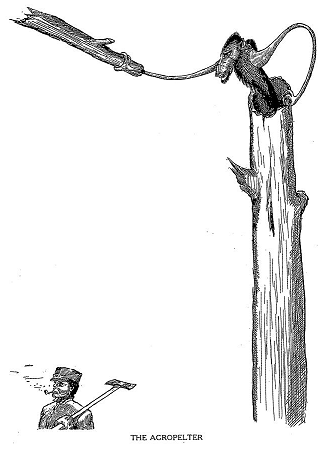
The Argopelter is a "fearsome critter" -- a folkloric beast of America's back-country. In the 19th century, it reputedly terrorized loggers and lumberjacks, attacking them when they intruded on its habitat. Physically, this creature was not intimidating -- it was thin, lanky and monkey-like. But don't let its appearance fool you. The Argopelter was a lethal menace, and a master of projectile warfare.
This critter was completely arboreal, living and sleeping within the treetops. By night, it would sleep in woodpecker holes, feeding upon the owls that sometimes dwelled there. By day, it would climb out onto a branch and wait for passerby. When one came near, the Argopelter would break off a rotting chunk of wood, whirling it around its head at high speed. Finally, it would let go, launching its weapon and striking the "trespasser" dead.
Generally, an Argopelter attack was never seen coming. A lumberjack would vanish into the woods, seeking a tree to cut, and simply wouldn't come back. Eventually, his comrades would come searching -- to find only his body, crushed beneath a fallen branch. Most would call this a freak accident, unsuspecting of the real culprit. The Argopelter, meanwhile, would lie in wait -- until another victim came into range.
As a side-note, I've always wondered the source of the Argopelter's name. I've never seen one recorded, but I've come up with my own pet theory. The Argo is a ship of Greek legend -- a wooden vessel that carried many great heroes. Eventually, though, the boat began to decay and was taken out of service. Its former captain, Jason, still visited the vessel -- until he was killed when its prow fell off and crushed him. Perhaps the name "Argopelter" is a reference to this story. Death by rotting wood sounds awfully familiar.
Read more about the Argopelter:
http://www.fearsomecreaturesofthelumberwoods.com/pg35.htm
http://www.fearsomecreaturesofthelumberwoods.com/p3.htm
Image (public domain) from http://www.fearsomecreaturesofthelumberwoods.com/images/agropelter_small.png
Tuesday, January 28, 2014
The Splinter Cat
It’s time
for a “fearsome critter!” I’ve left
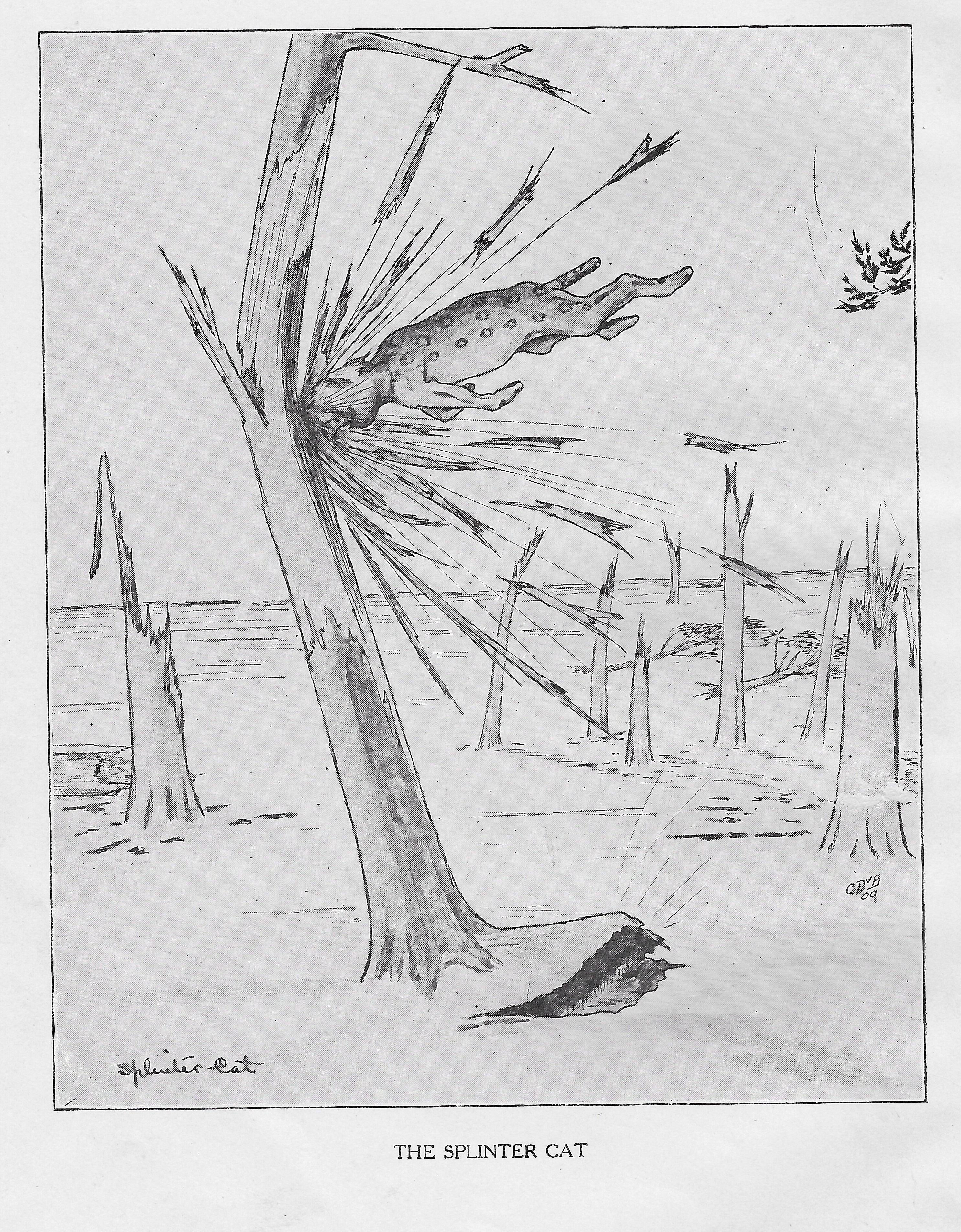
dozens of these guys undescribed, and haven’t written one up in weeks. Today I introduce you to the Splinter Cat--
an arboreal beast of the Pacific Northwest.
These felines cannot be distinguished from normal cats, except by their
unusual behavior. Your average tabby
eats mice and cat food, but the Splinter Cat feeds on bees.
This is odd, but not unheard of in nature.
Plenty of animals eat insects, and many have adaptations to prevent
stings. No, the odd thing about the
Splinter Cat isn’t its diet-- it’s how that diet is obtained. When it gets hungry, a Splinter Cat climbs
the nearest tree before leaping off into thin air. It will then crash head-first into a nearby
trunk, shattering it completely and destroying any beehives within. The destroyed trees are often explained as lightning-strike victims.
The problem
is this-- not all trees contain hives. A
Splinter Cat is thus forced to ram its way through entire groves every time it
wants a meal. This is a rather
inefficient method of hunting, and not pleasant for the animal. It's easy to see why the Splinter Cat is so ornery. You would be too, if you had a massive headache every time you tried to eat!
Read more
about the Splinter Cat:
Tuesday, January 14, 2014
The Gumberoo
Today marks my last post (for the time being) on a "fearsome critter" of lumberjack myth. Tomorrow I'll tackle a proper cryptid. For now, though, I give you the Gumberoo. This creature supposedly lives on America's west coast, haunting the northwest's cedar forests. It dwells in burned trees, emerging only to hunt and breed.
Descriptions of the Gumberoo are highly variable. One source describes a resemblance to the black bear. Another claims the Gumberoo has nineteen legs, and that it likes to swing in trees. The consistent points are as follows: this monster is black in coloration, nearly hairless, and covered in thick, rubbery hide. The Gumberoo's skin can reflect any projectile, including bullets, back at its attackers.
Why, then, would anyone attack a Gumberoo? First of all, it can easily be mistaken for a bear-- and second of all, the beast is dangerous in itself. The Gumberoo has a voracious appetite, and will devour large animals in a single sitting. No amount of food will make it ill-- as the Gumberoo's stomach can stretch to accomodate its prey.
This creature has only one weakness-- fire. When exposed to flame or extreme heat, a Gumberoo will violently explode. This may explain their rarity-- cedar forests are notoriously flammable. Gumberoo detonations smell of burnt tires, which reveals an interesting fact. Gumberoos don't imitate rubber-- their bodies contain it.
Read more about the Gumberoo:
http://www.fearsomecreaturesofthelumberwoods.com/pg11.htm
http://www.lumberwoods.com/p21.htm
Image from http://www.fearsomecreaturesofthelumberwoods.com/images/gumberoo_small.png (public domain)
The Hidebehind
No matter how much you hate your job, it has one bright side you may have forgotten. You're very, very unlikely to be eaten by a bear. Nineteeth-century lumberjacks had no such comfort, and they faced many other dangers to boot. If a bear didn't get you, perhaps a falling tree would-- or a flash flood, or a forest fire, or some other disaster. A number of grim fates were possible.
The worst of all, according to lumberjack folklore, was death by Hidebehind. The Hidebehind was a "fearsome critter" rather different from its brethren. While most of these folkloric beasts were comical, the Hidebehind was feared. This was no monster to joke about-- it was a horrific murderer, used to explain mysterious disappearances.
The Hidebehind was so named because it was incredibly slender-- able to conceal itself behind even the thinnest of trees. It would stalk its human prey through the woods, darting from trunk to trunk whenever its quarry turned his back. When it finally came close enough to strike, the Hidebehind would gouge out the intestines of its target, consuming them raw. Assault was so sudden that a victim might die of fright.
The one defense against the Hidebehind was alcohol. The monster could not stomach the smell of beer, saving many inebriated lumberjacks. A convenient excuse, certainly-- but one by which many foresters swore. Indeed, this encouragement of drunkenness was the Hidebehind's sole redeeming trait.
Read more about the Hidebehind:
http://www.lumberwoods.com/p23.htm
http://content.wisconsinhistory.org/cdm/ref/collection/tp/id/55361
Image from http://upload.wikimedia.org/wikipedia/commons/9/92/Hidebehind.jpg (public domain)
Thursday, January 9, 2014
The Snoligoster
You'd be right to sense a pattern in my recent posts-- since I returned to this blog, I've only written about the "fearsome critters" of American folklore. I'll be broadening my subject matter soon, but I've been reading a lot about these guys lately-- and have a few more I want to share before moving on. One of them is the Snoligoster, an obscure monster that I learned about recently.
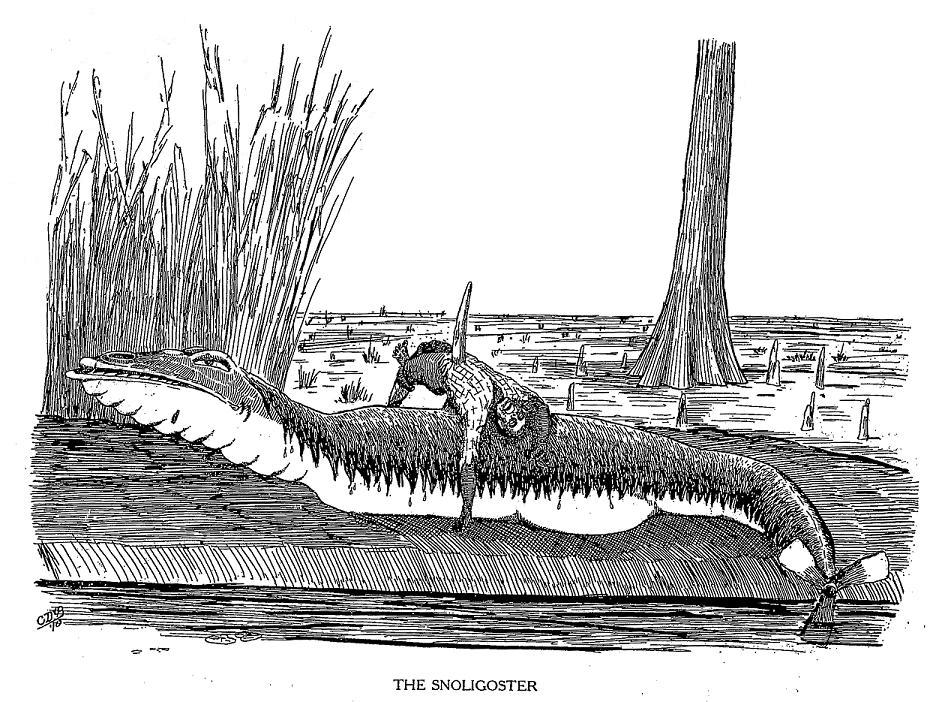
The Snoligoster is Floridian in origin, dwelling primarily in cypress swamps. An aquatic reptile, it prefers warm climates, and spends most of its fime floating in the river. While swimming, the Snoligoster is difficult to spy. It looks much like a crocodile, and shares this more common animal's low profile in the water. When it is floating on the surface, it's easy to mistake a crocodile (or a Snoligoster) for a log.
The Snoligoster, however, is a bit easier to spot. This is due to the large, bony spike that portrudes from its back. This natural spear is the Snoligoster's main weapon, used to impale prey and carry it off. The Snoligoster prefers to eat human flesh, and will sneak up behind some poor soul before stabbing him and swimming away. Once its victim stops struggling, the Snoligoster buries him in the riverbank and feasts.
Before eatings its meal, the Snoligoster pounds it to a pulp with its three-bladed, propellor-like tail. The monster has no limbs, and requires this unusual appendage to move through the water. In fact, it can move far more rapidly than a crocodile-- allowing it to catch victims by surprise. The Snoligoster's tail can also be used as a club, battering enemies too evasive to stab.
Read more about the Snoligoster:
http://www.fearsomecreaturesofthelumberwoods.com/pg15.htm
Image from http://www.fearsomecreaturesofthelumberwoods.com/images/snoligoster.jpg (public domain)
Wednesday, January 8, 2014
The Squonk
Lumberjack folklore of the 1800s is rife with "fearsome critters"-- creatures invented to amaze and amuse. Not all of them, however, are fearsome. The Squonk may be the least intimidating of all, despite its repellant looks. The creature's face is warped and twisted, and its skin hangs like a loose, wrinkled bag. It is covered with warts, pustules, blemishes and scars. Its color is a sickening brown, and its eyes bulge out from its face.
The Squonk is, in fact, so ugly that it cannot bear to look at its reflection. This sad little beastie is perpetually ashamed of its own appearance, and spends all of its time weeping in shame. Most animals flee from their predators-- instead, the Squonk flees from all who might see it, for fear of their mocking its hideousness. This self-consciousness makes the Squonk extremely hard to catch, and sightings of it are rare. More often than not, the beast's presence is only revealed by the sound of its tears.
Unfortunately for the Squonk, its constant crying makes it very easy to track. Hunters in the woods can simply listen to its wailing or follow the trail of its tears-- which inevitably leads to wheverer the beast is hiding. This method works best on moonlit nights, when the Squonk sees its appalling reflection upon the rivers where it drinks. This is when it sobs the most.
But this beast's self-hatred is also its best defense. Though easily captured, the Squonk is almost impossible to retain-- for when trapped, the poor creature grows even sadder. The Squonk cries so hard, at the thought of being seen, that it dissolves into a pool of its own tears. One hunter managed to bring a Squonk home in a sack-- or so he thought. Upon reaching home, he had no trophy to mount on his wall... instead, he had a puddle to clean off his floor.
Read more about the Squonk:
http://www.lumberwoods.com/p49.htm
http://www.sarahsawyer.com/2011/02/mythic-creature-the-squonk-and-others/
Image from http://www.fearsomecreaturesofthelumberwoods.com/images/squonk.jpg (public domain)
The Cactus Cat
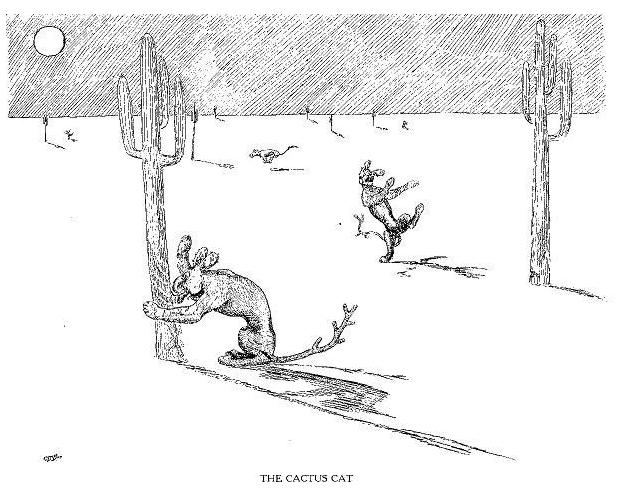
The Cactus Cat is a "fearsome critter" of the American southwest; a folkloric creature that both resembles and feeds from its namesake. In most respects, it resembles a standard bobcat or wildcat. Its fur, however, is composed of thin, cactus-like spines. These spines are longest and sharpest on the ears and tail, which are long and branched like a cactus.
The Cactus Cat is also equipped with blade-like bones that extend from its forelegs. These blades not weapons; the Cactus Cat prefers to scourge its enemies with its tail. Instead, they are used to cut into cacti. Water is scarce in the deserts of the southwest, but cacti store large amounts of it in their pulp. This facts has saved many a desert traveler; by gouging into a cactus, they can obtain the water that saves their lives. The Cactus Cat also drinks in such a manner, lacerating the local plants whenever it grows thirsty.
Interestingly, a thirsty Cactus Cat does not drink immediately. Instead, it cuts open a number of different cacti in the same area of desert. It then revisits each of the cacti it has slashed, once the watery pulp within has fermented into alcohol. Only then does the Cactus Cat quench its thirst, before running off into the desert yowling with drunken joy.
Read more about the Cactus Cat:
http://www.lumberwoods.com/p9.htm
http://www.weirdca.com/location.php?location=166
Image from http://img-fotki.yandex.ru/get/5701/botev.a/0_54e94_3ecbd6c3_XL.jpg (public domain)
The Tripodero
A beast of Californian folklore, the Tripodero is not a proper cryptid. Rather, it's another "fearsome critter"-- an animal featuring in 19th-century tall tales. Lumberjacks and pioneers would tell greenhorns about these monsters, inventing ever more outrageous stories for amusement. One of the least probable-- but most entertaining-- concerns the Tripodero.
Despite its name, the Tripodero does not have three legs-- this is a common misconception. In fact, it has only two, along with a long, kangaroo-like tail. Using these three appendages, the Tripodero can stand with perfect balance, surveying its surroundings without the slightest wobble. From this viewpoint it can spot its preferred prey (small birds and mammals) before preparing to hunt it down.
The Tripodero is not an especially fast mover-- but it can run down its target with alarming speed. This is largely due to the creature's telescoping legs, which can reach ten feet in length when fully extended. The Tripodero can also retract its limbs when it needs to hide-- for example, from a predator, or from a hunter trying to capture the mysterious beast. With its legs fully drawn into its body, the Tripodero can slither through the undergrowth like a snake.
Even if the Tripodero is outrun, its prey never manages to escape. For the creature's most unusual trait is not its elongating legs, but its method of hunting. The Tripodero stores small globs of mud in its cheeks, which it can then shoot through its long snout like bullets. These mud-pellets are launched with incredible accuracy-- the Tripodero can adjust for wind, distance and drift when firing. Furthermore, due to its great balance, the monster's aim is perfectly steady. Once struck, a prey-animal will be knocked out cold-- allowing the Tripodero to dispatch it.
Read more about the Tripodero:
http://www.museumofhoaxes.com/hoax/animals/comments/tripodero
http://www.lumberwoods.com/p57.htm
http://www.fearsomecreaturesofthelumberwoods.com/pg45.htm
Image from http://www.lumberwoods.com/images/tripoderox.jpg (public domain)
Tuesday, January 7, 2014
The Side-Hill Gouger
The Side-Hill Gouger is a "fearsome critter;" one of the monstrous denizens of American tall tales. It is named for its most unique behavior-- every day, it walks the same circular path around the hilltop where it lives. Hundreds of times it repeats this journey, and in doing so, it gouges a trail into the mountainside. But even stranger than the Gouger's lifestyle is the reason behind it. Each Gouger has longer legs on one side of its body.
There are two varieties of the Side-Hill Gouger-- one with longer legs on the right, and one with longer legs on the left. The left-legged ones are forced to walk clockwise around mountains, while the opposite is true for their right-legged counterparts. If ever a Gouger tries to turn around, or to walk in the wrong direction, it will disbalance and tumble downhill. It will then find itself on solid ground, where it will be unable to walk properly. A thusly-stranded Gouger is easy prey for hunters and other predators.
The two types of Gouger are not, in fact, different species. The two can interbreed, and even produce offspring. Unfortunately, this often leads to tragedy. A left-legged Gouger may give birth to a right-legged son-- who would be forced to walk in the opposite direction, only rarely encountering its parent. Even worse, a hybrid gouger may be born with one longer left leg and one longer right leg. Such an animal would be unable to find sound footing anywhere, and would surely not survive.
Read more about the Side-Hill Gouger:
http://www.princeton.edu/~achaney/tmve/wiki100k/docs/Sidehill_gouger.html
http://www.lumberwoods.com/p39.htm
http://www.museumofhoaxes.com/hoax/animals/comments/sidehill_gouger/
Image from http://www.lumberwoods.com/images/sidehillgouger.jpg (public domain)
Monday, January 6, 2014
The Hodag
By the late 19th century, America had been settled coast to coast-- but not all of it had been explored. It was easy to imagine monsters lurking in the nation's millions of acres of untouched forest. And imagine people did. Hunters and lumberjacks, on their trips back from the wild, brought with them fantastic tales of the Jackalope, Guyascutus, and Fur-Bearing Trout. These creatures were completely fictional, created for amusement at the expense of the gullible. Yet many of them became iconic parts of American folklore.
One such creature is the Hodag, made famous in 1893 by a surveyer and practical joker named Gene Shepard. It is unclear whether Shepard invented the beast; some stories indicate that it already existed within local legend. But this much is certain: Shepard made the Hodag a media sensation after he claimed to have killed one with dynamite. He backed up his claims with a photograph, which he had forged and sent to local newspapers. And three years later, Shepard repeated his stunt, claiming to have encountered another Hodag and captured it. This "monster"-- in fact, a model-- was displayed at a county fair and moved around via puppet-strings.
The hoax fell apart after scientists from the Smithsonian threatened to investigate. In any case, it had never been particularly convincing. Shepard claimed that his beast was on the verge of extinction, due to the rarity of its only prey-- white bulldogs. Other sources attributed it the ability to breathe fire, a deathly fear of lemons, and the habit of crying at its own appearance. The sheer unlikelihood of this creature-- even before its exposure as a fraud-- made it hardly a "cryptid" at all.
But to the people of Rhinelander, Wisconsin, the Hodag's blatant falsehood matters little. The creature was first "discovered" there in 1893, and has served as the town's symbol for decades. It appears in tourism ads, as the local high school's mascot, and in the form of a gigantic fiberglass statue. Every year, the town holds a "Hodag country" music festival to celebrate its local monster. This creature is more famous than many real animals-- not bad at all for a wire-operated puppet.
Read more about the Hodag:
http://www.lumberwoods.com/hodag1.htm
http://www.environmentalgraffiti.com/featured/where-wild-things-legend-behind-hodag/16295
http://www.explorerhinelander.com/what-is-the-hodag/
Image from http://upload.wikimedia.org/wikipedia/en/4/40/The_hodag.jpg (public domain)
Subscribe to:
Posts (Atom)