Showing posts with label Australia. Show all posts

Tuesday, February 25, 2014

The Zuiyo-Maru Creature


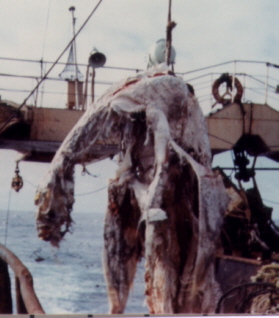
In 1977, the Zuiyo-Maru caught itself a sea monster.  This Japanese trawler was looking for mackerel -- but what it found in its net was something else entirely.  The creature was long dead and badly decomposed.  Most of its flesh had rotted away, and its skeleton was clearly visible.  Still, the animal looked like nothing else on earth.  It was thirty feet long -- too big to be anything but a shark or whale.  Yet it resembled neither.  Its most distinguishing traits were its long neck and large fins -- which made it, more than anything, resemble a plesiosaur.

Unfortunately, the Zuiyo-Maru carcass was never brought to shore.  Concerned it would spoil his fish, the captain had it tossed overboard -- after the crew took photographs.  One of these (seen above) was widely publicized as evidence of surviving plesiosaurs.  It caused a media sensation, and sparked the interest of countless cryptozoologists.  According to recent studies, though, it's not a reptile at all.  It seems most likely that the Zuiyo-Maru caught a dead basking shark.

If you've ever seen a basking shark, you're probably very skeptical.  They're bulky, thick-headed, giant-mouthed filter-feeders -- in short, they look nothing like the picture above.  The key point to note, though, is how basking sharks decay.  Most animals, after death, "fall apart" in a specific sequence.  The study of decomposition is called taphonomy, and it can tells us a lot about the Zuiyo-Maru's find.

A basking shark's corpse distinegrates head-first.  The giant lower jaw sloughs off, separating from the rest of the body.  The fat, fleshy portions slide away from the skeleton -- leaving an emaciated carcass behind.  This carcass seems to have a long "neck" with a small head -- but in fact, this "head" is just the brain case.  The animal's jaws are long gone; in effect, the corpse has been decapitated.  A dead basking shark is a dead ringer for this cryptid.

This idea didn't convince everyone -- some were sure that the Zuiyo-Maru had found a sea serpent.  They pointed to purported discrepancies seen in the photograph -- features that a basking shark shouldn't have.  Eventually, though, testing of the monster's flesh revealed its identity.  According to amino acid tests, the carcass was indeed a shark.  Could plesiosaurs still be out there?  Many cryptozoologists think so.  But the Zuiyo-Maru's monster isn't one of them.

Read more about the Zuiyo-Maru Creature:
http://paleo.cc/paluxy/plesios.htm
http://bizarrezoology.blogspot.com/2013/10/zuiyo-maru-carcass-shark-or-unknown.html
http://frontiersofzoology.blogspot.com/2013/12/zuiyo-maru-addendum-and-rebuttal.html
Image (public domain) from http://upload.wikimedia.org/wikipedia/en/4/4e/Zuiyo_Maru.jpg

Friday, February 21, 2014

The Kumi Lizard


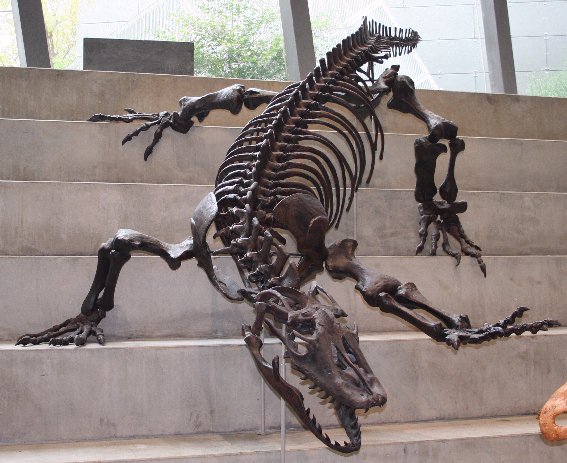
The monitor of Komodo is a dragon indeed.  At ten feet long, it's Earth's largest lizard -- and certainly its most dangerous.  the Komodo dragon is a mighty predator, capable of taking down water buffalo.  This isn't due to strength alone -- the creature is venomous, and can poison its prey with a bite.  Impressed?  You should be -- the Komodo dragon is truly the king of the lizards.  But this crown, as paleontologists know, has been recently earned.  Only 30,000 years ago, it belonged to a much larger and deadlier species.

Its name was Megalania.  A neighbor of the Komodo dragon, it lived in prehistoric Australia alongside many other extinct species.  During the Pleistocene, Australia's animals were huge -- much larger than anything seen there today.  Megalania could exceed twenty-three feet; its prey included ten-foot wombats and thousand-pound kangaroos.  Around 30,000 years ago, all of these "megafauna" disappeared -- right when humans arrived on the continent.  Few scientists think this is a coincidence.  A popular theory is that humans overhunted these animals -- driving Megalania to extinction.

But some are convinced that the beast still lives.  They point to tales of the "Kumi Lizard" -- a reptilian cryptid of New Zealand.  It lives in trees, so it's said, and is about five feet long.  The creature has been sighted as recently as the '70s, and is far larger than the island's other lizards.  Is Megalania's survival possible?  Perhaps, but it's not likely.  On the plus side, New Zealand has plenty of undeveloped land, and a giant reptile would not lack for habitat.  But on the other hand, what would Megalania eat?  There are no giant wombats in New Zealand -- only thousands of sheep, which would surely be noticed if they went missing.

Furthermore, the Kumi Lizard sounds nothing like Megalania.  The latter is four times the cryptid's length -- nothing that size could climb a tree.  Furthermore, Megalania was not native to New Zealand.  Could it have swum there from Australia?  Maybe -- several monitor lizards are semi-aquatic.  But that's an awfully long distance, and would challenge heavy reptiles.

Unfortunately, Megalania seems to be truly extinct.  But that doesn't debunk the Kumi Lizard.  There are two other theories that might explain this cryptid, and both of them are far more likely.  First of all, the creature might be a crocodile monitor.  This species is a powerful swimmer, and lives on nearby New Guinea.  It's a much better seafarer than Megalania -- perhaps it once reached New Zealand.  Furthermore, it's close to the Kumi in size -- adults can reach reach eight feet, and they're fairly decent climbers.

Alternatively, the Kumi Lizard might be a new species.  There are several monitors living in Oceania; an undiscovered type isn't impossible.  If such a species existed, it would belong to the genus Varanus.  That would make it a smaller cousin of the Komodo dragon -- and, of couse, of Megalania.

Read more about the Kumi Lizard and Megalania
http://nzcryptozoologist0.tripod.com/id20.html
http://www.paranormalinvestigators.org.nz/home.php?page=cryptozoology&id=14
http://picsandstuff.wordpress.com/2011/09/27/the-mysterious-kumi-1898/
http://www.bbc.co.uk/nature/wildfacts/factfiles/3046.shtml
http://animaldiversity.ummz.umich.edu/accounts/Varanus_komodoensis/
Image (of Megalania skeleton, public domain) from http://upload.wikimedia.org/wikipedia/commons/0/07/Varanus_priscus_Melbourne_Museum.jpg

Thursday, August 7, 2008

Bunyip


The Bunyip is a difficult beast to describe, as accounts of it vary from witness to witness. It features prominantly in Aboriginal mythology, and from all accounts it is a beast to be feared. This creature dwells in lakes, and is massive. They dwell in billabongs and come out at night, devouring any creature that comes near their watery abodes. They emit a loud, terrifying roar, and some major features that almost all accounts include are flippers, a horselike tail, and walruslike tusks. As its habitat is vanishing and since it has been sighted less and less over the years, the Bunyip may now be extinct. It is hard to say what the bunyip may be or have been, but one theory is that it is an example of prehistoric Austalian megafauna that managed to survive into the present day. The prehistoric beast Diprotodon is similar to the classic Bunyip in appearance and may be responsible for sightings of the monster.

Thylacine


The Thylacine or Tasmanian Tiger was a marsupial that resembled a wolf. It was overhunted after gaining a false reputation as a poultry thief, and the last one known to science died in 1936 in a Tasmanian zoo. Ever since, though, these creatures have been frequently sighted in the wild in both Tasmania and Australia, signalling that perhaps these animals have not died off after all. There are a number of rewards for proof that this animal still lives, and alleged photos from after 1936 exist. However, the issue is yet to be decided either way, as no bodies or captured Thylacines have surfaced since the death of the last one in a zoo. If the cryptid exists, it probably only does so in very small numbers away from major human developments-- perhaps in small colonies in the outback, for example. If the animal still lives, humanity may have a second chance to prevent its complete destruction.

Blue Mountain Panther and Gippsland Phantom Cat


These two cryptids are both large puma-like cats that dwell in Australia. The Blue Mountain Panther is in fact a localized form of the second beast that only dwells in the more mountainous regions of the continent. There is much evidence that these creatures exist, as their footprints and hair have been found in Australia for over a century. Even recently, a hunter shot a large cat in the range of the Gippsland Phantom Cat and cut off its tail. When DNA tested, the tail was a perfect match for a large feral cat of some sort. Authorities cannot prove that these creatures exist, but even they concede that it is more likely than not. These creatures are probably not native, but instead a small population of a creature such as a mountain lion or panther that was imported, escaped, and bred to form a small population.