Showing posts with label Asia. Show all posts
Saturday, May 17, 2014
The Umibozu
Yokai are Japanese spirits that range from harmless to monstrous. Some dwell in the woods, some dwell among the clouds, and some (like the Umibozu ) dwell underwater. The Umibozu resembles a gigantic mound of black flesh -- smooth and hairless like a shaven head. This trait gives the yokai its name, which translates to "sea monk". Unlike its namesake, the Umibozu is far from harmless. It menaces ships that pass nearby, rising from the sea without warning. It will then wreck the helpless vessel, dragging all onboard to a watery grave.
Thankfully, attacks by the Umibozu can be avoided. Usually, the yokai remains submerged, and might not attack unless provoked. While sailing, it is best not to speak its name -- a surefire way of summoning it forth. If an Umibozu does attack, it may not sink its target directly. Sometimes, it will ask for a barrel, which it will fill with water and use to flood the ship. If an Umibozu makes such a request, give it a barrel filled with holes -- the creature will be unable to collect water, and will leave in frustration. This beast, evidently, is not one of the smartest yokai.
Through the years, many explanations have been proposed for the Umibozu legend. These range from natural phenomena like rogue waves and storm clouds to living beings -- like sea turtles and jellyfish. The theory I find most believable equates the Umibozu to a large octopus. The heads of these creatures look extremely similar, with a saclike structure and bulging eyes. Furthermore, the Umibozu's torso bears long, scrawny limbs -- which greatly resemble octopus tentacles.
Read more about the Umibozu:
http://www.markburrier.com/illustration/umibozu/
http://hyakumonogatari.com/2012/02/21/umi-bozu-the-sea-monk/
Image (public domain) from http://upload.wikimedia.org/wikipedia/commons/6/69/Kuwana_-_The_sailor_Tokuso_and_the_sea_monster.jpg
Tuesday, March 11, 2014
Post Revamp: the Buru
The Himalayas are home to the Yeti, one of Earth's most famous cryptids. But the western part of this mountain range once contained a lesser-known beast. This aquatic creature, known as the Buru, dwelled in the river valleys of eastern India. According to locals, it has been extinct for decades, but lived recently enough to be clearly remembered.
The Buru, it is said, was a reptilian creature between ten and fifteen feet long. It had a long neck and forked tongue, along with claw-like feet well adapted for digging. The beast had fish-like skin, a rounded tail and a flat snout behind which lay its eyes. For a time, the Buru coexisted with the Indian inhabitants of its valleys. But eventually, it came to be seen as dangerous, and the species was exterminated. The marshes where it dwelled were drained, and its watery homes were filled with boulders. No Buru has been seen since.
To most cryptozoologists, the Buru's traits suggested an aquatic monitor lizard. Some of these lizards, like the Komodo dragon, can exceed ten feet in length -- and prehistoric varieties like Megalania grew even larger. Furthermore, fossil monitors lived in India, meaning that finding one in the region wouldn't be improbable. The downside of the monitor theory is that these lizards don't live in the water. Some of them can swim fairly well, but the Buru was said to spend most of its time submerged. Monitors are terrestrial reptiles; they need to warm themselves in the sun and hunt land-dwelling prey. These energy requirements would be more profound, not less, in a gigantic species -- making an aquatic variant unlikely.
Another possibility is that that the Buru was a crocodilian. Crocodiles spend much more time in the water than monitor lizards, and are generally far larger. They also share the Buru's flat snout, rounded tail and claws. Further evidence comes from the Buru's name -- which can also mean "crocodile" in the native languages. The crocodile theory would seem a fairly good fit, but one piece of evidence undermines it. The Buru, it is said, could hardly leave the water -- while crocodiles do so on a regular basis. These cryptids, after their marshes were drained, remained buried in the mud at the bottom. In a crocodile's marsh was drained, it could easily move around and hunt on the shore.
This odd discrepancy inspired Karl Shuker, a noted cryptozoologist, to pose another theory. He proposes that the Buru was a gigantic species of lungfish. These fish have skin resembling the Buru's, along with eyes at the back of a long, flattened snout. They lack long necks or a forked tongue, but spend virtually all their time in water -- unlike any other Buru-candidate. Personally, I don't think this the best of matches. Lungfishes don't grow close to the Buru's size, and none are found in Asia whatsoever. Besides, nobody would be in danger from a giant lungfish -- these creatures are absolutely harmless. Personally, I favor the crocodilian explanation.
Read more about the Buru:
http://karlshuker.blogspot.com/2012/08/riddle-of-buru-and-lungfish-link.html
http://www.newanimal.org/buru.htm
http://cryptomundo.com/cryptozoo-news/miller-buru/
Image (public domain, of a swimming water monitor) from http://upload.wikimedia.org/wikipedia/commons/8/86/Flickr_-_don_macauley_-_Varanus_salvator.jpg
Tuesday, February 18, 2014
The Hokkaido Wolf
If you want to see wolves in Japan, you'll have to visit the zoo. But this wasn't always the case; 125 years ago, the nation was home to two unique subspecies. The first was the Honshu Wolf, a diminutive creature extinct since 1905. Once common, their populations were ravaged by disease starting in the 1700s. Human persecution finished off the species for good. The othe Japanese wolf disappeared even earlier. This was the Hokkaido Wolf, a larger and rarer breed found in the north.
European tradition has long featured murderous wolves. But Japanese folklore portrayed them differently. Wolves, to the Japanese, were noble and spiritual animals. They were guardians of the mountains, and protectors of those in need. They had supernatural powers, according to some stories, and were always treated with great respect. When it became a threat, an individual wolf might be killed -- but when this happened, its spirit was appeased with great ceremony.
Overall, Japanese wolves were seen in a very positive light. There are various theories which attempt to explain this -- some more likely than others. One hypothesis is that Japanese wolves were actually helpful to farmers. Yes, they took occasional livestock -- but they also hunted crop-stealing deer and rabbits. Sometimes, wolves would even leave part of their prey behind. On the whole, they increased the productivity of farms, and their benefits outweighed their dangers.
Unfortunately for the wolves, this changed during the 1800s. After the Meiji Restoration, Japanese agriculturalists put tremendous emphasis on livestock. And in an effort to "catch up" with western nations, the nation kicked its economy into overdrive. Rapid industrialization followed, along with increased agricultural land use. This had several effects on wolf populations. First of all, it reduced their habitat, bringing them into frequent conflict with humans. Second of all, it killed off their natural prey -- forcing them to hunt livestock
No longer were wolves seen as beneficial. Now, they were common farm pests to be killed at every opportunity. Farmers slaughtered the animals with guns and poison; eventually, this was incentivized by the government. It issued formal bounties, awarding prize money for every wolf killed. Dog-spread diseases further reduced populations. The Hokkaido Wolf disappeared with tremendous speed -- and by 1889, it was extinct.
Or so it is said. Sightings of the animal have never ceased, and dozens have been reported in the past decades. Locals report hearing wolf howls, finding wolf dung, seeing wolf footprints and even encountering the animals. Many of these stories are dubious, but the sheer volume of sightings gives one pause. There are still plenty of wild places in Japan, and plenty of large prey. The animals once hunted by wolves -- the deer and the serow -- are still present, and could support a small population. Perhaps someday, like other "Lazarus species", the Hokkaido Wolf will be rediscovered.
Read more about the Hokkaido Wolf:
http://wolfology1.tripod.com/id147.htm
http://www.scilogs.com/endless_forms/2010/09/27/although-the-gray-wolf-canis/
http://www.cryptomundo.com/cryptozoo-news/brent-wolf3/
Image (public domain) from http://upload.wikimedia.org/wikipedia/commons/4/40/%E3%82%A8%E3%82%BE%E3%82%AA%E3%82%AA%E3%82%AB%E3%83%9F%E5%89%A5%E8%A3%BD%E3%83%BB%E9%96%8B%E6%8B%93%E8%A8%98%E5%BF%B5%E9%A4%A8%EF%BC%91%EF%BC%99%EF%BC%98%EF%BC%94%EF%BC%90%EF%BC%99%EF%BC%91%EF%BC%94.jpg
Monday, February 17, 2014
Post Revamp: the Maltese Tiger
Tigers are among Earth's most fascinating animals. Their size, majesty and charisma has made them enormously popular -- and enormously recognizable. In a way, this is ironic, since tigers as reclusive as it comes. In the wild, they are near-impossible to find, and even researchers can go years without seeing one. There are two main reasons for this. First of all, tigers are shy and solitary, spending little time even with members of their own kind. And second of all, tigers are extremely rare, with under 4,000 left in the world.
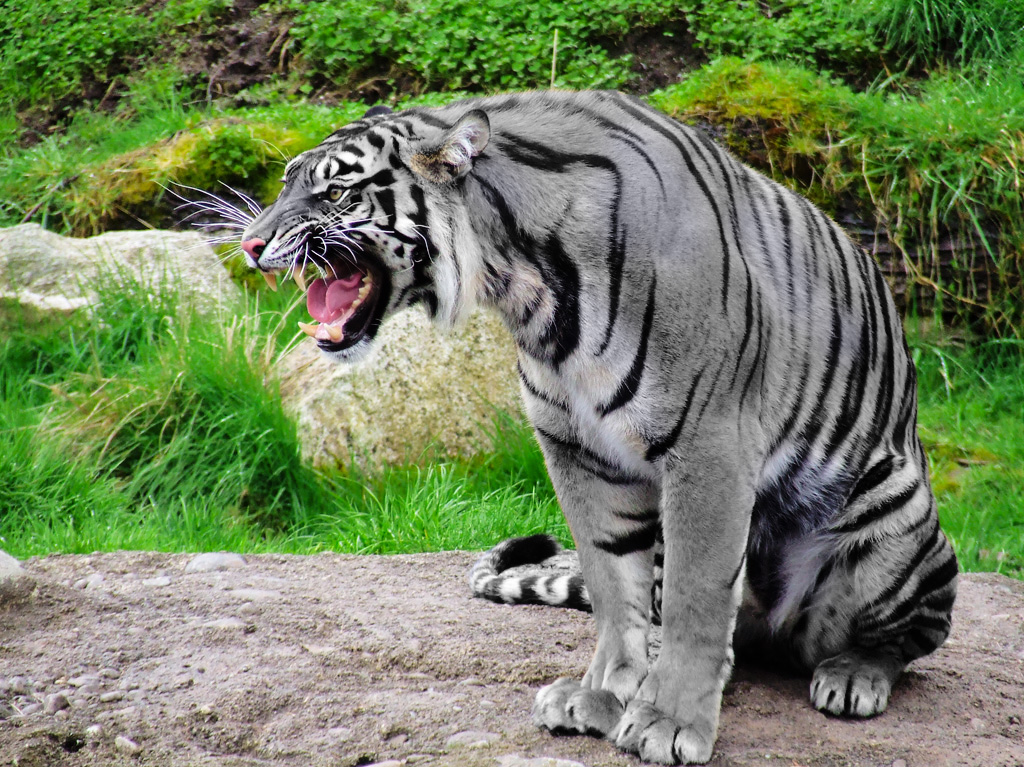
Even rarer, some say, is the "Maltese Tiger." This is an unusual sort of cryptid -- not a new species, but a variant of an existing one. Maltese Tigers, supposedly, are discolored by a rare mutation. Their fur is blue instead of orange, and their normally-black stripes are grey. This explains the name "Maltese" -- many cats from Malta have blue-grey fur.
Before talking about the probability of this cryptid, we should discuss whether Maltese tigers are even possible. In normal cats, this coloration pattern is created by a specific set of genetic alleles. Were these alleles present in tigers, they would indeed produce a blue-colored animal. But such a tiger would not have stripes, unlike the Maltese Tigers of cryptozoology. A more complicated set of alleles could indeed produce a blue, striped animal -- but such an individual has never been observed.
A perhaps likelier theory is that "Maltese" tigers are not blue at all. White tigers do exist, and can be produced by a lack of pheomelanin. This mutation is not uncommon; several white individuals have been captured or bred over the years. Tigers are mostly nocturnal, and in the moonlight a white animal could easily appear bluish. The "Maltese" coloration may thus be a trick of the light.
Whether Maltese Tigers are blue or white, they cannot be common. Only a handful of sightings have ever been reported -- mostly from China, but also from neighboring countries. In this region, tigers are extremely rare, due to poaching and use in traditional medicine. Do unusually-coloerd morphs appear on occasion? Perhaps, but there certainly isn't a population -- and tigers are so infrequently seen that we may never know for sure.
Read more about the Maltese Tiger:
http://www.redorbit.com/education/reference_library/general-2/cryptozoology/1112993059/maltese-tiger/
http://io9.com/could-the-mythical-blue-tiger-actually-exist-1331164937
Image (public domain) from http://upload.wikimedia.org/wikipedia/commons/f/f7/Maltese_Tiger.jpg
Sunday, February 16, 2014
Post Revamp: Bergman's Bear
Most cryptids, no matter how many sightings they have, suffer a lack of physical evidence. Bergman's Bear has the opposite problem. It is mostly known from tangible remains -- a hide and skull examined in the 1920s. This bear has never been reliably reported, and only sketchy accoutns testify its existence. Supposedly, this creature lives in Russia's Kamchatka Peninsula, and resembles a grizzly in appearance. The main differences are its size and the quality of its hair.
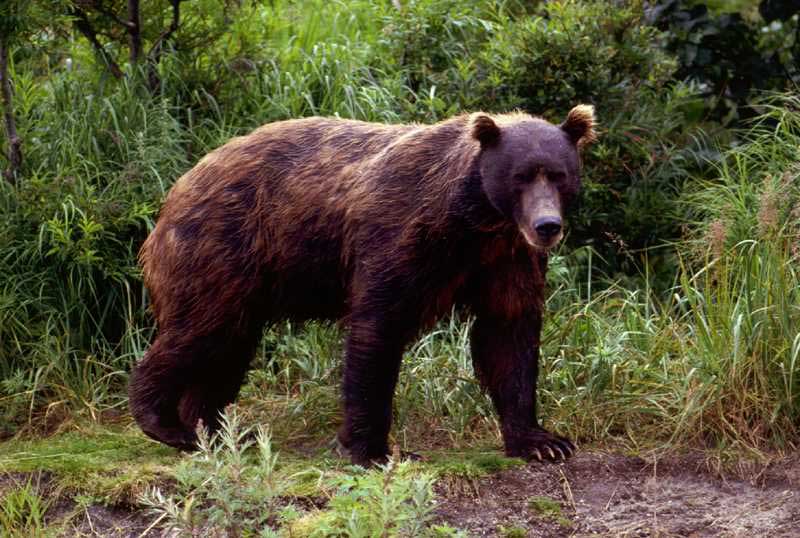
Bergman's Bear is named for Sten Bergman -- the Swedish zoologist who examined its remains decades ago. He was instantly struck by the hide's unusual character. First of all, its hair was black -- darker than that of a normal Russian brown bear. The hair was also unusually short, and the pelt itself was massive. Bergman was also shown the creature's outsized skull, and some of its footprints -- which were over fourteen inches long. The naturalist believed he was dealing with a new subspecies. Scientifically, it has been named "Ursus arctos piscator" -- but it has gone down in history as "Bergman's Bear."
What is this mysterious animal? One theory, raised during a rare spurt of sightings, is that Bergman's Bear is a prehistoric relic called Arctodus. But this ancient bear only lived in North America, and had long, thin legs. Bergman's Bear sounds nothing like this -- in fact, a native name for the animal means "trousers pulled down." Does that sound lanky to you? A better theory is that Bergman was right -- and that his bear is a new brown bear subspecies.
That is, if the animal still exists. Kamchatka is sparsely inhabited, and during the Cold War was inaccessible due to military testing. At a glance, it seems an ideal cryptid hiding spot -- but the peninsula has not remained empty. It is regularly patrolled by bear hunters, few of whom report giant short-haired animals. Some say Bergman's Bear is extinct; were it present, it would surely be encountered. Others argue the bear never existed. Brown bears are variable in color, and some can appear black. They can also grow to incredible sizes -- with Kamchatka bears (Ursus arctos beringianus) being some of the largest. Was Bergman's Bear a simple misidentification? Until more remains are found, we cannot be sure.
Read more about Bergman's Bear:
http://www.cryptozoology.com/cryptids/godbear.php
http://www.examiner.com/article/cryptozoology-bergman-s-bear-of-the-kamchatka-peninsula-russia
http://www.unknownexplorers.com/bergmansbear.php
http://www.strangeark.com/bfr/historical/bille-mystery-bears.html
http://thelordgeekington.wordpress.com/2014/01/16/bergmans-hypersplitting/
Image (public domain, of a Kamchatka brown bear) from http://upload.wikimedia.org/wikipedia/commons/3/3f/Brown-bear-in-spring.jpg
Saturday, February 15, 2014
Post Revamp: the Barmanou
The Barmanou is a mysterious hominin of northwestern Pakistan. Like many cryptids, it has been known to locals for centuries -- but has only recently been the subject of serious research. The creature came to European knowledge during the 1900s, after a series of Spanish explorations in Pakistan. These reports inspired, nearly a century later, a dedicated Barmanou-finding expedition. Led by zoologist Jordi Magraner, it collected years' worth of evidence -- most of which was lost after Magraner's tragic murder.
The Barmanou belongs to the "wildman" subtype of crypto-hominins. Unlike the Yeti and Sasquatch -- which resemble apes -- this creature is far more human-like. It is large and hairy, like all mystery primates, but also evidently intelligent. It is said to wear animal hides like clothes, and to kidnap human women with amorous intent. This means that, if the Barmanou is real, it may be something close to our own species. No ape recognizes humans as viable mates.
What could the Barmanou be? If anything, it's likely a relict hominin. We aren't the only species of human -- dozens evolved, then disappeared, during the past six million years. Only a few of these species made it into Eurasia -- most notably the Neanderthals and Homo erectus. It's been suggested that the Barmanou is one of these. The Neanderthals are better candidate, as they were more intelligent and more closely related to our species. Besides, they lived more recently, dying out only tens of thousands of years ago.
It's hard to believe that prehistoric hominins could be hiding in Pakistan. All human species were social creatures; they'd have to live in groups, making concealment difficult. But consider this -- the mountain ranges where the Barmanou live are among Earth's least explored peaks. And the Barmanou live close to other reported cryptids. This species' range is sandwiched between those of the more famous Yeti and Almas. The Yeti, if anything, is an ape -- but the Almas sounds quite Neanderthal-like.
Read more about the Barmanou:
http://www.bigfootencounters.com/biology/jordi.htm
http://www.americanmonsters.com/site/2010/08/barmanu-afghanistan-pakistan/
http://www.examiner.com/article/cryptozoology-the-man-of-the-forest-known-as-the-barmanou
http://www.unknownexplorers.com/barmanu.php
Image from http://whitengreen.com/imagenew/bigfootpakistan2.jpg
Friday, February 14, 2014
Post Revamp: the Arabhar
The Arabhar is a cryptid snake known for its ability to fly. It reportedly lives in the Arabian Sea region, and is capable of traveling great distances through the air. The mechanism for this creature's flight has not been reported -- I've seen it depicted with both wings and sails. The former would make it capable of true flight; the latter would make it better suited to gliding.
Surprising as this may seem, the Arabhar is a fairly believable cryptid. After all, there are already five species of "flying snake" known to science. Found in the genus Chrysopelea, they are capable of climbing trees and gliding hundreds of feet through the air. They do this by flattening their body to form a wing-like shape, then undulating back and forth for propulsion.
This gliding is not true flight. Flying snakes lack wings, leaving them unable to surmount the force of gravity. This means that they are incapable of increasing their altitude, and can only travel downwards. Furthermore, they have little control over their direction, and can vary it only slightly in midair. During "flight", these snakes are living javelins -- traveling only in the direction they were launched.
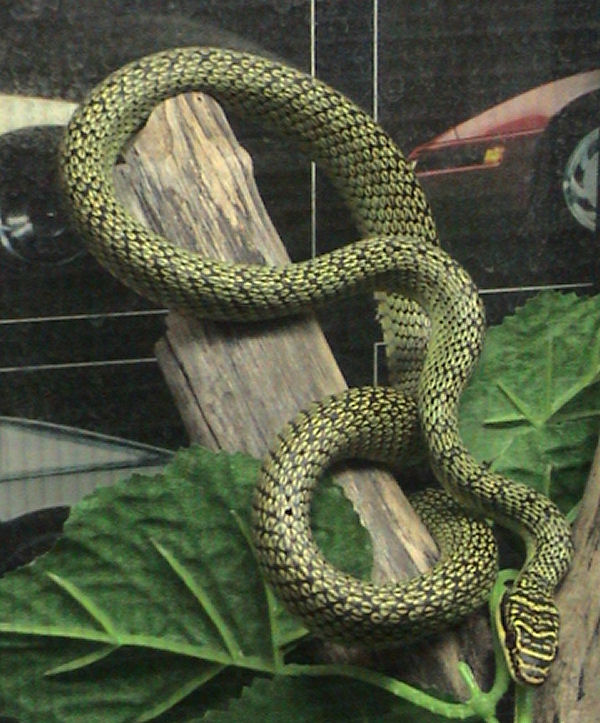
Could the Arabhar be a new "flying" snake? Easily. Multiple Chrysopelean species live in India and Sri Lanka -- exactly where the Arabhar is found. The snake pictured here is one of them, and may well belong to this cryptid's genus. This theory does an excellent job of explaining the Arabhar -- but it's not the only one out there. With great hesitation, I now present to you a second option. It's highly improbable, especially because the Chrysopelean theory is so strong. But nothing is impossible, especially in cryptozoology, and so I'm forced to ask... could the Arabhar actually have wings?
Flight has independently evolved several times. Birds, bats and insects all developed this feature quite separately -- so perhaps a snake could too. But how would such a flight mechanism work? Birds and bats use modified forelimbs as wings -- but snakes have no limbs at all. The most popular theory is inspired by the "flying dragon" -- lizard that "flies" using flaps of skin. These skin-flaps are attached to long, projecting ribs, which form a sort of sail. When the dragon leaps out of a tree, it extends its "wings" and glides -- sometimes up to 200 feet.
Again, though, this is not true flight. The flying dragon is a glider, just like the flying snakes -- which have a much more efficient and probable propulsion system. There's only one piece of evidence that the Arabhar has wings -- and it comes from ancient Egypt. There, legends told of flying snakes, capable of spitting deadly poison. These creatures were portrayed with massive wings, and their images served as tomb decorations. Were the Egyptians recording a real creature? Most likely not, but who knows... perhaps they were witnesses to the Arabhar.
Read more about the Arabhar:
http://www.lorencoleman.com/top_cryptids.html
http://theunexplainedworld.tumblr.com/post/62113897864/arabhar-these-unconfirmed-flying-snakes-are
http://animals.nationalgeographic.com/animals/reptiles/flying-snake/
http://animaldiversity.ummz.umich.edu/accounts/Draco_volans/
Image from http://upload.wikimedia.org/wikipedia/commons/b/b6/Chrysopelea_ornata.jpg (public domain)
Thursday, February 13, 2014
The Basan
Legends from every continent mention the "Will-o'-the-Wisp". This mysterious phenomenon is witnessed only at night, usually in forests and swamps. It manifests as a flickering ball of light, often seen at a distance through the trees. Travelers may mistake these lights for lanterns, following them off the past and getting lost in the woods. In fact, they are not human-made at all -- but what are they?
Nowadays, we know that the answer is swamp gas -- ignited by natural processes. Bioluminescent fungus may also produce the "Wisp" phenomenon. But these explanations weren't available until the advent of modern science. The world's mythologies, understandably, thus came up with other answers. Some legends claim these lights are demons, trying to lure wanderers to their doom. Other say they are ghosts -- or fairies, or monsters, or something else entirely. But my favorite theory comes from Japan. The "Will-o'-the-Wisp" is produced by a yokai, it's claimed. And this yokai is a fire-breathing chicken.
Yes, you read that right. I did mention that there were a lot of strange yokai out there -- this is one of them. It's called the Basan, and by day it sleeps in the canopy of the forest. At night, it emerges from its sleep, and lights the darkened sky with its glowing, fiery breath. The Basan is not dangerous -- thankfully, its fire produces no heat, and is incapable of burning. This chicken's serve only to illuminate -- as a weapon, they're absolutely useless.
The Basan's flames are often mistaken for those of other yokai. In fact, various creatures of Japanese legend can produce wisp-like fire. One is the kitsune -- a trickster fox, which can produce glowing lights called Kitsune-Bi. Other phantom lights come from Hitodama -- human souls, wandering the earth before entering the afterlife. These are interesting legends, and certainly worthy of attention, but not quite so interesting as a supernatural chicken.
http://yokai.com/basan/
http://matthewmeyer.net/blog/2009/10/25/a-yokai-a-day-basan/
Image from http://upload.wikimedia.org/wikipedia/commons/4/4f/ShunsenBasan.jpg (public domain)
Wednesday, February 12, 2014
The Nopperabo
The Nopperabo is a common type of yokai. These creatures are trickster spirits, seeking to scare but generally not to harm. They are capable of perfectly impersonating any human -- transforming their face and voice to match their target. Upon doing so, they will terrify their victim's loved ones, engaging them in conversation before revealing their true identities. Generally, to frighten a victim, the imposter will wipe off its face -- revealing a blank, featureless one underneath. This is the true appearance of a Nopperabo.
A typical Nopperabo story goes like this. A man is taking a nighttime walk, and sees a young woman crying by the side of the road. Her face is buried in her hands, and the man goes over to comfort her. When he asks if she is alright, she lifts her head to look at him --revealing the blank countenance of a Nopperabo. Terrified, the man flees down the road. As he continues along, he encounters a food vendor , with whom he shares his story. At first, the vendor seems sympathetic -- until he, too, reveals his blank face.
The man loses his wits entirely at this point, and flees all the way home. Shaking with fear, he arrives at his house, and nearly collapses from exhaustion. Concerned, his wife asks what had happened and frightened him so badly. The man relates his tale, explaining his encounters with the faceless girl and the Nopperabo at the food stand. His wife comforts him, telling him that yokai aren't real, and that he must have been hallucinating. The man, relieved, begins to convince himself that his wife is right. He looks up to thank her for her advice... and sees the smooth, white features of a Nopperabo.
Nopperabo are sometimes referred to as "Mujina" -- a word meaning "badger". In Japanese folklore, badgers are one of many animals to which supernatural powers are attributed. Badgers, it is said, are capable of changing their shapes -- and transforming into a faceless Nopperabo. This is a source of much confusion; Nopperabos are imposters who may be impersonated themselves.
Read more about the Nopperabo:
http://web.archive.org/web/20071231182409/http://www.geocities.com/area51/hollow/6166/faceless.html
http://matthewmeyer.net/blog/2009/10/23/a-yokai-a-day-noppera-bo/
http://www.japanpowered.com/japan-culture/noppera-bo-the-faceless-ghost
Image from http://upload.wikimedia.org/wikipedia/commons/thumb/8/87/Ryoi_Nopperabo.jpg/220px-Ryoi_Nopperabo.jpg (public domain)
Tuesday, February 11, 2014
The Namazu
As of today, BeastPedia is adding a new category. Meet the yokai, mysterious beasts of Japanese folklore! These creatures are an incredibly diverse bunch. Some yokai are ghosts, some are monsters, some are demons, and many are too strange to classify. In no other mythology will you see an ox-headed spider or an animated teacup. Believe me, I know. Excited to read about some yokai? You should be -- read on, and prepare to meet the Namazu. It's one heck of a fish story.
Mythology is rife with giant fish, and it's hard to say which is most impressive. The Greek Aspidochelone was the size of an island -- and was often mistaken for one. The Bible presents a fish who swallowed a prophet, and Arabian legend gives us Bahamut. This piscine Atlas was so large that the world rested on its back. Still, in my opinion, none of these can rival the Namazu. This catfish was so large, and so dangerous, that it had to be restrained by a god.
The Namazu spent most of its time buried underground. There a vigilant deity held it in place, preventing it from ever breaking loose. When the god's concentration slipped, the Namazu thrashed around -- causing the earthquakes that ravaged Japan. This beast was natural disaster personified.
In 1855, the Namazu went from yokai to national symbol. After a devastating earthquake leveled Edo, the catfish appeared in a number of woodblock prints. These prints utilized the Namazu as a symbol of the quake, for reasons ranging from religious to satirical. On one end of spectrum, people began to venerate the Namazu. They saw it as a force of cleansing destruction, wiping out the corrupt old order and replacing it with something new. Others used Namazu prints as a sort of "political cartoon." They mocked earthquake profiteers (such as carpenters, who built new buildings) by depicting them as catfish worshippers.
The image of the Namazu is still commonplace in Japan. This yokai lends its likeness to an earthquake-causing Pokemon, and is the logo of an earthquake warning system. The Namazu has transcended its mythological roots, and is now an icon of popular culture.
Read more about the Namazu:
http://blogs.scientificamerican.com/history-of-geology/2012/03/10/namazu-the-earthshaker/
http://pinktentacle.com/2011/04/namazu-e-earthquake-catfish-prints/
http://historyofgeology.fieldofscience.com/2011/01/namazu-earthshaker.html
Image (public domain) from https://blogger.googleusercontent.com/img/b/R29vZ2xl/AVvXsEi_LaqF-3zoRrjFBVCLW3qdCWSQHThYbfUIIdEY57VDh8I1jyel6tCuBgSS6gPjS2ae4u8lKzONMXvYzywM8P_SF27UQMLIJgQO8TRGTZWRu5yfHzbEt6bR_q-cENTuQSMP_8CcR9ssoa3a/s1600/Namazu_Kashima.jpg
Thursday, January 30, 2014
Post Revamp: Orang Pendek and Ebu Gogo
Writing a crypto-blog makes you feel like a party pooper. I'm an optimistic person, especially about the existence of cryptids-- but fact must dictate BeastPedia's content. I'm not going to post what I'd like to be true; I have to write what the evidence supports. Unfortunately, that means I do a lot of debunking. That's why I've been looking forward to this post-- instead of shutting down an unlikely creature, I get to trumpet its possibility.
The Orang Pendek is a mysterious Sumatran primate. It has been sighted dozens of times, and locals have known of it for centuries. The creature is small-- two to five feet tall, say most sources, with an average of about three. It lives in the forest like an ape, but walks upright on feet resembling a child's. The Orang Pendek has a human-like face, but with a larger brow ridge and prominent incisors. Its feet are bent slightly outwards, giving it a bow-legged appearance.
This cryptid is quite cunning, and locals attribute it an almost human intelligence level. Some say it can use tools, and that it hunts its prey with small axes. The Orang Pendek also obtains its food through thievery-- it's known to raid local farms, stealing crops from villagers. Nonetheless, the locals treat it with respect, and see it as an animal with which they can coexist.
The first westerners to see the Orang Pendek were Dutch colonists in the 1920s. Their reports launched a debate of identity that has continued to this day. There are three basic possibilities, one of which is misidentification. Many believe this primate simply doesn't exist-- and that most sightings can be attributed to the local siamangs. These siamangs are apes of Orang Pendek's size-- and they can walk bipedally, at least in short bursts. The cryptid's "humanoid" footprints, skeptics say, are actually those of a sun bear.
But the Orang Pendek can't be easily written off. The creature is well-documented in local reports, and the locals know a siamang when they see one. They insist that the Orang Pendek is a different animal; a much larger, stronger one that walks upright and has a humanlike face. This doesn't sound like a gibbon relative to me. As for the sun bears, it's true that their prints look like those of humans. However, sun bears also have claws-- which are noticeable in the prints when examined by an expert.
In my opinion, the evidence points to Orang Pendek as a new animal-- not a case of mistaken identity. So what is it? According to one theory, it's a new species of orangutan. Orangutans don't live in central Sumatra, but they do live in the north of the island. These large apes are big enough to pass for Orang Pendek, and do spend some time on the ground. There are some clear differences-- Orangutans are arboreal, and the Pendek lacks orange fur. But perhaps this beast is a ground-dwelling variant.
But the more compelling theory is this-- Orang Pendek might be a surviving hominin. In 2003, scientists on Flores-- a nearby island-- made an incredible discovery. They uncovered the bones of a new prehistoric human; a tiny species they dubbed Homo floresiensis. Commonly called "Hobbits," these diminutive creatures greatly resembled Orang Pendek. They were three-foot ground-dwelling bipeds, and would have been quite intelligent. They had human-like faces, and their footprints resembled a child's. Most strikingly of all, these hominins vanished just 12,000 years ago. Floresiensis certainly interacted with modern humans, and may continue to under the name Orang Pendek.
It's impossible to mention floresiensis without mentioning Ebu Gogo. This is another Indonesian island hominin-- this one from Flores. It's near-perfect match for the "Hobbits", and locals believe it died out a century ago. It was finally killed off by humans, they report, but only quite recently. Was Ebu Gogo the same creature as Orang Pendek? Do both represent surviving "Hobbits?" For now, it's hard to say-- but the evidence is striking. Have faith, crypto-fans! This is a beast in which it's easy to believe.
Read more about the Orang Pendek:
Image, of Homo floresiensis skull compared to a human, from https://blogger.googleusercontent.com/img/b/R29vZ2xl/AVvXsEjwvvJnzVKgBZODsnxgaefbKjvo_s96ivtgoEtqAEf6ampuL0yosczUoUvV0sfzVSanqngoxh-me3CdFnVx-nTUTRL0Njgzx9G7OgO7PDHkVjZAEiJH5xrBQ-pGmvgSoazKmhwty3eIheQ/s1600/craneo+++humano.jpg
Monday, January 27, 2014
The Veo
On the Indonesian island of Rinca lives a creature called the Veo. This cryptid is found in the island's mountainous center, where it emerges at night to feed on termites. The Veo is larger than a horse, and its hide is covered in armored plates. The creature looks rather formidable-- but thankfully, it eats only insects, and locals do not fear the beast.
If you've studied your obscure mammals, the Veo might seem familiar. Except for its size, it's a near-perfect match for a creature called the pangolin. These little beasties-- sometimes called "scaly anteaters" are found throughout Africa, Asia and Oceania. They have platelike armor, long tongues and insectivorous diets. There are plenty of pangolins in southeast Asia-- and the Veo sounds just like a large one.
If you've read my recent posts, you know how I feel about extinct creatures. They're cool, but I consider their survival unlikely-- moreso the longer they've been dead. The Veo, though, is one cryptid I actually believe to be prehistoric. Very close to Rinca is an island called Borneo-- where fossils have been found of gigantic fossil pangolins. The largest living species are about four feet long, but these ancient varieties could be twice that size. What's more, they died out only thousands of years ago. It's not a far stretch to imagine their continued existence.
Now, I've heard other ideas about the identity of the Veo-- that it's an ankylosaur, for example, or another armored dinosaur. To me, these theories sound silly. Which seems more likely to you: the survival of a giant pangolin for ten thousand years, or the survival of a dinosaur for sixty-five million? Besides, anklyosaurs didn't eat insects-- while all pangolins do. If the Veo is real, there's no doubt in my mind about its identity.
Read more about the Veo:
http://asiaparanormal.blogspot.com/2010/01/10-mysterious-cryptids-of-asia-part-2.html
http://www.newanimal.org/giant-animals.htm
Image from http://static3.wikia.nocookie.net/__cb20090608231239/secretsaturdays/images/5/5f/Manis_paleojavanicus.jpg
Wednesday, January 22, 2014
The Camel Spider
The order Solifugae contains some 1,000 species-- collectively known as camel spiders. They are found on five continents, and the biggest can be five inches long. In the 1990s, these real-life arachnids gave birth to a cryptozoological legend, when soldiers brought back exaggerated stories from the Gulf War. They described the spiders they had seen in Iraq, greatly inflating their size and threat level.
During the Iraq War, the Camel Spider legend returned in full force. This time, it was spread by hoax emails, accompanied by the misleading image above. The essential Spider story goes like this. A soldier in Iraq was bitten at night by a huge spider. It injected him with anasthetizing venom, so he felt nothing while the spider gnawed a huge hole in his leg. These spiders are said to be highly dangerous to American soldiers-- capable of running thirty miles per hour, and jumping three feet high. Their name, it is claimed, comes from their habit of eating camels' stomachs-- and their size is compared to a frisbee.
In truth, camel spiders are tiny and harmless. They contain no venom whatsoever, and catch prey (insects) with their claws. Their name simply comes from their desert-dwelling lifestyle-- these spiders have no connection to camels. They can run ten miles an hour, not thirty, and are completely incapable of jumping. Camel spiders are bizarre-looking to be sure, but they aren't true monsters at all.
Read more about the Camel Spider:
http://www.camel-spiders.net/
http://www.brownreclusespider.org/camel-spider/camel-spider-in-iraq.htm
http://eol.org/pages/8547/overview
http://www.snopes.com/photos/bugs/camelspider.asp
Image from http://skunksoup.com/wp-content/uploads/2011/09/camelspider02.jpg
Monday, August 24, 2009
Ahool

The Ahool is a large cryptid bat native to the Indonesian island of Java. It is greater in size than any known bat, with a wingspan of almost fifteen feet, and its body is the size of a human infant. The creature has a flat, squashed, human-like face and a loud wailing cry that can be heard for miles. The sound made by this cry (ahooOOOOool) gives this cryptid its name. The Ahool is assumed to be generally tree-dwelling as are most jungle bats, but it has also been seen squatting on the forest floor. The Ahool is grey in coloration and blends well into the night environment in which it lives-- this creature is nocturnal. This leaves some doubt as to its appearance, since sightings of it are often not clear. It has been suggested that the Ahool is a bird, a pterosaur, or even a winged monkey. However, the general consensus is that the Ahool is a giant bat, perhaps related to the flying fox.
Wednesday, August 19, 2009
Con Rit

The Con Rit, or Sea Centipede, is a very unusual Vietnamese cryptid sea serpent. It does not resemble a snake of any sort as do most sea serpents, but instead it appears to be an arthropod. The Con Rit is usually described as aa 60-150 foot long centipede-like creature with many paddle-like fins instead of legs. Its body is covered in segmented armor plates like its land-dwelling relatives, and according to some reports it has several antennae. This particular feature of the Con Rit was first described by an ancient Greek general, who described the creature as having "hairy nostrils." This has later been taken to refer to antennae. At least one corpse of this cryptid has also been reported, though the body was found in 1883 and subsequently dumped out at sea. According to this accound the Con Rit was some 60 feet long and found headless on the beach. The carcass was disposed of after its stench became too much for those examining it. If indeed the Con Rit exists, it would be the largest arthropod known to man by far. Just this fact alone makes its existence very unlikely, especially as it lives in the sea.
Tuesday, April 14, 2009
Fenghuang

The Fenghuang of Chinese mythology reigned over all other birds. The males of this immortal, magical species were called Feng and the females Huang. It lived atop the Kunlun mountains in China, and was a powerful bringer of good luck. It represented fire, the sun, and justice. The Fenghuang was notable for its long neck, which it shared with the Phoenix-like Bennu bird of Egypt. It may have been based on a crane or pheasant, or possibly an extinct species of ostrich. Chinese Dragons were partially described from the fossils of dinosaurs, and bones of the extinct Asian ostrich may have inspired stories of the Fenghuang in a similar manner.
Yamata no Orochi

Yamata no Orochi, or Orochi for short, was an eight-headed dragon in Japanese mythology. Every year one Japanese couple was forced to sacrifice one of their eight daughters to the creature, which consumed them. Their last daughter, however, was saved by the god Susanoo. He transformed the girl into a comb to hide her. He then set up a gated enclosure with eight windows and a vat of rice wine beneath each one. The dragon put one head through each window and began to drink the wine, soon falling into a drunken slumber. Susanoo then drew his sword and beheaded the creature. Within the creature's body he found a powerful magical sword, Kusanagi, which he used in later battles.
Tuesday, August 5, 2008
Xing-Xing

The Xing-Xing is a specific regional name for one or more species of small Chinese apes. These are fairly recent cryptids, and may be a type of short-tailed monkey, such as a new macaque species, or a new ape or hominid such as its neighbor the Yeren. Since mostly locals have seen them so far not much is yet to be known about this animal. Hopefully with more research new information will surface about this creature.
Yeren

The Yeren is a large Chinese hominid that is often identified with the supposedly-extinct Gigantopithecus. It is covered in reddish-brown or black fur. White specimens are not unheard of. It is usually 5 to 7 feet tall, although some specimens in excess of 10 feet have been seen. There may be two different species--A leftover gigantopicus population and the hominids that descended from it. This creature's range is close to the Yeti's, so one may be a subspecies of the other, or they both may be the same species entirely. The Yeren may also be a new species of Orangutan native to China rather than Sumatra and Borneo.
Yeti

The Yeti is a Himalayan mountain biped that has been known of by Sherpas for hundreds of years. Others in the area have seen it as well, and it is one of the most famous and commonly-seen cryptids. It is found in three different varieties: One at eight feet tall, one at six, and one at four. All three types are solitary creatures, and they are covered in white or brown fur. They have somewhat pointed scalps. Yeti are known to carry off and eat yaks and goats, and there are even some reports of them harming humans. However, these shy creatures are not known to be overly vicious. They, like other crypto-hominids, are known for their massive feet and the footprints they leave in the snows of Nepal and Tibet. Currently, alleged Yeti hairs are being DNA analyzed, which will hopefully shed some light on the Yeti mystery. Is it a descendant of gigantopithecus? A local legend? Since it is a cryptid, no one yet knows.
Subscribe to:
Posts (Atom)