Showing posts with label Africa. Show all posts
Sunday, February 9, 2014
Post Revamp: the Mngwa
Recently, I've been on a streak of African crypto-revamps. For now, this will be my last post in that series; you'll get something very different tomorrow! But today, I bring you the Mngwa -- a rare man-eating cryptid like the Nandi Bear. Like many African cryptids, this monster is an enormous cat. Its size is variable in description -- some say it's smaller than a donkey; others say it's larger than a lion. But all sources agree on this: the Mngwa has striped grey fur, and it's extremely deadly.
Sightings of the Mngwa date back 900 years -- it appears in African folklore, where it's described alongside the leopard and the lion. Clearly, the native tribes view it as a distinct species; something unlike any other cat. It certainly doesn't sound like any species we know of. Lions have manes, and are never grey in color. Cheetahs are tiny compared to the mngwa. Leopards are spotted, not striped -- and again, they're not grey. If the Mngwa exists, it may be a completely unique animal.
That is, if it exists at all. Many believe it doesn't, and that this cryptid is completely folkloric. One such skeptic was William Hichens, a British magistrate in colonial Tanzania. He first heard stories of the Mngwa in the 1920s -- and paid them no heed whatsoever. Until, that is, several citizens of his town were reportedly slaughtered by the beast. One of their corpses was clutching a grey tuft of hair -- confirmed by scientists to belong to a cat.
Do we have any good theories about the Mngwa's identity? Unfortunately, no. Among the big cats, our best suspect is the leopard -- which has pawprints of similar shape. Bernard Heuvelmans, the father of cryptozoology, proposed that the Mngwa was a giant relative of the African golden cat. This is an odd theory, as that species is very small -- but it would explain quite a lot. For one thing, the Mngwa is said to purr instead of roaring. For another, golden cats can actually be gray in color. Perhaps Heuvelmans was right -- the feared Mngwa's only relative may be tabby-sized.
Read more about the Mngwa:
http://cryptozoo-oscity.blogspot.com/2009/09/mngwalegendary-big-cat-of-tanzania.html
http://www.unknownexplorers.com/mngwa.php
http://webcache.googleusercontent.com/search?q=cache:http://thecryptozoologist.webs.com/apps/blog/show/14850761-the-mngwa-terror-of-the-coastlands
Image from http://criptozoologia.webmisterio.com/images/mngwa-leyenda-animal.jpg
Saturday, February 8, 2014
Post Revamp: the Nandi Bear
The Mokele-Mbembe is Africa's most famous cryptid. But surely the most infamous is the Nandi Bear. By definition, cryptids are mysterious creatures -- but for the most part, they're not particularly deadly. The Nandi Bear is an exception, known for its reported habit of eating human brains. This creature dwells in eastern Africa, and tends to hunt at night. It is large, slightly smaller than a bear or lion, and lacks a long tail. It has a bearlike snout, a shuffling gait, and longer front legs than hindlimbs. It is said to be a climber of trees, and is much feared by native Kenyans. Due to superstition, some will not speak of it; they view it as a sort of boogeyman.
The Nandi Bear's identity is the subject of fierce speculation. But contrary to what its name implies, the creature is probably not a bear. Only one modern bear species lived in Africa -- the Atlas Bear, now extinct for 120 years. The Nandi Bear could be a relic population, but this doesn't seem probable. The Atlas bear never lived in eastern Africa, and the migration of this species across the Sahara is unlikely. Besides, small bears like this one aren't known to attack humans.
Another popular candidate is the chalicothere -- a prehistoric mammal that shared the Nandi Bear's claws and sloped back. Chalicotheres did live in East Africa, but they went extinct 800,000 years ago. More importantly, all of them were herbivores, and used their claws to strip vegetation from trees. The idea of a brain-eating chalicothere is honestly preposterous.
Somewhat more likely is a giant baboon. Baboons have sloped backs, long fangs, and aggressive temperaments. They've been known to attack humans before, and on occassion they will eat meat. In prehistoric times, gigantic variants did exist, and these reached the size of the Nandi Bear. But all baboons live in packs, while the Nandi Bear is solitary -- and unlike the cryptid, baboons are diurnal.
And so we come to our final candidate, and by far the most likely -- a hyena. Hyenas are deadly predators, and an excellent phyiscal match for the Nandi Bear. They have powerful jaws, short snouts and a sloping back. Their gait resembles the cryptid's, and so do their habits -- hyenas often hunt at night, and occasionally attack humans. What's more, a prehistoric species called the short-faced hyena is about the Nandi Bear's size. It was a known predator of our ancestors -- in fact, one hominin fossil contains bitemarks that match its teeth. Where did the hyena bite its poor victim? Right on the skull, like a Nandi Bear.
Now, the hyena theory isn't perfect. Hyenas tend to go for the faces of human victims, not the braincases. What's more, the people of Kenya know a hyena when they see one -- and typically, they call the Nandi Bear a primate. But no other candidate is very likely, leaving the short-faced hyena as our best bet. Has this species been hiding in Africa for half a million years?
Read more about the Nandi Bear:
http://www.cryptozoology.com/cryptids/nandi_bear.php
http://www.unknownexplorers.com/nandibear.php
http://karlshuker.blogspot.com/2012/09/nandi-bears-and-death-birds-my-top-ten.html
http://www.karlshuker.blogspot.co.uk/2011/05/do-black-ratels-and-orange-hyaenas.html
Image (of short-faced hyena) from http://upload.wikimedia.org/wikipedia/commons/2/2e/Short-faced_hyena1.JPG
Friday, February 7, 2014
Post Revamp: the Marozi
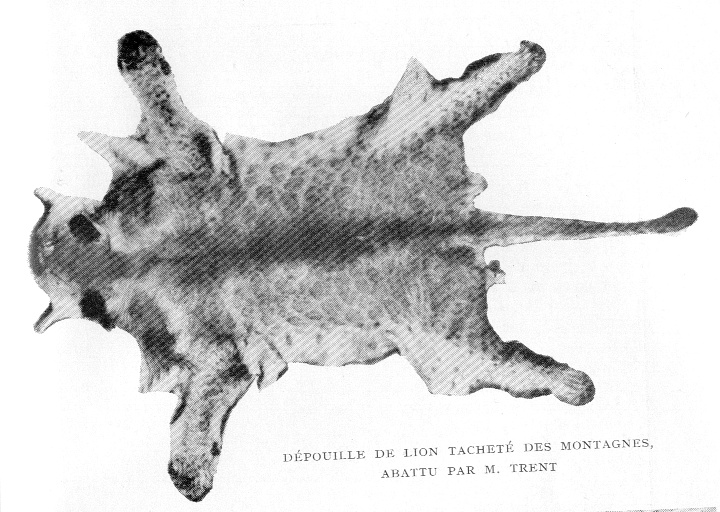
Whether the Marozi exists is hardly a question. This mysterious cat, also called a "spotted lion," has been sighted in Africa for more than a century. Scientists have obtained Marozi dung, Marozi footprints, Marozi bones and even a Marozi skin. The creature has been measured, studied, and even preserved in a museum. There's little doubt that this cryptid is out there -- the real question is what it is.
Physically, the Marozi resembles an adolescent lion. It's slightly smaller than an adult lion would be, and tends to lack a mane. Most notably, however, it is lightly spotted like a leopard. Spotting is often observed in young lions -- but this trait fades with age. Only cubs have spots as prominent as the Marozi's. There are various theories about the identity of these spotted cats. Some belive they are a new lion subspecies, adapted for life in the mountains. Others say they are lion/leopard hybrids, or simply a mutant population like the King Cheetahs.
The hybrid hypothesis is fairly unlikely. In the wild, lions and leopards are competitors -- they hunt the same prey, and generally consider each other to be enemies. In captivity, the two species have been bred, but this has never been known to occur in nature. Furthermore, lion/leopard hybrids don't look much like the Marozi. They still often have manes, and their spots are more visible than a Marozi's should be. Is it possible that an occasional lion and leopard could interbreed in the wild? Yes. But this would never happen often enough to establish a population.
The mutation and subspecies theories are more likely. There are at least five lion subspecies -- another one isn't hard to imagine. And since lions are not overly common, it's possible that genetic drift could produce a different-looking group. A mutation, allowing spots to persist into adulthood, could occur in a single individual. If that individual had many offspring, and was part of a small population, its mutant coloration could spread through the entire group. Sooner or later, this mystery will be solved -- there's already Marozi DNA in London's Natural History Museum. All we need now is a motivated scientist and a simple genetic test. Soon the Marozi will be cryptid no more.
Read more about the Marozi:
http://www.newanimal.org/marozi.htm
http://www.lairweb.org.nz/tiger/marozi.html
http://www.messybeast.com/genetics/lions-spotted.htm
Image (of Marozi skin) from http://i12.servimg.com/u/f12/09/04/81/20/marozi10.jpg
Thursday, February 6, 2014
Post Revamp: the Lau
High-profile cryptids get a lot of attention. There are dozens of Bigfoot books, and the internet is full of Nessie info. But there are other beasts -- more obscure ones -- about which virtually nothing has been written. Try looking up the Lau and you'll see what I mean. I spent half an hour reading about this cryptid -- or trying to. What I learned can be summed up in a sentence: it's a thirty-foot Ugandan catfish.
A lesser crypto-blogger might give up in exasperation. But
lack of information won't stop me! This post will be an exercise in creativity
-- let’s see how far we can get with the facts we have. Personally, my hopes are high. Location, size and possible identity can tell
us quite a lot – especially when it comes to cryptids.
Let’s start with some geography.
The Lau is said to live in Uganda – in particular, in its larger
lakes. This does, in fact, sound fairly
plausible. Catfish are found on every
continent except Australia, and they tend to live in fresh water. The largest species (including, one would
imagine, the Lau) favor deep lakes and slow-flowing rivers. Uganda has plenty of these, and furthermore,
its lakes would provide plenty of food for a monster fish. There are hundreds of catfish species, and
their diets are highly variable. Some
eat worms, some eat fish, some eat insects – and some even snatch
waterbirds. The diverse fauna of Uganda’s
lakes would be a catfish buffet.
A new catfish in Africa would not be very surprising. It’s the Lau’s size that makes it
unusual. How realistic is a 30-foot
fish? Not very, but not as unlikely as
you’d think. The world’s biggest fish is
the whale shark, which can grow to 42 feet at the largest. No catfish comes close to that size – but some
of them can get very large. The Mekong catfish
averages nine feet in length – and the Wels catfish can reach up to fourteen.
Africa’s longest catfish is not so large. It’s called the Vundu, and the biggest specimens are about five feet long. That’s
a far cry from thirty. Still, it's not too unreasonable to imagine a bigger species out there. Large catfish dwell in the deeper parts of lakes -- they might not be easily accessible to anglers. And the Lau's size may also be exaggerated. Catfish are very strong; some have been known to pull humans underwater. This often leads to an overestimation of their size. The thirty-foot estimate is hard to believe, but a giant Ugandan catfish is certainly posisble.
Read more about catfish (you're not gonna find much about the Lau):
Image (of Jeremy Wade from "River Monsters" with a Wels catfish) from http://img.poptower.com/pic-9106/jeremy-wade.jpg?d=600
Wednesday, February 5, 2014
Post Revamp: the Buffalo Lion
In 1898, Britain was the world's great superpower. India, Canada and much of Africa remained under its control -- and would not achieve independence for decades. It was thus an Englishman, John Patterson, who oversaw the bridging of the Tsavo. This Kenyan river was a major barrier to transportation -- in particular, to the construction of railroads. The Uganda Railway Committee thus commissioned Patterson to create a bridge, across which the tracks would run. He agreed, hiring a crew of Indian and African laborers. Nine months later, when they finished the project, thirty-five of them would be dead.
As soon as construction commenced, workers began to die. In the middle of the night, they would be slaughtered one by one -- by lions, which snuck into the camp and attacked them in their tents. Lions are dangerous predators, and are certainly known to attack humans. But for the most part, they aren't maneaters. The killers of Tsavo were an exception. Night after night they would return, eventually forcing construction to a halt. The workers were terrified, and threatened to abandon the project. Patterson was forced to take action, and set out to hunt the lions.
His attempts to trap the beasts failed, but Patterson (an experienced tiger-hunter) was not discouraged. Eventually, he managed to fatally shoot the first lion -- and took down the second three weeks later. Patterson later wrote a book about his adventures, claiming that the maneaters had killed 135 workers. Official records indicate a much smaller death toll (28) -- but records were not kept of native Africans. More recent estimates, based on studies of the lions' remains, indicate that they consumed thirty-five men. But this fails to count those who were killed and not eaten.
It's been over a century since the slaying of the Tsavo lions -- but their story remains of cryptozoological interest. Some have suggested that these attacks were not isolated. The lions of Tsavo, they say, were a new kind of feline -- one with a taste for human flesh. These "Buffalo Lions," it is said, have no manes and are unusually vicious. Supposedly, they are genetically distinct from other big cats, and may represent a new subspecies.
These claims are certainly plausible, and are based on two lines of evidence. First of all, East African lions do lack manes -- at least in many cases. Second of all, lions from this region do have a maneating reputation. Tsavo lions do appear to be distinct. But are these distinctions the result of genetic differences, or are they caused by environmental factors? Evidence seems to lean towards the latter argument. Studies have shown that lions grow longer manes in cooler climates. Large manes greatly increase heat retention -- which is helpful in cold places, but harmful in warm ones. Kenya is brutally hot -- we should expect its lions to be less hairy.
The man-eating behavior of Tsavo lions may also be environmental. In 1898, the year of the attacks, disease killed off massive numbers of African buffalo. These animals were normally the lions' main food source -- without them they likely turned to other prey. Furthermore, they may have been conditioned to eat human flesh. Smallpox-slain workers in Kenya were often left unburied -- so that people wouldn't have to handle their infectious corpses. The lions may have eaten these bodies, and come to think of humans as a food source.
A final piece of evidence is this -- we have reason to believe that man-eating is cultural. Man-eating lions have been observed passing down the behavior, just as humans would pass down a custom or tradition. They teach their offspring to act a certain way, and the offspring follow their parents' lead. When one lion learns to eat human meat, it teaches its young to do the same -- raising a new generation of killers. Man-eating lions are real, but they may not be a new species. They're more comparable to a cultural group, and a very dangerous one at that.
Read more about man-eating lions:
http://www.smithsonianmag.com/science-nature/the-most-ferocious-man-eating-lions-2577288/
http://news.nationalgeographic.com/news/2003/02/0211_030211_tsavolions.html
http://science.howstuffworks.com/zoology/mammals/man-eating-lion1.htm
Image (of the Tsavo lions, stuffed after their deaths) from http://upload.wikimedia.org/wikipedia/commons/6/6e/Lionsoftsavo2008.jpg
Tuesday, February 4, 2014
Post Revamp: the Bili Ape
Today I'm adding a new tag to BeastPedia -- "Confirmed." As you'd imagine, it refers to former cryptids whose existence has been definitively proven. The first such animal to feature on my blog is the Bili Ape -- discovered in 2003 after years of rumors. These rumors spoke of a new primate species, living alongside the chimpanzees of the Congo. They were said to resemble a cross between chimps and gorillas -- much larger than a chimp, with a gorilla-like sagittal keel and ground-dwelling habits. "Bili Apes," as they are called, were believed to be highly aggressive, and capable of walking upright.
In 1996, conserationist Karl Ammann documented the first physical evidence for this cryptid. While exploring the Congo, he found massive piles of dung -- three times the size of a chimpanzee's. He also found apelike footprints longer than those of a gorilla, and most significantly of all, an unusual skull. This skull was somewhat larger than a chimp's in size -- and it had the sagittal crest of a gorilla. More evidence soon followed, and by the early 2000s the Bili Ape had been confirmed. The beast had "graduated" from cryptid status -- something which happens all too infrequently.
So were the Bili Ape legends accurate? In most cases, yes. The Bili Ape is a chimpanzee, as scientific study has proven. But it's certainly a distinct population, and it may even be a new species. On average, it's much larger than a standard chimp -- and its feet are bigger than a gorilla's. Bili Apes do nest on the ground, and they can walk upright -- but no longer than your average chimp, which can do the same for short distances. It's not particularly aggressive, though like all chimps it is predatory. And some male specimens do have a sagittal keel.
There are many unanswered questions about the Bili Ape. Most notably, its taxonomic status is still unclear -- is it a population, species or subspecies? Another major question concerns its unusual behavior. What caused a group of chimpanzees to start acting like gorillas? The good news is this -- now that science has acknowledged the Bili Ape, new research is sure to follow. All it takes is a couple good pieces of evidence; once these are obtained, the floodgates of knowledge burst open. May all other cryptids share the Bili Ape's fortune!
Read more about the Bili Ape:
http://news.nationalgeographic.com/news/2003/04/0414_030314_strangeape.html
http://karlshuker.blogspot.com/2013/02/the-bili-bondo-apes-unmasking-congos.html
http://www.dailymail.co.uk/sciencetech/article-468644/From-myth-reality--meet-chimps-eat-lions.html
http://www.karlammann.com/bili.php#.UvEB6PldWSo
Friday, January 31, 2014
Post Revamp: the Agogwe
There are literally dozens of cryptid hominins. They hail from six of the seven continents-- only Antarctica lacks a rumored species. From Australia, we hear of the Yowie. Asia gives us the Xing-Xing, the Barmanou and the Yeren. In North America we have Bigfoot and the Skunk Ape; South America has the Mapinguari. Europe is represented by the Almas -- a Russian species that could be a Neanderthal. And in Africa, we find the Agogwe.
This cryptid is not commonly seen -- my sources describe only three sightings. All come from Europeans in the early 1900s, and all are fairly suspect. The three witnesses, however, gave fairly uniform descriptions. The Agogwe, they say, are about four feet tall. They are covered in reddish hair, and have human-like feet with splayed big toes. Their faces resemble chimps, but the Agogwe walk upright -- and move far more gracefully than an ape.
Bernard Heuvelmans, the father of cryptozoology, believed the Agogwe were relict Australopithecines. These hominins lived in Africa three million years ago, and eventually developed into modern humans. Their survival is unlikely, but the Agogwe well matches their description -- if Australopithecines did exist, this cryptid would look much like them. Another possibility is that the Agogwe are misidentified chimps. This is no more likely -- chimps can walk bipedally, but only for short distances, and they aren't red in color. Besides, they live only in the jungle, and are familiar to Africa's native peoples.
A final theory is that these cryptids are gibbons. In Africa, these lesser apes died out millions of years ago. They still exist, however, in southeast Asia. Gibbons do look like the Agogwe -- they're the same size, and share a high forehead. But gibbons are extremely awkward walkers, with gangly arms that make them well-suited for tree-swinging. They're also jungle-dwellers like the chimpanzee, and would never live on the savannah. None of our current theories seem particularly probable; honestly, neither does the Agogwe's existence. Could there be Australopiths surviving on the plains of Zimbabwe? I'd love to believe so, but the odds are stacked against it.
Read more about the Agogwe:
http://www.americanmonsters.com/site/2009/12/agogwe-east-africa/
http://www.strangeark.com/reprints/beasts.html
Image from http://www.cryptomundo.com/wp-content/Numriser0033.jpg
Wednesday, January 29, 2014
Post Revamp: Nguma-Monene
The Nguma-Monene is a reptilian cryptid of the Congo. Unlike the Mokele-Mbembe and other local beasts, it's generally not confused for a dinosaur. instead, this beast is said to be a gigantic snake or monitor lizard. The Nguma-Monene has been sighted several times since the 1960s-- sometimes by reliable eyewitnesses. The local tribes are also familiar with it, and seem somewhat afraid of the beast. According to some sources, discussions of the monster are taboo.
The Nguma-Monene shares much with other Congolese cryptids. It hates hippos, for one, and is said to kill them on sight. This same trait is ascribed to the Mokele-Mbembe, and sometimes to the Emela-Ntouka. Also notable is the Nguma-Monene's aquatic lifestyle. This cryptid has never been sighted out of the water, making it difficult to physically describe. At the very least, we can say this: it's big. A commonly-cited figure is thirty feet, but the animal may be even larger. This measurement comes from a witness who only saw the beast's tail.
The other distinguishing trait of the Nguma-Monene is the spiky ridge on its back. In this it resembles Mbielu-Mbielu-Mbielu-- through the two animals are clearly different. Nguma-Monene is long and thin; the other cryptid has a more standard quadrupedal body. For this reason, it is often argued that Mbielu-Mbielu-Mbielu is a crocodile, while Nguma-Monene is a snake.
This is a fairly solid theory-- many huge snakes are semi-aquatic. Take the anaconda for example. At thirty feet in length, it's the world's longest reptile-- and it spends much of its time in the water. Of course, anacondas only live in South America, but Africa has plenty of similar creatures. The twenty-foot African rock python is a great swimmer-- perhaps the Nguma-Monene is a similar species.
Another possibility is that this creature is a monitor lizard. These animals are also African natives-- and are also fond of the water. I've heard it said that Nguma-Monene must be a monitor-- because snakes don't have spiky ridges on their backs. Of course, neither do most monitor lizards, and for that reason I think snakes are a better candidate. Monitor lizards don't grow nearly large enough to pass for this cryptid.
Read more about the Nguma-Monene:
http://frontiersofzoology.blogspot.com/2012/11/reposting-congo-dragons-and-colossal.html
http://carnivoraforum.com/topic/9740968/1/
Image from https://blogger.googleusercontent.com/img/b/R29vZ2xl/AVvXsEg1nHdnZcjs9cwIbuRs3rWD-knPx75dhC2YX_QL5WVBQzKXvHrAXJVM5XKoBJQ4USRC_O9_Zv9klIyn8NUz1Vl1Twm_aBSOoVgEphMPJtoebeS5zgBmF6oi4KT4-n2LZQ23wDUvSrgS61W4/s400/Nguma-monene%252C+David-Miller-Roy+Mackal.jpg
Sunday, January 26, 2014
The Man-Eating Tree of Nubia
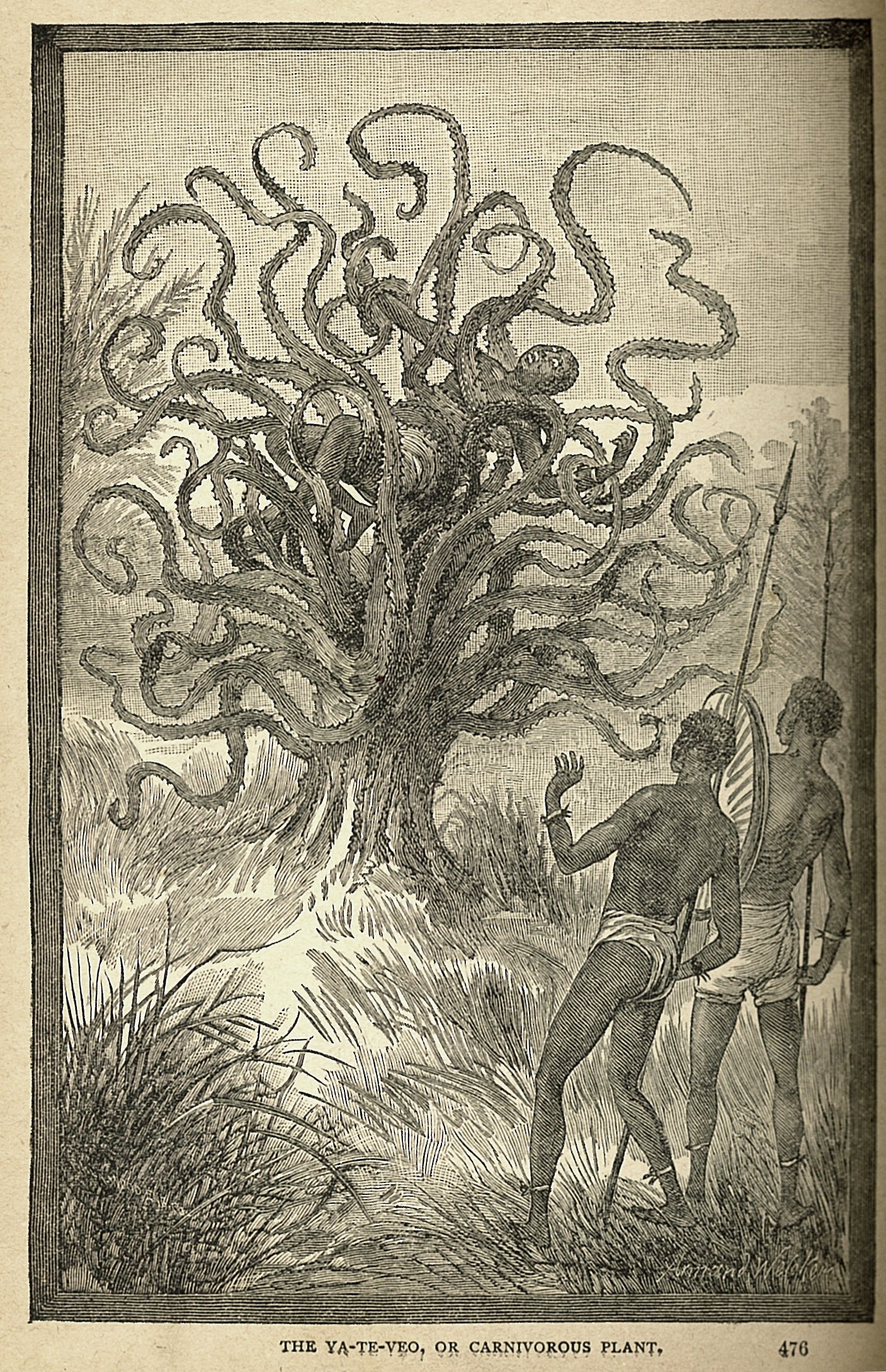
As readers of this blog, you're obviously all familiar with cryptozoology. But have you heard of cryptobotany? It's a real field, though a small one-- and its version of Bigfoot is the Nubian Tree. This plant is described in only one account-- which comes from Egypt in the late 1800s. The story sounds fantastical, and is probably a work of fiction. But nonetheless, it's a fascinating tale of cryptid foliage, and it deserves a place on BeastPedia.
The Man-Eating Tree is a deadly organism, but to the unwary it seems appealing. It is always found in shade-filled clearings, surrounded by lush grass. Golden fruit hangs from its branches, and dew glistens on its leaves. This harmless appearance is a carefully-constructed trap-- every facet of which is lethal. The plant grows alone because it poisons all nearby trees. Its fruit serves as a lure, drawing animals to their deaths. And its dew drips onto the grass below-- nourishing it, and causing it to grow tall. Why is this so dangerous? Because it conceals the skeletons of previous victims, lying beneath the tree.
When prey approaches, the tree's leaves begin to rustle-- with or without a breeze. These leaves are the plant's primary weapons, capable of latching onto victims and sucking their blood. Usually, the Man-Eating Tree feeds on wildlife-- but when they're available, it will take human victims. A man can be consumed in under a minute, wrapped up in long branches and drained of life.
Predatory trees abound in cryptobotany-- though few are as deadly as this one. Fortunately, none of them are backed by sgood evidence. Carnivorous plants do exist, but most of them feed solely on insects. The biggest may occasionally catch a shrew-- but there's a big difference between a two-inch rodent and a six-foot human. Never fear; you're safe from the world's foliage!
Read more about the Man-Eating Tree of Nubia:
http://vampiresrealm.files.wordpress.com/2011/11/the-man-eating-tree-phil-robinson.pdf
Image from http://upload.wikimedia.org/wikipedia/commons/6/60/The_ya-te-veo.jpg (depicting another man-eating tree, not the one described here)
Saturday, January 25, 2014
Post Revamp: the Ngoubou
Well, I've finished updating my first batch of old posts-- the ones covering Africa's "dinosaurian" cryptids. The last among them is the Ngoubou, a beast only recently described. In 2000, Bill Gibbons and John Kirk launched a cryptozoological expedition to Cameroon. Their goal was to search for Mokele-Mbembe-- but they found something else entirely. Members of the expedition interviewed many locals, seeking out information on unknown animals. As expected, some natives talked about Mokele-Mbembe, but others brought up a creature called the Ngoubou.
This animal, they said, was a savannah-dwelling beast-- about the size of an ox, and fiercely tempered. It had a beaklike face, a rhino-like snout, and a frill bearing six long horns. To Kirk and Gibbons, this animal sounded a lot like the dinosaur Styracosaurus. Physically, the two animals are almost identical-- and their habitats match perfectly. The similarity between this dinosaur and the Ngoubou is striking.
As I've mentioned in previous posts, there are no ceratopsian fossils in Afica. This makes one's existence there unlikely, and drives me to seek alternative explanations. It's been suggested that the Ngoubou is a misidentified rhino, and in fact, the two animals share the same local name. However, the natives of Cameroon insist that the beasts are different, and that the cryptid Ngoubou has many more horns. Another theory is that the Ngoubou is a surviving Uintathere. This prehistoric mammal is another good match for the creature-- or it would be, if it had ever lived in Africa.
One more theory, presented by Dale Drinnon at the blog "Frontiers of Zoology," deserves mention. Mr. Drinnon identifies the Ngoubou with Sivatherium-- a prehistoric giraffe that had multiple horns. This creature is a good physical match for Ngoubou, though giraffes aren't particularly aggressive. However, Sivatherium has two major points working in its favor: first of all, it lived in Africa, and second of all, cave paintings reveal that it may have lived even a few thousand years ago. Perhaps a small population survived, giving rise to the Ngoubou legend.
Read more about the Ngoubou:
http://www.cryptomundo.com/cryptotourism/ngoubou/
http://frontiersofzoology.blogspot.com/2011/04/surviving-sivatheres.html
Image from http://static1.wikia.nocookie.net/__cb20130501133457/cryptidz/images/0/08/Ngoubou.jpg
Thursday, January 23, 2014
Post Revamp: the Mbielu-Mbielu-Mbielu
Dr. Roy Mackal was one of the most famous cryptozoologists of the 20th century. A biologist at the Univeristy of Chicago, he was also vice-president of the International Society for Cryptozoology and a long-time researcher of the Loch Ness Monster. Later in his cryptozoological career, he developed a strong interest in the Mokele-Mbembe-- launching two African expeditions in order to find it. Dr. Mackal never located the creature, but he brought back tales of several other cryptids from the Congo. One of them was the Mbielu-Mbielu-Mbielu.
Like virtually every Congolese cryptid, this animal has long been associated with a dinosaur. In this case, it's often claimed as a relict stegosaur of some kind-- perhaps a Kentrosaurus. Why? Its name, rather aptly, means "the animal with planks growing out of its back." The Mbielu-Mbielu-Mbielu is semiaquatic, and its full body has never been seen-- locals have only caught glimpses of its back, which is covered in tall plates.
The case of Mbielu-Mbielu-Mbielu reminds me of the Emela-Ntouka. Both are claimed to be dinosaurs, although the dinosaurs in question could not live underwater. Furthermore, neither was found in Africa. How could a North American reptile end up in a Congolese swamp? If it exists, Mbielu-Mbielu-Mbielu is probably a reptile-- few other creatures have notable back-plates. But this animal is surely not prehistoric.
Mbielu-Mbielu-Mbielu is more likely an undiscovered crocodile. These reptiles have platelike scales on their backs-- though they're not as large as this purported cryptid's. Crocodiles are also native to the Congo, and spend much of their time underwater. We don't have much information on Mbielu-Mbielu-Mbielu, but what we do know sounds crocodilian to me.
Read more about the Mbielu-Mbielu-Mbielu:
http://frontiersofzoology.blogspot.com/2011/04/muhuru-mbielu-mbielu-mbielu-and.html
Image from http://2.bp.blogspot.com/-xjrYJb-V758/TbM7asBGBZI/AAAAAAAAB_w/CModePXdDNU/s1600/mbielu_mackal.jpg
Wednesday, January 22, 2014
Post Revamp: the Emela-Ntouka
The Emela-Ntouka and Mokele-Mbembe have a lot in common. Both are large, four-legged, semi-aquatic herbivores. Both are reputedly aggressive towards other large animals-- Mokele-Mbembe is said to slaughter hippos, and the name "Emela-Ntouka" means "killer of elephants." Both are sometimes depicted with a horn, though this is more common in the case of Emela-Ntouka. And both are considered highly dangerous by locals.
The first reports of Emela-Ntouka came during the "Lost World" craze. During the early 1900s, many cryptids (including this one) were hastily identified with dinosaurs. In some cases, the connection is valid-- Mokele-Mbembe comes to mind. But in most, such theories are far from probable. Take Emela-Ntouka for example. It's generally depicted as a one-horned Triceratops relative, despite much evidence to the contrary. All ceratopsians have frills-- Emela-Ntouka does not. No ceratopsians lived in Africa, where Emela-Ntouka is found. Perhaps most significantly, ceratopsians were too heavy to survive in water-- making one a poor match for this amphibious cryptid.
If not a dinosaur, what is the Emela-Ntouka? Noted cryptozoologist Loren Coleman believes it may be a new species of semiaquatic rhino. This is a much more plausible theory-- rhinos are a better geographic fit for the cryptid, and are certainly capable of swimming. Of course, the Emela-Ntouka does have non-rhino-like features-- the photo above (of a Cameroon sculpture) shows large ears and a lizard-like tail. Whether these differences are fact or artistic license remains to be seen.
Read more about the Emela-Ntouka:
Tuesday, January 21, 2014
Post Revamp: the Mokele-Mbembe
This dinosaur infatuation boded poorly for cryptozoology. Many an African explorer, when hearing of a local cryptid, jumped to the conclusion that it was prehistoric. Such a fate befell the Kongamato (more likely a large bat) and the Emela-Ntouka (more likely a rhino). But the most famous "dinosaur" cryptid of all is the Mokele-Mbembe-- and its case is not so easy to dismiss.
Mokele-Mbembe means "one who stops the flow of rivers"-- and as that name implies, this creature is reportedly massive. Some accounts say it is the size of a hippo; others say it dwarfs an elephant. This monster is semi-aquatic; it spends much of its time underwater, but also leaves huge footprints on the shore. Highly dangerous, it is much feared by local villagers, who view it with great superstition. According to their stories, it has a long neck and a single enormous tooth or horn. Some say it has a frill on its head, and a thick, lizardlike tail.
This description is certainly reminiscent of a dinosaur-- in particular, a large sauropod. Are alternative explanations possible? Yes, but not strong ones. A hippo might be mistaken for Mokele-Mbembe, as might a submerged elephant. Indeed, swimming elephants often hold their trunks aloft-- making them look much like a sauropod's neck. But elephants and hippos are well-known to Congolese locals, who insist that Mokele-Mbembe is a different creature.
Another theory is that Mokele-Mbembe is based on the rhinoceros. No species of rhino lives in this cryptid's region of the Congo-- and the locals are not familiar with these animals. Indeed, when showed a picture of a rhinoceros, one Congolese native described it as Mokele-Mbembe. Of course, other locals have identified the creature with pictures of Apatosaurus-- but this is not surprising, as descriptions of Mokele-Mbembe are variable. According to some, the animal has a sauropod-like neck and tail. According to others, it has a short neck and a large horn like a rhino.
None of these explanations is especially satisfying. Sauropods are long extinct, and could not support their own weight underwater. Rhinos have short necks, and would be hard to mistake for a dinosaur. The swamps of the Congo could certainly hide a monster-- eighty percent of them (a region larger than Florida) are unexplored. But we have no solid theory for what that monster might be. For the time, Mokele-Mbembe must remain a frustrating enigma. Hopefully new evidence will shed some light on this creature.
Read more about the Mokele-Mbembe:
http://www.trueauthority.com/cryptozoology/mokele.htm
http://www.livescience.com/38871-mokele-mbembe.html
Image from http://static2.wikia.nocookie.net/__cb20130930015048/cryptidz/images/a/a8/Mokele.jpg
Monday, January 20, 2014
Post Revamp: the Kongamato
I've written about the Kongamato before-- in fact, it's the first cryptid I profiled on this blog. Fitting, then, that it features in my first-ever post revamp. Eventually, I hope to improve and recreate all of my old blog entries. I wrote them in ninth grade, and as you might expect, they're not high-quality stuff. The Kongamato deserves better treatment, and now I have a chance to provide it.
So what is the Kongamato? Last time I wrote about the creature, I had a very clear idea. I was convinced that the animal was a relict pterosaur-- a survivor of the Mesozoic era. This isn't an unusual theory, and it's been passed around since the 1920s. Congolese natives describe the Kongamato as a leathery-winged flying beast, with sharp teeth and a very long tail. There are plenty of pterosaurs with those traits-- perhaps the closest match is Rhamphorhynchus (pictured above). This pterosaur was small, with a six-foot wingspan that matches the Kongamato's. It also lived by rivers and ate fish, just like the cryptid here described.
But some things about the pterosaur explanation don't add up. Especially suspicious are the origins of the theory. In the early 20th century, Congolese tribesmen told European explorers of the Kongamato. Without ever seeing the creature, the explorers then identified the beast as a pterosaur. They showed pictures of Rhamphorhynchus to the natives, who agreed that it resembled the cryptid. But they failed to compare the Kongamato to less sensational animals-- like large birds or bats.
This "leading of the witness" is not uncommon in cryptozoology. In the early 1900s especially, dinosaurs held a huge grip on the imagination of European scientists. They desperately wished to find living specimens-- perhaps hiding in some unexplored corner of Africa. Explorers were thus extremely willing to identify cryptids as dinosaurs. Almost every African beast has been compared to a prehistoric one: Mokele-Mbembe might be a sauropod, Emela-Ntouka might be a ceratopsian, and Kongamato might be a pterosaur. Could there really be a "lost world" of Congolese dinosaurs? Perhaps. Is it particularly likely? No.
This doesn't mean that the Kongamato isn't real. In fact, there's a fair body of evidence for it-- multiple claimed attacks, drawings by locals, and plenty of Congolese folklore. If the Kongamato exists, though, it's most likely a large bird or bat. It could be a misidentified stork-- there are plenty of these in Africa, and they're large enough to be mistaken for a pterosaur. But since the Kongamato is reportedly nocturnal, a bat is a more likely culprit. There are plenty of enormous chiropterans in the old world-- and this cryptid may be an unidentified Congolese species.
Another theory relates to the Kongamato's name-- which means "overturner of boats." It has been suggested that the Kongamato is not a flying creature at all-- but that it represents a freshwater stingray. Stingrays have leathery wings and whiplike tails like the Kongamato-- and a large one, rising from beneath, could certainly overturn a canoe. Was the flying element of the Kongamato a later addition to the story, or a European corruption? It's certainly possible that this "pterosaur" is in fact a fish.
Read more about the Kongamato:
http://www.trueauthority.com/cryptozoology/kongamato.htm
http://www.unknownexplorers.com/kongamato.php
http://frontiersofzoology.blogspot.com/2011/04/things-with-wings-in-africa-2-kongamato.html
Image from https://blogger.googleusercontent.com/img/b/R29vZ2xl/AVvXsEii1XFNN3PG63pNYa6XRxGhtAFXmLC7NvFHfUNbaBkosTtIB19_oK0XirqWhJRzPaCfSJZbWtBw53LgvmrpnykZAKem1m86sFvSgV33xtvJVPEqyboocyafKW3JmcOvRIwprqDK5_KH1XQ/s1600/11.Kongamato%20attack.jpg
Wednesday, August 26, 2009
Kasai Rex

The Kasai Rex is an African cryptid that resembles the dinosaur known as Tyrannosaurus. Sightings of the beast began in 1932, and originally described a red-and-black reptile with large fangs that had a long snout, thick legs and stripes. Multiple sightings have occured and a couple of photographs have also surfaced. However, the photos and the eyewitness accounts of this beast are suspect. At least one of the photographs is clearly a forgery made by cutting-and-pasting of pictures, and the accounts are full of improbable details. Also, this cryptid has no unique name in the native language, unlike most other mythical beasts. This indicates that it may be a recent invention and not a real beast at all.
Inkanyamba

Like the Grootslang, the Inkanyamba is a legendary snake cryptid from southern Africa. It lives by waterfalls, and is most commonly seen at Howick Falls in South Africa. This creature resembles a snake, except for the head, which looks like that of a horse. The Inkanyamba is aquatic and lives in lakes and waterfalls, so some suspect it to be a species of giant eel instead of a snake. This creature is said to be over twenty feet long, though its exact size is debated.
Grootslang
The Grootslang is a cryptid that supposedly dwells in a deep cave known as the "Wonder Hole" in Richtersveld, South Africa. Its name means "Great Snake" in Afrikaans, and it is described as either a forty-foot-long serpent or an elephant with a snake's tail. This cryptid is not the only unusual legend associated with the Wonder Hole cave. The caverns are also said to be filled with diamonds, to continue on for forty miles until they reach the ocean, and to stretch on forever.
Tuesday, August 25, 2009
Ennedi Tiger

The African cryptid known as the Ennedi Tiger is native to Chad, which lies below the Sahara desert. This cryptid is a cave-dwelling feline that lives in the mountains of Africa. It is much larger than a lion at up to twelve feet, and it is red or brown with white stripes. The Ennedi Tiger also lacks a tail. The one main feature of this cryptid, however, is its huge fangs. This obviously links the animal to the prehistoric Saber-Toothed Tiger, and indeed this supposedly-extinct beast is the main candidate for the true identity of this cryptid.
Interestingly, another species of Ennedi Tiger is also occasionally reported, though this one is very different. It dwells in water, and has a reddish coat with white stripes, much like the other species. It also posesses long fangs, but this variety has a long tail as opposed to its tailless mountain-dwelling brother. This species is also compared to the Saber-Toothed Tiger, but also to a walrus. Still, the tiger explanation is more likely, as no other walrus relative lives in Africa.
Deinotherium

Deinotherium was a prehistoric elephant also known as the "hoe-tusker." It resembled a modern elephant, but had a shorter, stumpier trunk, tusks that curved downwards from the lower jaw and a large range extending from Africa to eastern Europe. This elephant was suggested by Bernard Heuvelmans to be a still-living creature responsible for the killings of pachyderms that are frequently attributed to Mokele-Mbembe. However, as no sightings actually indicate that Deinotherium was the culprit, this is unlikely.
Tuesday, April 14, 2009
Roc

The Roc was a monstrous bird from Madagascar with feahters as large as palm frongs and a body huge enough to carry off a fully-grown elephant. It frequently raided mainland Africa and Arabia to hunt its favored prey. Marco Polo and Sinbad the Sailor are both said to have encountered one of these colossal birds. Sinbad and his crew broke one of the beast's colossal eggs, inadvertently discovering another trait of the Roc: its vengeful nature. The Roc attacked Sinbad's fleet to get back at them for destroying its unborn chick, both by throwing bounders and by physically attacking them. The Roc was a vicious and relentless predator. This creature was probably based off of the Arabian Sharokh, but myths of the Roc are strikingly similar to that of other mythical beasts like the Native American Thunderbird and the Brazilian Blue Crow. Perhaps all of these giant mythical birds are based on the same creature-- a real giant bird that is either now extinct or yet undiscovered.
Subscribe to:
Posts (Atom)